Sponsorship Examples
A sponsorship buys association, not attention by itself. Read worked examples, a worked review, and why reach is not the same as fit.
Sponsorship is often measured by the audience size of the thing being sponsored, which ignores whether that audience is relevant. The Wikipedia entry describes commercial sponsorship, and the marketing-communications entry covers how messages are received. The examples show where the value actually comes from.
Direct answer: Evaluate sponsorship by audience fit, the association it creates, and a measurable outcome — not by reach alone. The sources describe the channel; the evaluation rule is a synthesis.
Delta: This article adds a claim-status table and worked examples, separating documented channel facts from local choices about fit.
The mechanism
The first consideration is fit between the sponsored property and the brand. A large audience that has no reason to care about the product is less valuable than a small one that shares a clear interest. The sponsorship entry describes the commercial arrangement, not the relevance of the audience, which is a decision for the buyer.
The second consideration is what the association communicates. The marketing-communications entry treats a message as something received, which applies to a logo as much as to an advertisement. A sponsorship implies a relationship, and that implication is stronger when the sponsored property is credible with its audience. A poor fit can suggest that the brand paid for attention it did not earn.
The third consideration is measurement.
A more useful measure is whether the audience changed something — a branded search, a visit, or a mention — against a baseline. The causal-inference distinction applies: exposure followed by a result is not proof that the sponsorship caused it.
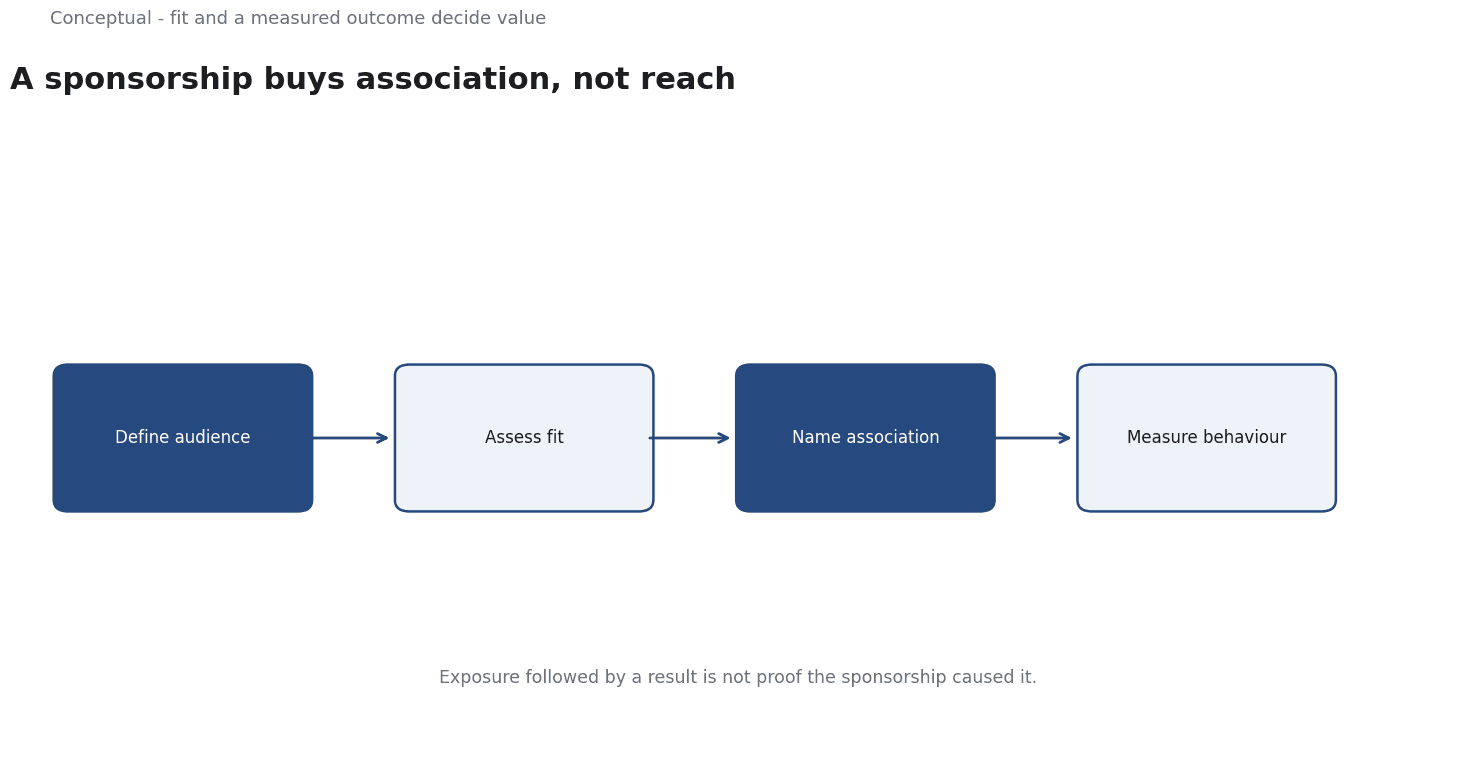
The sequence is: define the audience, assess fit, name the association, then measure a behaviour. Each step is a local decision, so the reasoning should be recorded with the result.
Worked examples
Illustrative. A developer-tools company sponsors a large general conference and reports thousands of impressions.
Three checks decide. First, are the attendees the people who could use the product? Second, does the conference's credibility transfer to the brand, or does the sponsorship feel out of place? Third, is there an observable behaviour against a baseline?
A second example: a smaller community event with a highly relevant audience produces fewer impressions but more qualified visits. The comparison shows why reach alone is a weak measure.
The outcome is a fit assessment, not a reach ranking. The scenarios are hypothetical; the method is the contribution.
Evidence status
| Claim | Status | Source | Verified | Recheck when |
|---|---|---|---|---|
| Sponsorship is a commercial association | source-reported | Wikipedia, Sponsor (commercial) | 2026-11-18 | Definition changes |
| Messages are received, not just sent | source-reported | Wikipedia, Marketing communications | 2026-11-18 | Practice changes |
| Judge fit and outcome, not reach | inferred | Derived from the channel | 2026-11-18 | Goal changes |
Why association is the product
A sponsorship does not deliver a message in the way an advertisement does. It places the brand next to something the audience values, and the audience draws its own conclusion.
That is why fit matters more than size, and why a property's credibility is part of what is being bought.
A sponsorship also has a renewal decision that is often treated as routine. Renewing because the previous arrangement existed is different from renewing because it produced a result, and the difference is visible only if the outcome was measured the first time.
The association can also change when the sponsored property changes its audience. A property that grows by attracting a different group may no longer fit the brand, and a renewal based on old fit will misjudge the new audience. Checking the audience at renewal is part of the evaluation.
The measure should be chosen before the arrangement begins, since selecting it afterwards invites a result that favours renewal.
The audience should be rechecked at renewal, since a growing property may no longer contain the people the brand wanted to reach.
An association only works when the audience perceives the fit, which is a reason to ask rather than assume.
What it cannot do
It cannot guarantee that the audience noticed the brand. It does not create a product worth trying. And it cannot prove causation from exposure.
The counterargument that maximum reach is the safest choice is fair for broad awareness and incomplete for a specific outcome.
A decision test
- Define the audience.
- Assess fit with the property.
- Name the association intended.
- Choose a behavioural measure.
- Use a baseline.
- Record the decision and recheck date.
For the broader channel, see Event Marketing.
References & Further Reading
- Wikipedia contributors, 2026. Sponsor (commercial) - Wikipedia — Commercial sponsorship and what it buys.
- Wikipedia contributors, 2026. Marketing communications - Wikipedia — The coordination of messages across channels and the distinction between consistent and identical communication.