How to Evaluate Event Marketing
An event produces attention, not automatically demand. Read how to evaluate it, a worked example, and why attendance is a weak outcome.
Event marketing is often measured by attendance and leads, which conflates activity with effect. The event-marketing entry describes the channel, as AAPOR's standards apply to any survey used after an event, as the funnel article treats stage measures, as the geo-experiment guidance offers a comparison design, as the attribution article warns about credit rules.
Direct answer:
Evaluate an event by defining the decision it should change, measuring the right audience before and after, and using a comparison where possible.
Wikipedia's event-marketing entry provides the channel context, and AAPOR covers survey wording. The boundary: a tracked badge scan is not proof of incrementality, which the attribution article warns, as the publication standard forbids guaranteed outcomes, as the risk article requires residual risk.
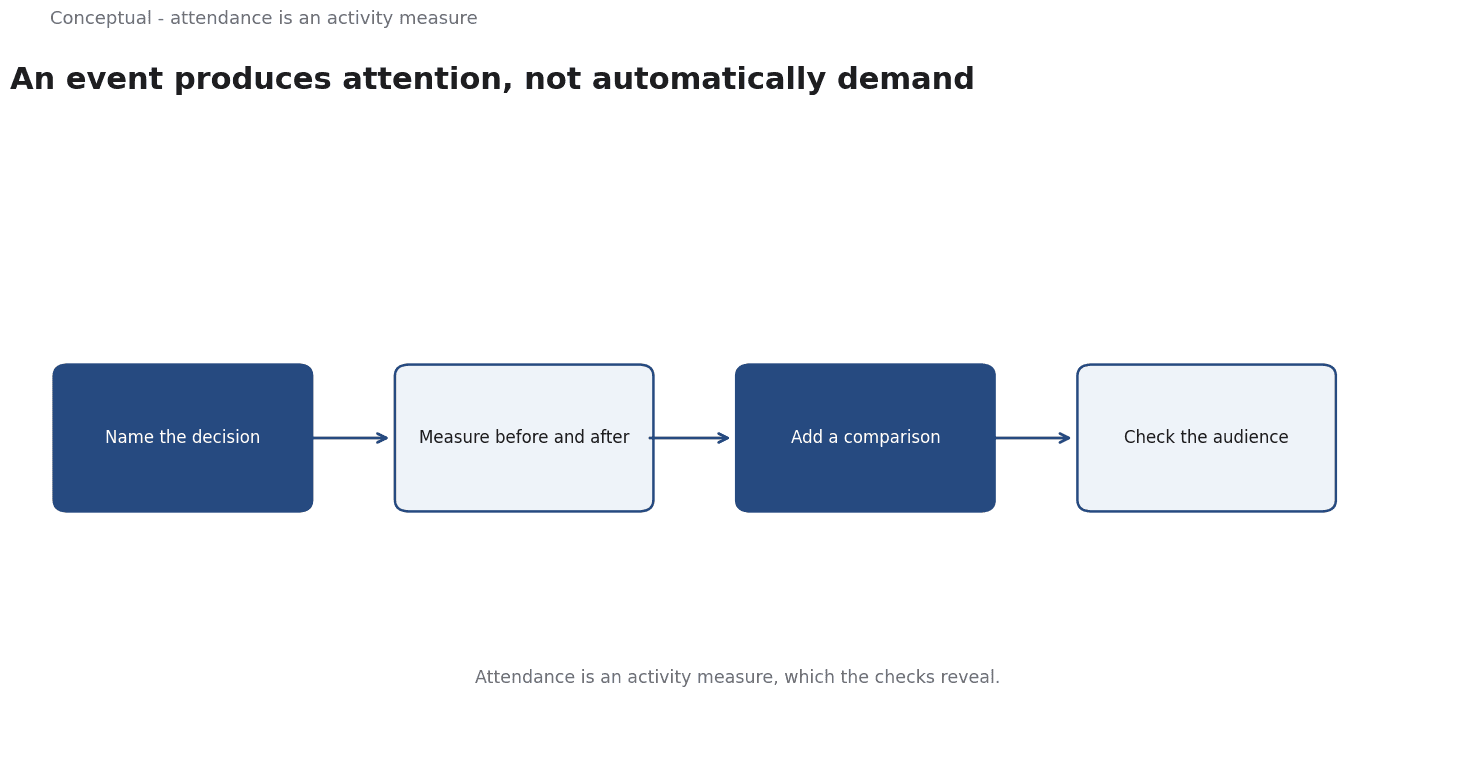
The checks
Define the outcome. What decision should the event change — pipeline, retention, or awareness, which the decision-memo article requires for a specific question, as the rubric article requires concrete criteria, as the dashboard article argues for metrics tied to decisions, as the funnel article advises for stage measures, as the value-proposition article treats the buyer's evaluation.
Measure the right audience. Attendance is not the target if the goal is qualified buyers, which the market-definition article advises, as the segmentation article treats groups, as the survey-design article advises for neutral wording, as AAPOR's standards require for transparent reporting, as the data-governance article requires provenance.
Use a comparison. A post-event lift may have happened anyway, which the geo-experiment guidance addresses, as the causal-inference article treats as a different question, as the correlation article warns about association, as the experiment guidance recommends for comparisons, as the risk article requires residual risk.
Track the follow-up. An event's value often comes after it, which the referral and retention articles treat, as the email-metrics article treats sequences, as the analytics article recommends for observed behaviour, as the attribution article warns about credit rules, as the decision-memo article requires for a record.
Three consequences follow. The outcome comes before the metric, as the decision-memo and dashboard articles advise, as the rubric article requires, as the data-governance article requires dated figures, as the monitoring article advises for review, as the attribution article warns, as the risk article requires residual risk to be stated, as the AAPOR standards require for transparent reporting, as the survey-design article advises.
A worked example
The following is hypothetical and illustrative. A company sponsors a conference and reports 500 attendees and 40 qualified leads.
Three checks decide. First, what decision should the leads change, as the decision-memo and dashboard articles require, with a criterion, as the rubric article requires? Second, were the leads incremental, as the geo-experiment guidance and causal-inference article recommend, with a comparison, as the attribution article warns about credit rules? Third, was any survey neutrally worded, as AAPOR's standards and survey-design article require, with provenance, as data governance requires, as the risk article requires residual risk?
Incrementality needs a comparison, as the experiment guidance advises. And the decision should be recorded, as the decision-memo article requires.
What event evaluation cannot do
It cannot prove causation from a lead form, which the attribution article treats as a credit rule, as the causal-inference article warns, as the experiment guidance recommends, as the publication standard forbids guaranteed outcomes. It does not guarantee a pipeline, which the value-proposition article treats as the buyer's evaluation, as the retention article treats behaviour, as the risk article requires residual risk. And it cannot fix an unclear offer, which the value-proposition and positioning articles treat as prior, as the decision-memo article requires for a question.
The counterargument that events are hard to measure is fair and incomplete, which the worked example shows, as the experiment guidance and decision-memo articles advise, as the AAPOR standards require transparency, as the risk article requires residual risk.
A decision test
- State the decision the event should change, as the decision-memo article requires.
- Define the qualified audience, as the market-definition article advises.
- Use a comparison for lift, as the experiment guidance recommends.
- Word any survey neutrally, as AAPOR's standards require.
- Track follow-up behaviour, as the analytics article advises.
- Treat tracked scans as credit rules, as the attribution article warns.
- Record the decision and residual risk, as the decision-memo and risk articles require.
For the channel, see Webinar and Event Marketing; for the design, see Geo Experiments.
References & Further Reading
- Wikipedia contributors, 2026. Event marketing - Wikipedia — The structure and measurement of event-based campaigns.
- American Association for Public Opinion Research, 2026. AAPOR — The professional association for public opinion and survey research; its standards and resources underpin the survey-design discussion.