Structured Output and Constrained Decoding for Production APIs
A JSON schema turns a model's output into data. Read how constrained decoding works, a worked example, and where validation still belongs.
Parsing free-form model output with regular expressions is a fragile way to build software. A stray sentence, a code fence, or a trailing comment breaks the parser. Structured output solves this by constraining generation to a schema, so the result is valid data by construction rather than by hope.
Direct answer: Structured output constrains a model's generation to a defined schema — typically JSON — using constrained decoding or schema-guided sampling. OpenAI's structured-outputs guide is the primary reference for the mechanism. The boundary: a valid shape does not mean a correct value — the model can fill a valid field with a wrong fact — so schema validation and semantic checks are different layers.
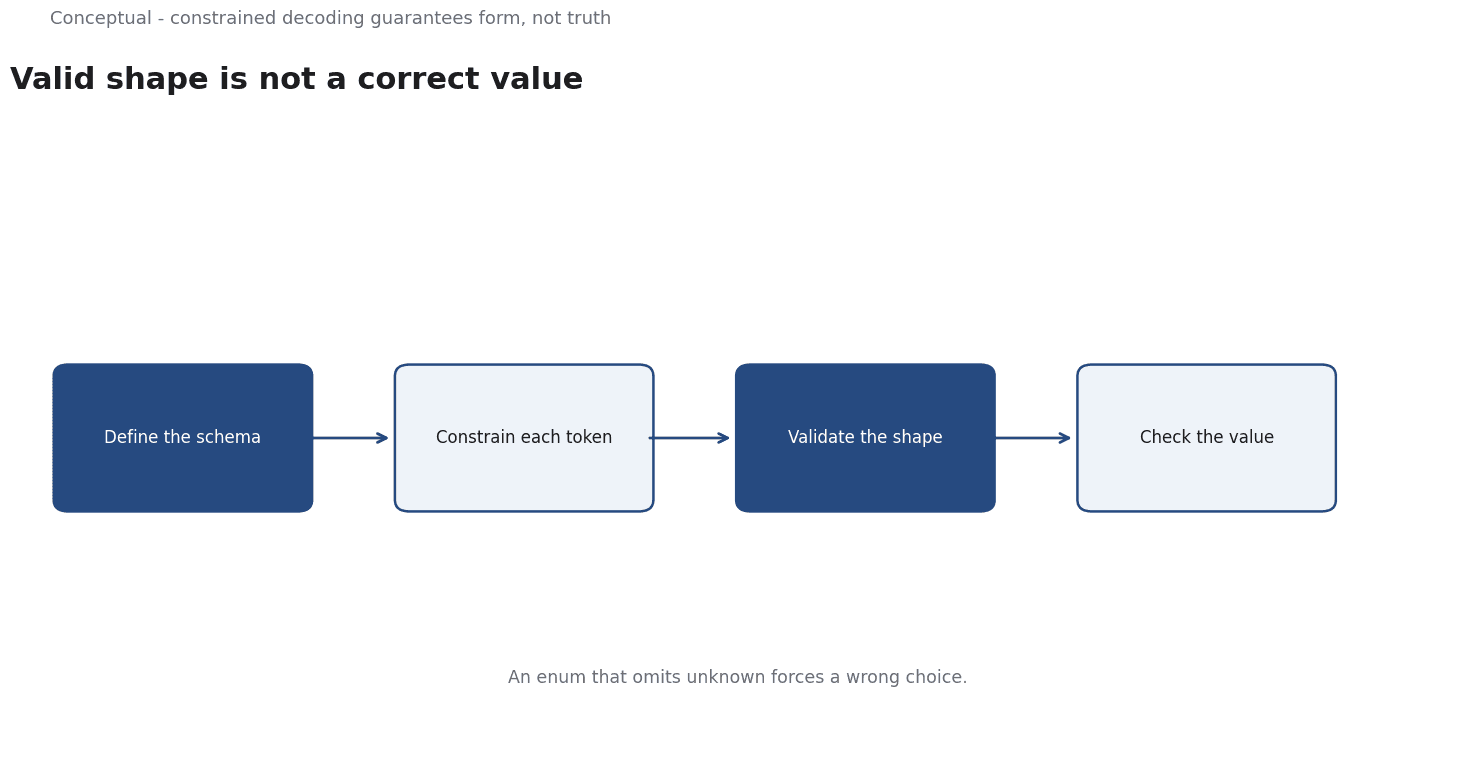
How constrained decoding works
A language model emits tokens one at a time, each chosen from a probability distribution over the vocabulary.
Constrained decoding restricts that distribution at every step to tokens that could still produce a valid instance of the schema.
If the schema says the next field is an integer, tokens that would start a string are excluded.
Three consequences follow:
Validity is mechanical. The output conforms to the schema, so parsing cannot fail for format reasons. That removes an entire class of error handling.
The schema is part of the interface. Field names, types, required properties, and enums become a contract between the model and your application. Changing them changes the system.
Constraints cost some freedom. A tight schema can prevent the model from expressing a legitimate edge case.
A worked example
The following is hypothetical and illustrative.
An invoice extractor returns a structured object:
{
  "vendor": "string",
  "invoice_date": "YYYY-MM-DD",
  "total": "number",
  "currency": ["USD","EUR","GBP"],
  "line_items": [
    { "description": "string", "amount": "number" }
  ]
}
Three checks make this production-safe:
- Schema validation is still run. Even when generation is constrained, validate on receipt. A provider update or a different model may behave differently, and a validation failure should be handled explicitly.
- Values need semantic checks. The
totalshould equal the sum ofline_items. A model can produce a perfectly valid object whose numbers do not reconcile. This is a business rule, not a format rule. - The enum has an escape. If a currency outside the three appears, the model must have an
otheroption or a clear failure path. Otherwise it will choose a wrong value to satisfy the schema.
Three decisions follow:
- Keep the schema minimal — every field is a decision the model must make.
- Validate twice — format on receipt, meaning against the source data.
- Define the failure path for values the schema cannot represent.
Where structured output fits
Extraction — turning text into records, as AI for Document Processing: Classification, Extraction, Redaction covers.
Classification — returning a label from a defined set, which makes the output directly usable.
Tool calls — most tool interfaces are structured output in disguise: the model produces arguments that must fit a schema.
Routing decisions — a structured decision with a reason field can be logged and audited.
In each case the gain is the same: the output becomes data that downstream code can handle without a parsing layer built on guesswork.
Versioning the contract
A schema is an interface, and interfaces change. Three practices keep changes from breaking consumers:
Treat fields as a contract. Adding an optional field is usually safe; removing or renaming one is a breaking change for anything that reads the output. Record which version of the schema produced a stored result.
Keep raw input with the result. When a value is disputed, the original text lets a reviewer decide whether the model extracted it correctly or the schema forced a wrong choice. Without the source, a structured record is unfalsifiable.
Test schema changes on past cases. Before changing a field, re-run a labelled set through the new schema and compare. A change that looks harmless in the abstract may reduce accuracy on a specific class of input.
These habits matter more when several services consume the output. A schema used by one function can be changed with a deploy; one used by a pipeline needs a migration plan.
What structured output cannot do
It cannot make the model right. A valid field can contain a wrong value, which is why semantic checks exist.
It cannot replace retrieval. The model still needs the information. Structured output only controls how it answers.
It cannot fix a badly designed schema. A schema with twenty loosely defined fields produces twenty plausible but untrustworthy values. Start with the decision the output supports and work backwards.
The counterargument — that free text is more expressive — is fair for exploratory tasks.
For a production API, expressiveness is less valuable than a contract your code can rely on.
A decision test
- Define the downstream decision the output must support.
- Design the smallest schema that serves it.
- Include an escape value for cases the schema cannot represent.
- Validate format on receipt, even when generation is constrained.
- Check semantic rules — totals, dates, cross-field consistency.
- Log the raw source beside the structured result for audit.
- Re-test after a model change, since behaviour can shift.
For the API context, see API Design: The Contract Between Systems; for extraction use cases, see AI for Document Processing.
References & Further Reading
- OpenAI, 2026. Structured model outputs | OpenAI API — The official guide to constrained decoding and schema-enforced model outputs.
- OpenAI, 2026. Models | OpenAI API — The GPT-6 lineup with published per-million-token input and output prices, context windows, reasoning levels and knowledge cutoffs.