Startup Valuation Methods Compared
Early-stage valuation is a negotiation framed by method. Read the approaches, a worked comparison, and why the number is not the value.
A startup valuation is often presented as a number produced by a method, which makes the process look more objective than it is. Early companies have little reliable financial history, so every approach rests on assumptions about the future. The methods still matter — not because they produce the right answer, but because they structure a negotiation and reveal what each side believes.
Direct answer: Common approaches include comparables from similar financings, discounted cash flow for companies with predictable cash, and scorecard or risk-factor methods for very early stages. The valuation overview distinguishes absolute and relative approaches, and Damodaran's work insists that assumptions be made explicit. The boundary: a valuation is a conditional estimate used to price a round, not a measurement of the company's worth, and the cap-table article explains how the number translates into dilution.
The approaches
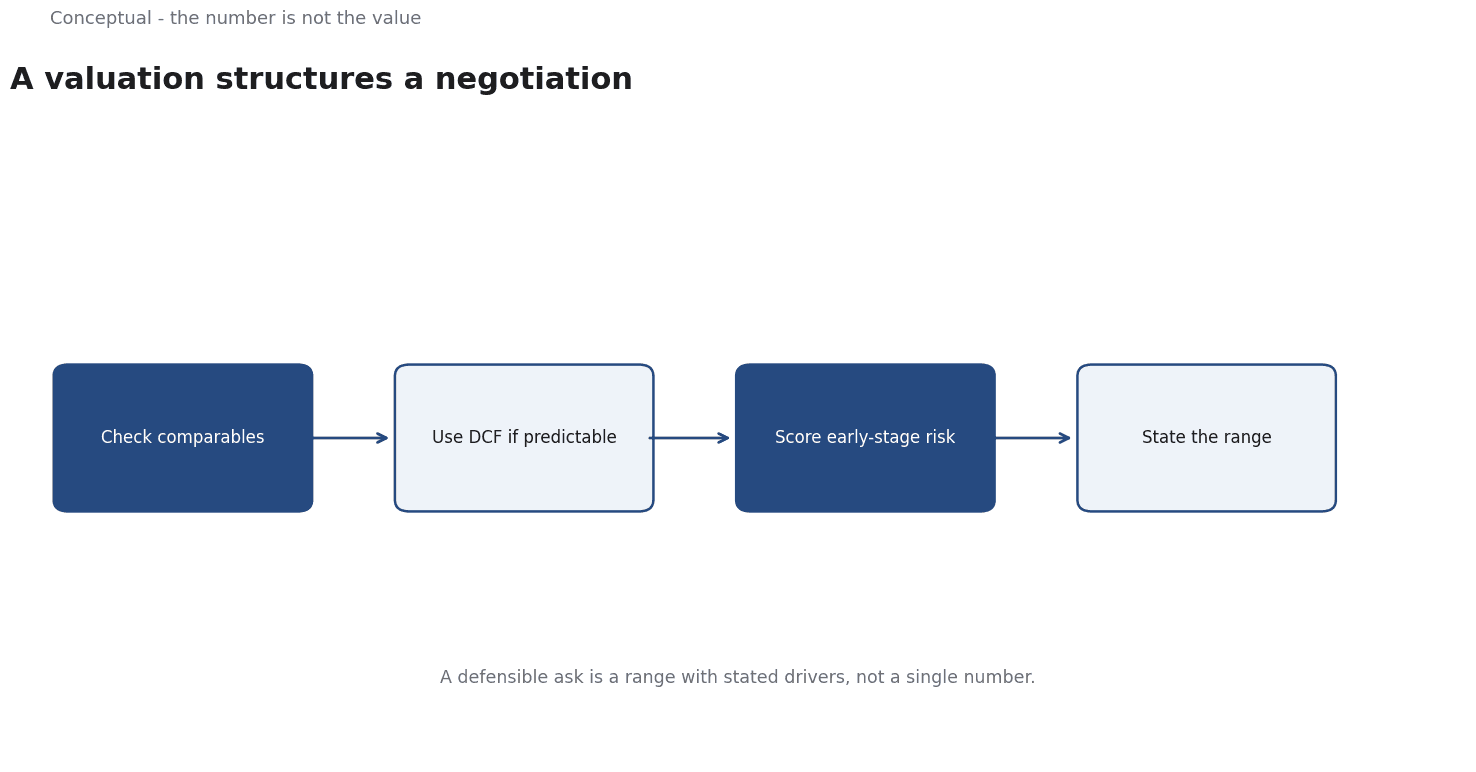
Comparable transactions. Look at financings for companies in a similar sector and stage, then adjust for differences. The method is relative and depends entirely on the comparison set, as the comparable-company-analysis article argues for stated selection criteria.
Discounted cash flow. Forecast future cash and discount it to the present. This is an absolute method and is useful when cash flows are reasonably predictable, which the DCF-pitfalls article treats as a condition, not a default.
Scorecard or risk-factor methods. Start from a baseline and adjust for team, market, product, and stage. These are transparent about being judgements, which is preferable to hiding them in a spreadsheet, as the financial-modeling article recommends for explicit assumptions.
Three consequences follow. The chosen method should fit the stage, because a pre-revenue company has no cash flows to discount. And the result should be a range with stated drivers, which the sensitivity-analysis article treats as more honest than a point estimate.
A worked comparison
The following is hypothetical and illustrative. A startup raising a seed round is valued three ways.
Comparable seed rounds in the sector suggest 8–12 million. A DCF using optimistic five-year cash flows gives 15 million, but the DCF-pitfalls article would flag the terminal assumption as dominant. A scorecard method gives 9 million. The founder anchors on 15 million; the investor anchors on 8 million.
Three checks decide how to negotiate. First, which method fits the evidence — with no revenue, comparables and scorecard are more defensible than DCF, as the stage discussion above implies. Second, which assumptions are material — growth, margin, and the discount rate drive the DCF, which the sensitivity-analysis article recommends ranking. Third, what is being exchanged besides price — board rights, liquidation preferences, and the option pool change the economics, which the term-sheet article treats as the real terms of the deal.
Three conclusions follow. The negotiation should include terms, not only price, which the cap-table article explains through dilution. And the result should be recorded as a decision with reasoning, as the decision-memo article requires.
A defensible ask is a range with stated drivers, not a single number, as the valuation article recommends.
What valuation cannot do
It cannot predict the outcome. A high valuation can create pressure and a larger dilution problem in the next round, which the cap-table article explains for cumulative ownership effects. It cannot create value: the business creates value through customers and margins, as the unit-economics article treats as the underlying reality. And it cannot remove the need for a good negotiation, which the negotiation article covers as a separate skill.
The counterargument that valuation is arbitrary is too strong.
It is assumption-dependent, which is different from arbitrary: explicit assumptions can be challenged, as the financial-modeling article argues for transparent models.
A decision test
- Choose a method that fits the company's stage and evidence.
- State the comparison set or the assumptions explicitly.
- Produce a range with the drivers named, as the sensitivity-analysis article recommends.
- Model the effect on ownership with the cap table.
- Negotiate terms as well as price, as the term-sheet article advises.
- Record the reasoning, as the decision-memo article requires.
- Revisit at the next round, as the monitoring article advises for changed circumstances.
For the financing instruments, see SAFE Notes; for the ownership effects, see Cap Table Mechanics.
References & Further Reading
- Wikipedia contributors, 2026. Valuation (finance) - Wikipedia — Overview of absolute and relative valuation approaches; secondary reference.
- Aswath Damodaran, 2026. Damodaran Online: Home Page for Aswath Damodaran — Publicly maintained datasets for industry averages, WACC, and valuation.