Subject Line Testing Costs Explained
A subject line test costs attention and inbox trust, not just sends. Read the real costs, a worked example, and why open rate is a weak goal.
Subject line testing is often treated as a cheap experiment, which hides its costs. The email-marketing entry describes campaign mechanics, and the A/B-testing entry covers controlled comparison. The question is what the test optimises, and what it spends to get there.
Direct answer: Test subject lines against a downstream outcome, not open rate alone, and count the cost of list fatigue and measurement error. The sources describe the channel and the method; the cost rule is a synthesis.
Delta: This article adds a claim-status table and a worked example, separating documented mechanics from the local choice of metric.
The mechanism
Three costs matter:
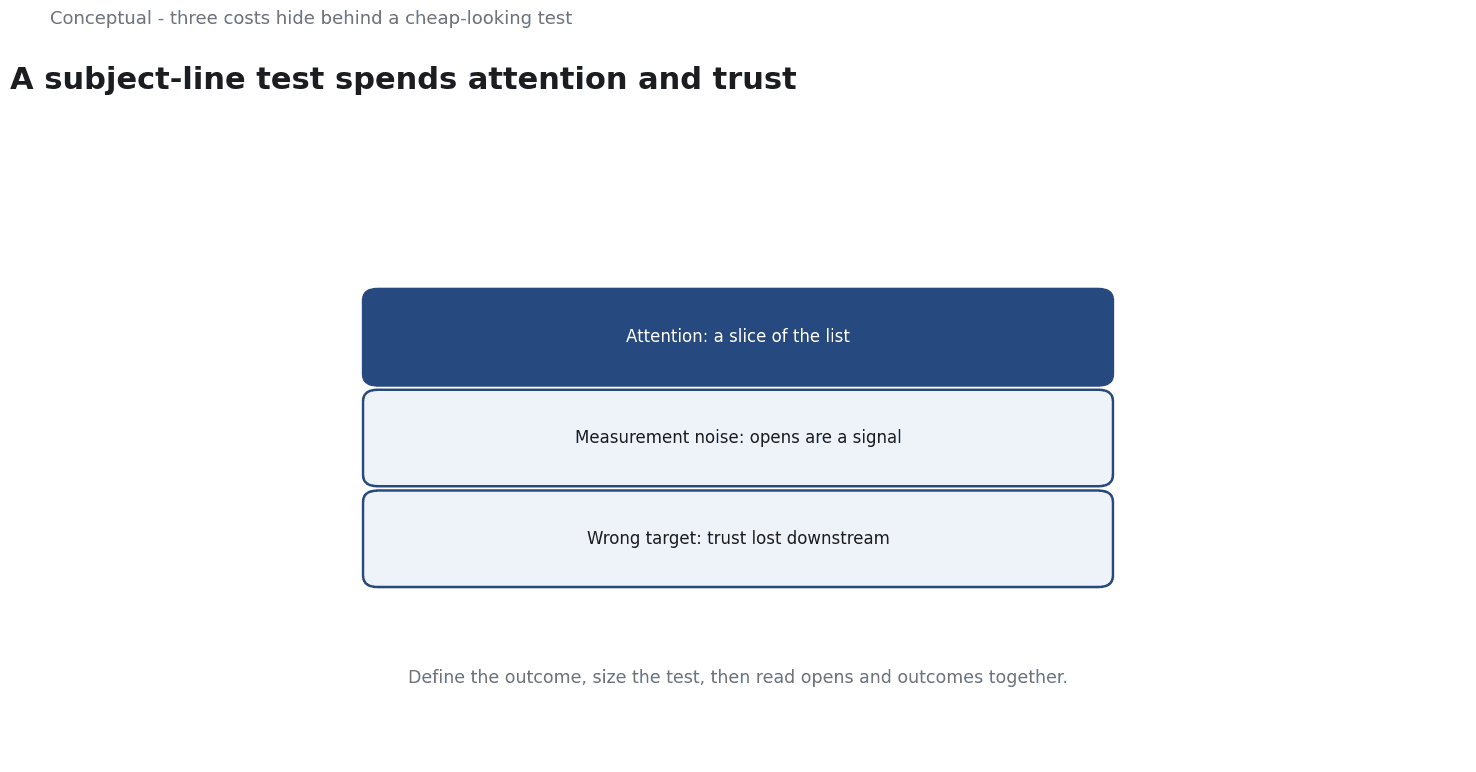
- Attention. Every test uses a portion of the list. Repeated tests train readers to ignore the sender.
- Measurement noise. The email-marketing entry describes opens as an intermediate signal. A/B testing requires enough sample to distinguish a real effect from variation.
- The wrong target. Optimising opens can favour misleading subject lines that reduce trust downstream.
The sequence is: define the outcome, size the test, run it once with a clear comparison, then read the result. Sizing and outcome choice are local judgement, so they are inferred; the mechanics are source-reported.
A worked example
Illustrative. A team tests two subject lines on half a list of 2,000 subscribers.
Three checks decide. First, is the metric opens or a downstream action, such as a qualified visit? Second, is the sample large enough that a two-percent difference is not noise, as controlled comparison requires? Third, what is the cost of running another test next week on the same readers?
The outcome is a decision about whether the test was worth running. The numbers are hypothetical; the cost accounting is the contribution.
Why the sample decides the result
A small test cannot distinguish a real improvement from ordinary variation, but it will always produce a winner.
Controlled comparison requires enough observations that a difference of a few percent is meaningful, which is often more than a small list can provide.
The second constraint is repetition. Running many tests on the same readers changes how they respond, because they learn the sender's patterns. A test that wins this week may lose next week not because the subject line changed but because the audience did. Treating each result as one observation in a longer history is more honest than treating it as a verdict.
Why the downstream outcome matters
A subject line that promises more than the email delivers can raise opens and reduce the actions the campaign exists for. Reading the two together reveals whether the gain was useful. When they disagree, the downstream measure should decide, because it reflects the reader's judgement after opening.
Evidence status
| Claim | Status | Source | Verified | Recheck when |
|---|---|---|---|---|
| Email campaigns have measurable mechanics | source-reported | Wikipedia, Email marketing | 2026-11-18 | Platform changes |
| A/B testing is a controlled comparison | source-reported | Wikipedia, A/B testing | 2026-11-18 | Method changes |
| Optimise a downstream outcome, not opens | inferred | Derived from metric logic | 2026-11-18 | Business goal changes |
Why open rate is a weak target
A subject line can increase opens while reducing trust, because curiosity and clarity are both effective at getting a click.
The downstream action is the more honest measure, because it reflects whether the message delivered on its promise.
Reading the two together shows whether an open lift was useful.
A final consideration is the purpose of the campaign. A subject line that drives opens for a transactional message has a different job from one that starts a sales conversation. Naming the purpose before the test prevents the team from optimising a metric that belongs to a different kind of email.
The result also needs a shelf life. A winning line from one season may not work in another, because the audience's context changes. Recording the date and the conditions of the test keeps the result from being applied as a permanent rule.
The test should record which list segment was used, because a result from engaged subscribers rarely transfers to a cold audience. Without that note, a winning line is applied to everyone and underperforms where it matters most.
The date of the test belongs beside the result for the same reason.
What it cannot do
It cannot guarantee that a winning line will keep working. It does not remove the need to know the audience. And it cannot undo list fatigue from too many tests.
The counterargument that a quick open test is cheap is fair for a single test and incomplete across a programme of tests.
A decision test
- Define the downstream outcome.
- Size the test.
- Keep the comparison clean.
- Read opens and outcomes together.
- Count list fatigue.
- Record the decision and recheck date.
For the mechanics, see Email Marketing Metrics.
References & Further Reading
- Wikipedia contributors, 2026. Email marketing - Wikipedia — The mechanisms and measurement of email campaigns.
- Wikipedia contributors, 2026. A/B testing - Wikipedia — Controlled comparison of two variants.