Systems Thinking Trade-Offs
Use systems thinking to surface feedback loops and delays, then decision analysis to make trade-offs explicit, with a worked review and the limits of each map.
Most bad decisions are locally reasonable: each team optimises its own metric and the cost appears elsewhere, later. The systems thinking entry describes feedback, delays, and interrelationships, while the decision-making entry describes selecting among alternatives under limited information. The real problem is that the trade-offs are made implicitly, so no one can see what was exchanged for what.
Direct answer: Use systems thinking to find the feedback loops, delays, and boundaries around a choice, then use decision analysis to name alternatives and criteria explicitly before choosing.
A local optimum is not a system optimum.
The sources supply the structure and the choice procedure; connecting them is a synthesis.
Delta: This article adds a translation step beyond the sources: it maps feedback loops and delays to decision criteria, with claim status explicit.
The mechanism
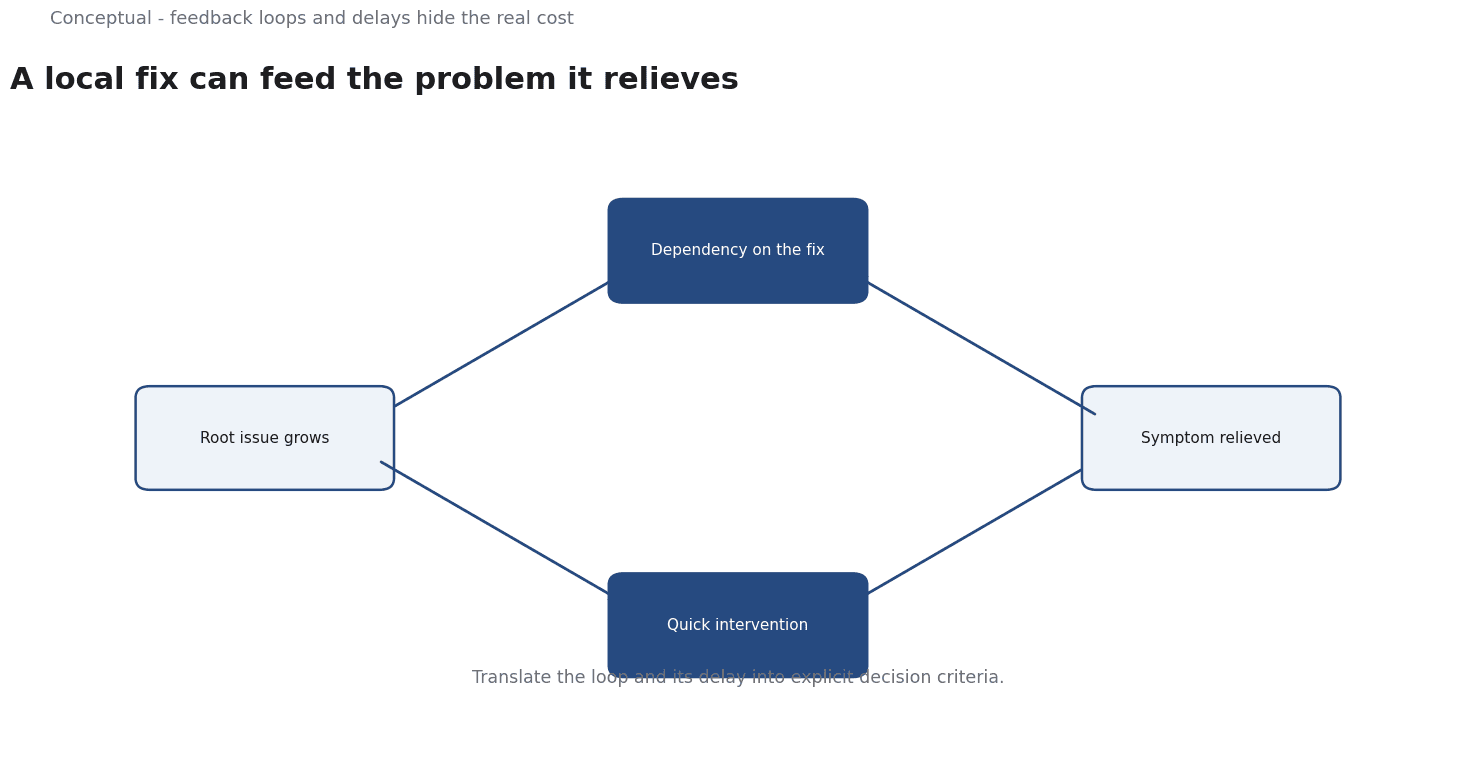
Systems thinking treats a problem as part of a larger structure rather than an isolated event. Its central ideas are feedback loops, in which an effect circles back to influence its cause, and delays, in which the consequence of an action arrives well after the action itself. It also distinguishes events from the patterns and structures that generate them. The entry describes archetypes such as fixes that fail, where a quick intervention relieves a symptom and quietly creates a dependency on the intervention. The practical consequence is that a decision should be judged by where its effects land and when, not by the immediate relief it provides.
Decision-making is the cognitive process of selecting a course of action among alternatives. A rational procedure identifies the decision, gathers information, lists alternatives, and applies criteria to choose between them. The decision-making entry also records bounded rationality: people work with limited information and time and often satisfice rather than optimise. The practical consequence is that unwritten criteria are filled in by whatever is salient in the moment. Writing the criteria down makes the trade-off visible and prevents an implicit weighting from masquerading as an objective choice.
The two sources meet at the question of what a criterion should include. Systems thinking supplies the structure: a loop that will amplify a side effect, a delay that will hide it until after the choice is locked in, a boundary that excludes a group who will pay the cost. Decision analysis supplies the procedure: list alternatives, state criteria, score them. Neither source says that a feedback loop should become a criterion. That translation is a local judgement, and it is what turns a systems map into a decision input rather than a diagram.
Marking the translation as inferred matters because it is the step most easily skipped. A team can draw a careful systems map and still choose on the familiar short-term metric, leaving the map as decoration. Conversely, a team can run a crisp decision matrix whose criteria omit every delayed effect, producing a precise answer to the wrong question. The value lies in forcing the structure into the criteria, where it can be weighed against the short-term metric instead of being admired separately.
A worked example
The following is hypothetical and illustrative. A support team considers deflecting more emails to cut ticket volume. Three checks structure the decision. First, the team maps the feedback loop: fewer visible tickets reduce pressure to fix the underlying product issue, which can raise tickets later. Second, it names alternatives, deflect further or fix the root cause, and the delay before each effect appears. Third, it writes criteria that include churn and repeat contacts, not just this month's ticket count. The outcome is that deflection wins on the short-term metric and loses once the delayed churn is scored, so the team funds the root-cause fix. The scenario is invented; the checking method is the contribution.
Evidence status
| Claim | Status | Source | Verified | Recheck when |
|---|---|---|---|---|
| Systems thinking emphasizes feedback loops, delays, and interrelationships | source-reported | Wikipedia, Systems thinking | 2026-11-18 | Entry concepts revised |
| Decision-making selects among alternatives under bounded rationality | source-reported | Wikipedia, Decision-making | 2026-11-18 | Decision model revised |
| System structure should be translated into explicit decision criteria | inferred | Derived from the sources | 2026-11-18 | Decision context changes |
The first two rows report what each entry describes. The third is a translation from structure to criteria, which neither entry states. Recheck the systems claim when the entry's concepts change and the decision claim when the decision model is revised; the inferred claim should be rechecked whenever the decision context shifts, because different contexts expose different loops. The table keeps the origin of each claim visible.
What it cannot do
A systems map is always incomplete. Someone chooses the boundary, and whatever falls outside it becomes invisible to the analysis. A loop that matters may be omitted because no one on the team knew it existed, and an archetype applied too eagerly can make a novel situation look like a familiar one. The systems thinking entry offers concepts, not a guarantee of completeness. Treating a map as the territory is the standard failure: the diagram looks authoritative while silently excluding the very effect that will decide the outcome.
Making trade-offs explicit is slow and political. Writing criteria forces disagreements into the open, and stakeholders who were happy with a vague consensus may resist naming what they value. The analysis can also be used as a delay tactic, endlessly expanding the system boundary to postpone a choice. The cost is real: an explicit decision matrix takes more effort than a quick call, and it can surface conflict that was previously avoidable. That cost is worth paying when effects cross boundaries or arrive late, and wasteful when a decision is small and reversible.
A common failure mode is analysis paralysis.
A related failure is reification, where the archetype becomes the explanation: the team labels a situation fixes that fail and stops looking for evidence. Neither source tells a team when to stop mapping. The boundary has to be set locally, and it should be set by the decision at hand rather than by the desire for a complete picture.
There is also a normative boundary. Systems thinking describes structure; it does not say which outcomes are worth pursuing. Decision analysis evaluates alternatives against criteria; it does not supply the values behind those criteria. A map can show that a policy shifts cost to a future group, but it cannot decide whether that shift is acceptable. That judgement belongs to the people accountable for the decision. No amount of structural clarity removes the need for an explicit choice about whose costs count.
Delays are the reason a review condition is essential. The consequences of a decision may appear months after it was made, long after the meeting and the map. Revisit the criteria when a delayed effect finally shows up, and redraw the boundary when a new actor is affected. Recording the criteria and the date with the decision lets a reviewer later see what was known at the time. Without that record, hindsight rewrites the rationale and the team learns nothing from the outcome.
Counterargument: "
The counterargument that local decisions are faster is fair for reversible, isolated choices and incomplete where effects cross boundaries or arrive with delay."
A decision test
- State the decision and who is accountable for it.
- Draw the boundary and name who is inside and outside.
- Identify feedback loops that amplify or damp the effect.
- Note delays between action and consequence.
- List alternatives and write criteria that include delayed effects.
- Choose, then record the criteria and the date.
- Revisit when a delayed effect appears or the boundary changes.
The test converts structure into a decision the team can defend. Each step asks for something visible: a boundary, a loop, a delay, a criterion. A choice made this way is not guaranteed to be better, but it is auditable, and an auditable choice can be corrected when the delayed effects arrive. That is the practical gain over a local optimum nobody can reconstruct.
For further reading, see Decision Memos That Survive Review.
References & Further Reading
- Wikipedia contributors, 2026. Systems thinking - Wikipedia — Understanding feedback, structure and behaviour over time.
- Wikipedia contributors, 2026. Decision-making - Wikipedia — Overview of decision processes, trade-offs and the distinction between the decision and its outcome; secondary reference.