Technical Portfolios for Beginners
A technical portfolio is judged on evidence, not adjectives. See how README files and technical writing turn projects into proof of skill, with each claim's status explicit.
Most beginner portfolios describe the author instead of proving anything. They list tools, certifications, and adjectives, then ask the reader to take skill on trust. A reviewer who has seconds to spend cannot verify any of it. The real problem is not a shortage of projects; it is that the projects are presented as claims rather than as inspectable evidence.
Direct answer: A technical portfolio is a set of artifacts - code, documentation, and README files - that lets a reviewer verify skill directly. Wikipedia's technical writing entry frames the discipline as communicating complex information precisely to a specific audience. GitHub Docs describes the README as the document that introduces a repository to a reader. The boundary: a portfolio displays evidence; it cannot manufacture the underlying ability.
Delta: This article adds a mapping from README structure and technical-writing principles to the one decision a reviewer actually makes - trust this person's skill or do not - with claim status explicit.
The mechanism
Technical writing, as the Wikipedia entry presents it, is defined less by elegance than by audience and purpose. The writer decides who needs the information and what that reader must do with it. For a portfolio, the audience is a skeptical reviewer under time pressure, and the job is to reach a grounded verdict about competence. That reframe changes what belongs in the portfolio. Anything that helps the reviewer reach that verdict belongs; anything that only decorates the page does not.
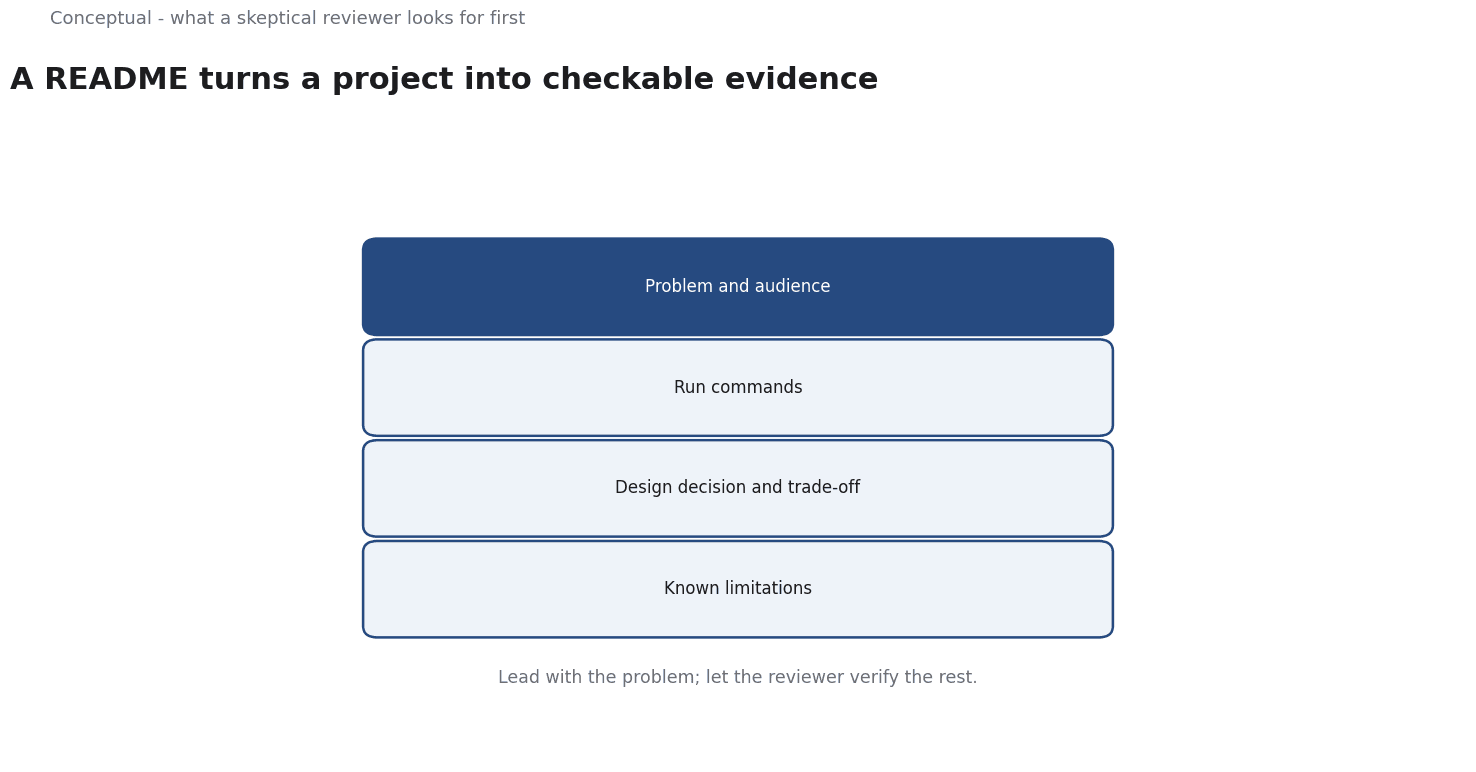
A README, per GitHub Docs, is the primary document that greets someone arriving at a repository. It is the natural unit of evidence because it is where explanation meets the actual work. A beginner who writes a README that states what the project does, how to run it, what decisions were made, and what the known limitations are gives a reviewer several things to check at once. The reader can compare the claims to the code, run the instructions, and see whether the stated limits match reality. Documentation becomes a testable surface rather than a marketing paragraph.
The practical consequence is that documentation skill and technical skill reinforce each other in a portfolio. Clear technical writing forces the author to understand their own work well enough to explain trade-offs. A vague README often hides a vague implementation, while a precise one exposes whether the decisions behind it were sound. This is why the README is a better centerpiece than a list of technologies: it is simultaneously a sample of communication and a map to the substance.
There is also a sequencing effect. Because the reviewer reads the README first, the order in which evidence appears shapes the verdict before the code is opened. Leading with the problem, the constraints, and the design choices gives the reader a frame for judging the implementation. Leading with a wall of tools, or with claims of expertise, invites suspicion and shifts attention away from the parts of the portfolio that could actually be verified.
A worked example
The following is hypothetical and illustrative. A junior developer publishes a small scheduling tool and wants a portfolio piece. Instead of a gallery screenshot, the repository opens with a README that states the problem, the run commands, one design decision, and two known limitations. Three checks follow. First, the reviewer runs the documented commands and confirms the tool starts without hidden setup. Second, the reviewer reads the stated design decision against the code and finds the trade-off honestly described. Third, the reviewer probes a listed limitation and sees it reproduce rather than being concealed. The outcome is a verdict formed from evidence in minutes, not from adjectives. The same project, presented only as a list of frameworks, would have left the reviewer with nothing to verify.
Evidence status
| Claim | Status | Source | Verified | Recheck when |
|---|---|---|---|---|
| Technical writing centers on audience, purpose, and precise communication of complex information | source-reported | Wikipedia Technical writing | 2026-11-18 | The Wikipedia entry is substantially revised |
| The README is the primary document introducing a repository to readers | source-reported | GitHub Docs | 2026-11-18 | GitHub changes its README guidance |
| A well-structured portfolio reduces reviewer uncertainty about a candidate's skill | inferred | Derived from the sources | 2026-11-18 | Hiring signals or review practices change |
The first two rows are taken from the cited sources and describe what the disciplines are. The third is an inference: it connects the audience-focused view of technical writing and the front-door role of the README to a practical effect on review. It is labelled inferred because the sources do not themselves measure hiring outcomes.
What it cannot do
A portfolio cannot substitute for the ability it documents. A polished README can make a shallow project look thorough, and a reviewer who only skims the front page can be misled. The artifacts reduce the cost of checking skill; they do not remove the need to check it. The honest portfolio is built on work that survives inspection, and its documentation is valuable precisely because it points to that work rather than covering for its absence.
It also cannot fully capture how someone performs in a team. Technical writing for a repository is asynchronous and self-directed; much professional work happens in conversation, code review, and shared decision-making. A portfolio shows what a person can produce alone, with time to revise. It says little about how they respond to a conflicting requirement or a reviewer who disagrees. Treating a portfolio as a complete picture of a candidate is a category error.
There is a hidden cost worth naming. Building good documentation takes time that could go into more features, and beginners often face pressure to show volume rather than depth. A single project with an excellent README may look smaller than ten projects with none, even though the one demonstrates more. This creates a temptation to pad the portfolio with trivial work, which dilutes the evidence and makes the reviewer's job harder rather than easier.
A README that claims a feature works but does not, or that lists dependencies the code no longer uses, does more damage than no README at all. Once a reviewer finds one inaccurate statement, every other claim in the repository is discounted. Consistency between documentation and code is therefore a trust asset that must be maintained, not a one-time writing task.
The boundary is that these artifacts answer a narrow question: can this person communicate and structure technical work clearly? They do not answer questions about judgment under pressure, collaboration, or long-term reliability. Those require other signals. A portfolio should be reviewed as one input among several, and its claims should be rechecked whenever the underlying project changes, because stale documentation quietly converts evidence into misinformation.
The counterargument that a portfolio over-rewards polished writing is fair for roles where communication matters little and incomplete for roles where nearly every decision is written down.
A decision test
- Does each project open with a README that states the problem and audience?
- Can a stranger run the project using only the documented steps?
- Are design decisions and their trade-offs written, not just the final result?
- Are known limitations listed honestly rather than hidden?
- Do the documentation claims match the code when checked?
- Does the portfolio show depth on a few projects instead of surface on many?
- Is every artifact current enough to survive a reviewer's check?
A portfolio earns its place when a reviewer can move from claim to check without friction.
Use these questions as a pre-publish pass: any item that fails is a place where the reader must guess, and guessing is where trust is lost. The goal is not volume but verifiability, so prune anything that cannot be checked.
For further reading, see Technical Writing.
References & Further Reading
- Wikipedia contributors, 2026. Technical writing - Wikipedia — Writing for technical audiences and purposes.
- GitHub Docs, 2026. About the repository README file - GitHub Docs — The platform's own guidance on what a repository README should contain.