Team Culture for Beginners
Culture is what a team actually does, not what it says. Read how it forms, a worked example, and why perks are a weak proxy.
Culture is often introduced through perks and slogans — free lunches, values on a wall. The organisational-culture literature treats it as shared values and behaviours that shape how work gets done, which means it forms through decisions, not declarations. A beginner's first task is to look at what the team rewards and tolerates.
Direct answer:
Culture is observed in what gets rewarded, what gets tolerated, and how disagreements are handled.
The organizational-culture overview provides the academic context, and O*NET's task descriptions help define the work a team actually performs. The boundary: a cultural claim is not evidence of how a team behaves, which the evaluation-rubric article argues for observable criteria, as Engineering Management: Hiring, Culture, Metrics, and Career Ladders treats culture as built by decisions.
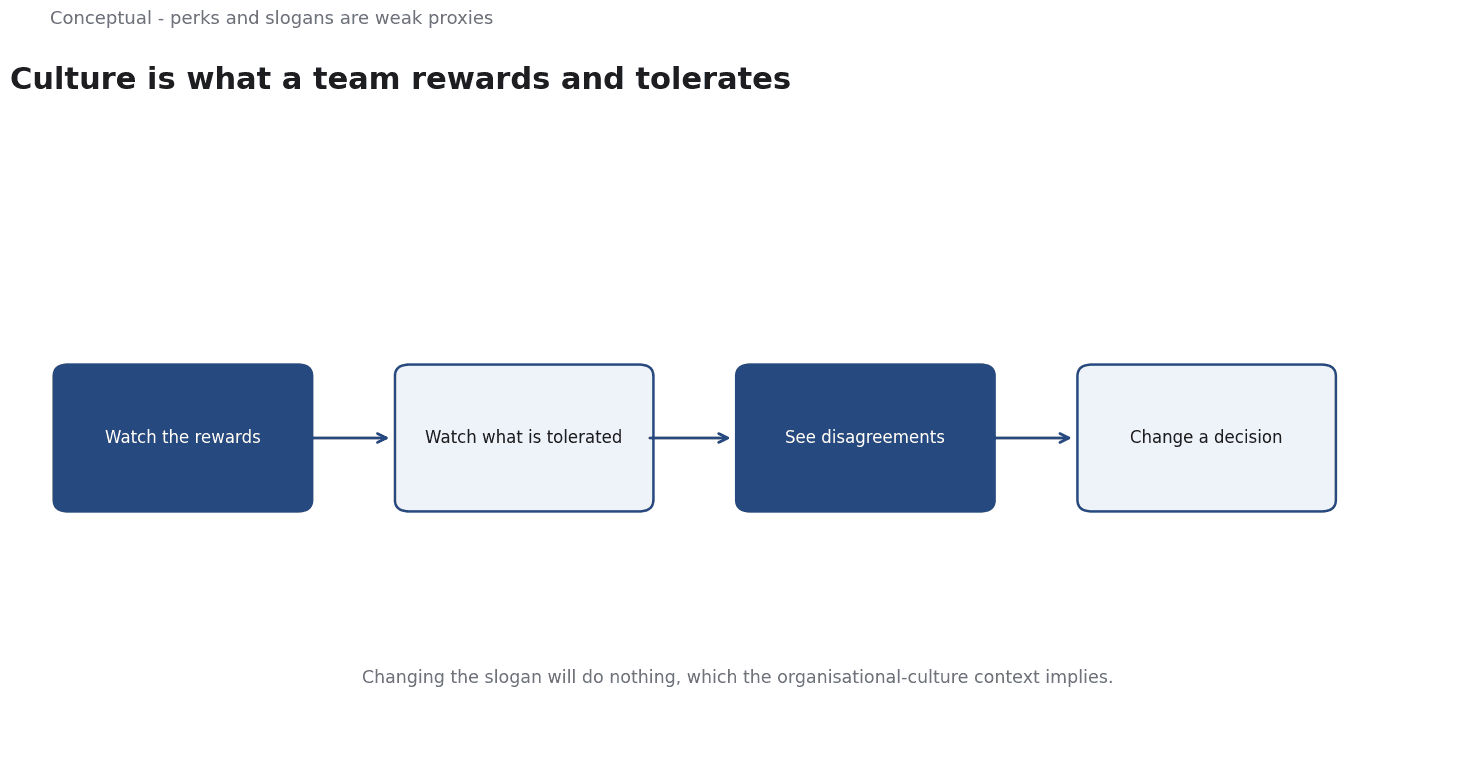
How it forms
What gets rewarded. If speed is praised while quality problems are ignored, the team learns that speed wins, as Engineering Management: Hiring, Culture, Metrics, and Career Ladders treats metrics as signals. The reward may be informal, which makes it more powerful than a stated value, as the behavioural-finance article warns about incentives.
What gets tolerated. A missed deadline that nobody discusses teaches that deadlines are optional, which the project-management context in the team article implies. The response to the first small violation sets the norm, as the incident-response article argues for acting on early signals.
How disagreement works. A team where people can challenge a decision without penalty makes better decisions, which the human-in-the-loop article treats as a condition for surfacing problems. The alternative is agreement in the room and doubt afterwards, as the internal-communications article warns about channels that carry only good news.
Three consequences follow. Culture is shaped by leadership behaviour, which the management article treats as the substance of culture. It is visible in artefacts — how meetings run, how feedback is given — which the documentation article argues for putting guidance where work happens. And it changes when incentives change, as the unit-economics article treats measurement as a driver of behaviour.
A worked example
The following is hypothetical and illustrative. A new manager joins a team that says it values quality but ships with failing tests.
Three checks decide what to do. First, what is rewarded, as the management article asks for the substance of culture? Releases are celebrated, test failures are not discussed, so the stated value is not the operative one. Second, what is tolerated, as the organisational-culture context implies? The failing tests are a norm, which the technical-debt article treats as accumulated shortcuts. Third, what happens when someone raises it, as the human-in-the-loop article asks for a safe escalation path? If the person is ignored, the norm is reinforced.
Three conclusions follow.
Changing what is celebrated and discussed is the lever, as Engineering Management: Hiring, Culture, Metrics, and Career Ladders argues for decisions that build culture. And the change should be recorded, as Decision Memos That Survive Review requires for consequential judgements.
How to observe culture without a survey
Culture can be read from ordinary artefacts. Look at which meetings are cancelled, whose suggestions are adopted, and what happens after a mistake, which the organisational-culture overview treats as expressions of shared values rather than declarations. A survey of stated values can be useful but is self-reported, which AAPOR's standards require you to label, as the evaluation-rubric article argues for observed criteria alongside stated ones.
The first week of a new hire is a useful test. What they are told to do and what they actually see often differ, which the onboarding article treats as a gap that shapes behaviour, as the internal-communications article argues for decisions others can act on. If the stated value is transparency but decisions are made elsewhere, the newcomer learns the real norm quickly, which the management article treats as the substance of culture.
For a beginner, the practical output is a short list of behaviours to reinforce and one to stop, which the decision-memo article requires as a recorded judgement. A vague goal to improve culture gives nobody anything to do, as the evaluation-rubric article warns about criteria that cannot be observed, as Engineering Management: Hiring, Culture, Metrics, and Career Ladders argues for decisions over declarations.
What culture work cannot do
It cannot fix a bad strategy, which the strategy article treats as a prior decision. It cannot substitute for fair process, which the AI HR screening article treats as an obligation in high-impact decisions. And it is not a perks programme, which the organisational-culture overview distinguishes from shared values and behaviours.
The counterargument that culture is soft and unmeasurable is partly true and misses the observable signals, which the evaluation-rubric article argues for explicit criteria, as Engineering Management: Hiring, Culture, Metrics, and Career Ladders treats behaviour as the substance.
A decision test
- Observe what is rewarded and tolerated, as Engineering Management: Hiring, Culture, Metrics, and Career Ladders advises.
- Check how disagreement is handled, as the oversight article requires for a safe escalation path.
- Look at artefacts — meetings, reviews, feedback — as the documentation article advises for where work happens.
- Change the reward, not the slogan, as Engineering Management: Hiring, Culture, Metrics, and Career Ladders argues for decisions over declarations.
- Record the decision, as Decision Memos That Survive Review requires.
- Review after a change in team or incentives, as the monitoring article advises.
For the management substance, see Engineering Management; for process, see Decision Memos.
References & Further Reading
- Wikipedia contributors, 2026. Organizational culture - Wikipedia — The study of shared values and behaviours in organisations.
- U.S. Department of Labor, 2026. O*NET OnLine — The standard occupational taxonomy used to compare roles across industries.