Tokenomics Checklist
Token design is a set of local choices, not a formula. Read how token mechanics and regulatory scope shape a review, a worked example, and where the checklist stops.
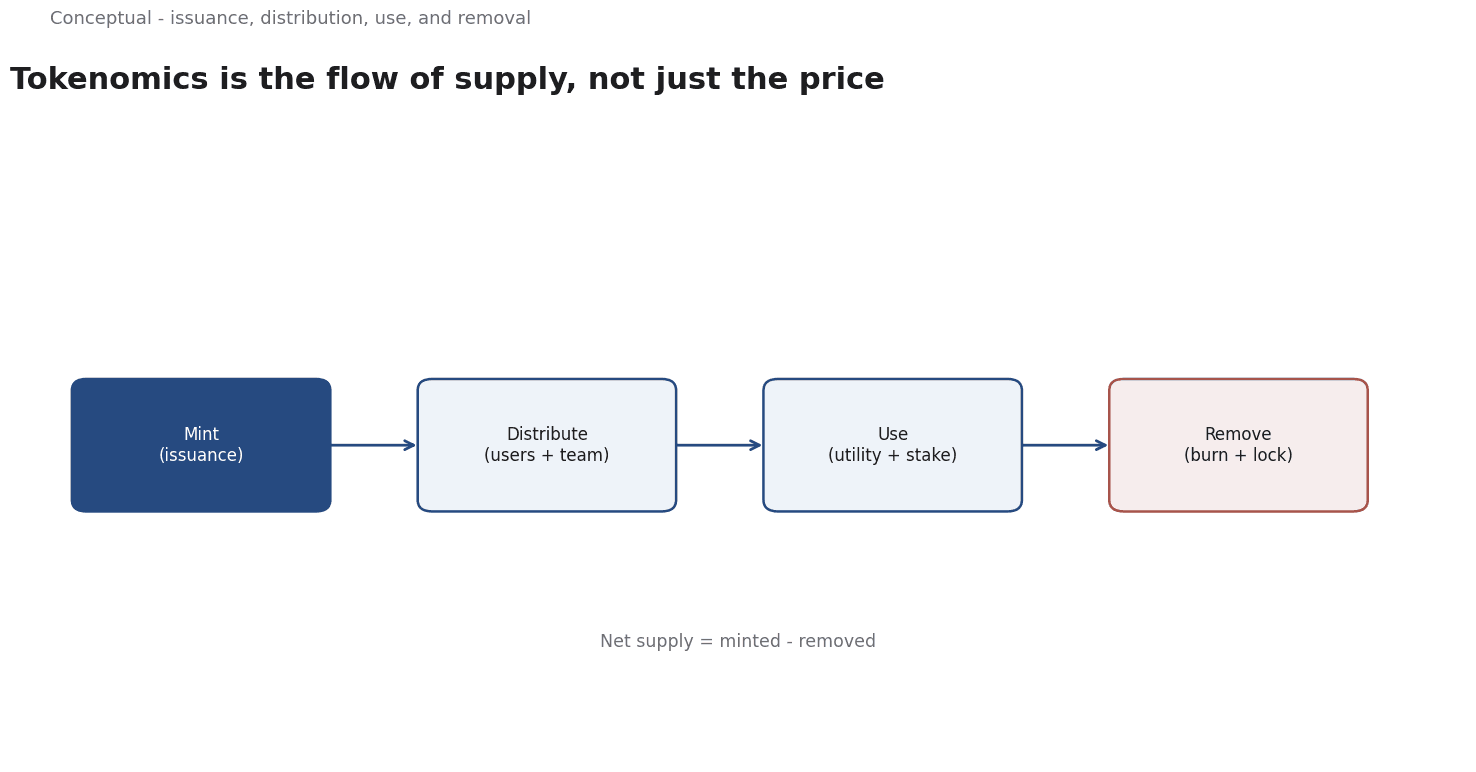
Tokenomics describes how a crypto token is created, distributed, and used, and a checklist can make that design reviewable. The two sources cover token mechanics and the regulator's work on cryptoassets. The real problem is that design checklists often stop at supply and incentives, leaving the regulatory dimension of the token unexamined.
Direct answer: Use the tokenomics source to check the design variables: supply, distribution, and incentive mechanics. Use the FCA source to check whether the token falls within a regulatory perimeter that needs specialist review. The sources describe mechanics and regulatory work; the two-part checklist that joins them is a synthesis, not a stated method.
Delta: This article adds a claim-status table and a design-to-review decision test beyond the sources: it maps each token design choice to a checklist decision, with claim status explicit.
The mechanism
The Wikipedia entry on tokenomics describes the economic design of a cryptocurrency token, including how tokens are issued, distributed, and what role they play in a network. Supply schedules, allocation, and incentives are all design variables rather than fixed laws. The practical consequence is that a reviewer can list these variables and question each one: how many tokens exist, who receives them, and what behavior the distribution rewards. A checklist turns those questions into a repeatable review instead of an ad hoc conversation.
The FCA entry describes the regulator's work on cryptoassets and the activities it brings within its remit. The practical consequence is that some cryptoasset activities are subject to regulation, so the way a token is used and offered matters to a serious review. A design that is internally coherent can still sit inside a regulatory boundary that its authors did not consider, and the FCA source is the place to notice that possibility rather than assume it away.
The two sources operate at different levels. Tokenomics describes what a designer chooses; the FCA work describes a boundary an authority draws around certain activities. A checklist that covers only the first can produce a token whose incentives are well reasoned but whose regulatory position has never been asked. Joining the two levels is an inference about how to structure a review, not a method either source sets out. The checklist is a local construct built from two different kinds of information.
The output is therefore a two-part checklist: one column for the design variable, one for the regulatory question it raises.
The sequence is to list the design choices, then ask which regulatory questions each one invites, and finally decide which questions need specialist input. The sources do not supply the token's purpose, the allocation numbers, or the answer to any regulatory question; those remain local decisions that must be owned and reviewed.
A worked example
The following is hypothetical and illustrative. A team drafts a utility token for a network and runs a two-part review. Three checks decide the outcome. First, are the supply schedule and allocation documented as explicit design choices rather than assumed? Second, does the distribution reward the behavior the network needs, or does it concentrate tokens in a way that distorts incentives? Third, given how the token will be offered and used, does the activity raise a question that falls within the FCA's described remit? The review finds the supply documented but the allocation rationale missing, and it flags one distribution feature for specialist regulatory input. The outcome is a checklist with open items, not a cleared token. The figures are hypothetical; the verification method is the contribution.
Evidence status
| Claim | Status | Source | Verified | Recheck when |
|---|---|---|---|---|
| Tokenomics covers token issuance and distribution | source-reported | Wikipedia, Tokenomics | 2026-11-18 | Definition revised |
| The FCA publishes work on cryptoassets | source-reported | FCA, Cryptoassets | 2026-11-18 | Regulatory scope updated |
| A design choice can raise a regulatory question | inferred | Derived from the sources | 2026-11-18 | Perimeter changes |
The first two rows are factual claims drawn from the sources. The third is an inference that links a design variable to a regulatory question, because neither source makes that connection for a specific token. Recheck the definitions when the source entries change, and the inferred claim when the regulatory perimeter or the token's use changes.
What it cannot do
A tokenomics checklist does not certify that a token is sound or compliant. It organizes questions; it does not answer them. The tokenomics source describes the design variables, and the FCA source describes regulatory work, but neither evaluates any particular token. A completed checklist with every box ticked is evidence that questions were asked, not proof that the answers were right.
The hidden cost is that the two halves of the review need different expertise. Filling in the design column asks for an understanding of incentives and supply; interpreting the regulatory column may need specialist or legal input that a small team does not have in house. The checklist makes the gap visible but does not close it. Budgeting for that input, and waiting for it, is a real cost that a purely design-focused review tends to overlook until a question is escalated late.
The main failure mode is a checklist that goes stale. Token designs change as a network develops: allocations shift, distribution rules are amended, and new uses appear. A checklist completed at launch reflects the design at that moment, and each later change can invalidate a row without anyone revisiting it. The result is a document that looks thorough while describing a token that no longer exists. Reviewing the interactions between rows matters here too, because a change to distribution can raise a regulatory question that the original review never faced.
There is a boundary around what these sources cover. The tokenomics entry describes economic design; the FCA entry describes the regulator's remit and activity. Neither provides a legal opinion, a valuation, or a judgment about whether a specific token should be issued. Those judgments sit outside the two documents and need other evidence. A reader expecting a definitive answer about a token's status will not find one, and should not treat a clear checklist as a substitute for advice that is qualified to give that answer.
Because designs and rules change, the checklist needs review at defined moments: after any allocation change, after a new use case, and when regulatory scope is updated. Each row should carry a recheck condition and an owner, and escalated questions should stay open until a qualified reviewer closes them. Without that record, a later reader cannot tell which items were settled and which were merely noted, and a small design edit can quietly reopen a question the earlier review had set aside.
The counterargument that a two-part checklist is fair for surfacing design and regulatory questions is incomplete when it is treated as a verdict on a token.
A decision test
- List the token's supply schedule and allocation as explicit choices.
- Record what behavior the distribution rewards.
- Note how the token will be offered and used.
- Ask which activities might fall within the regulator's remit.
- Flag every question that needs specialist input.
- Leave flagged items open until a qualified reviewer closes them.
- Assign an owner and a recheck condition to each row.
The checklist earns its place by keeping design and regulatory questions side by side rather than in separate documents. The test turns a design into a reviewable set of decisions with visible owners, so a reader can see which choices were made and which questions remain genuinely open. For further reading, see Responsible AI: Ethics, Fairness, and Regulatory Compliance.
References & Further Reading
- Wikipedia contributors, 2026. Tokenomics - Wikipedia — Design and economics of a crypto token.
- UK Financial Conduct Authority, 2026. Cryptoassets: Our Work | FCA — Primary regulatory guidance on cryptoasset promotion and disclosure.