Responsible AI: Ethics, Fairness, and Regulatory Compliance
Fairness criteria conflict, regulation is jurisdiction-specific, and documentation is the audit trail. Read what a responsible deployment actually requires.
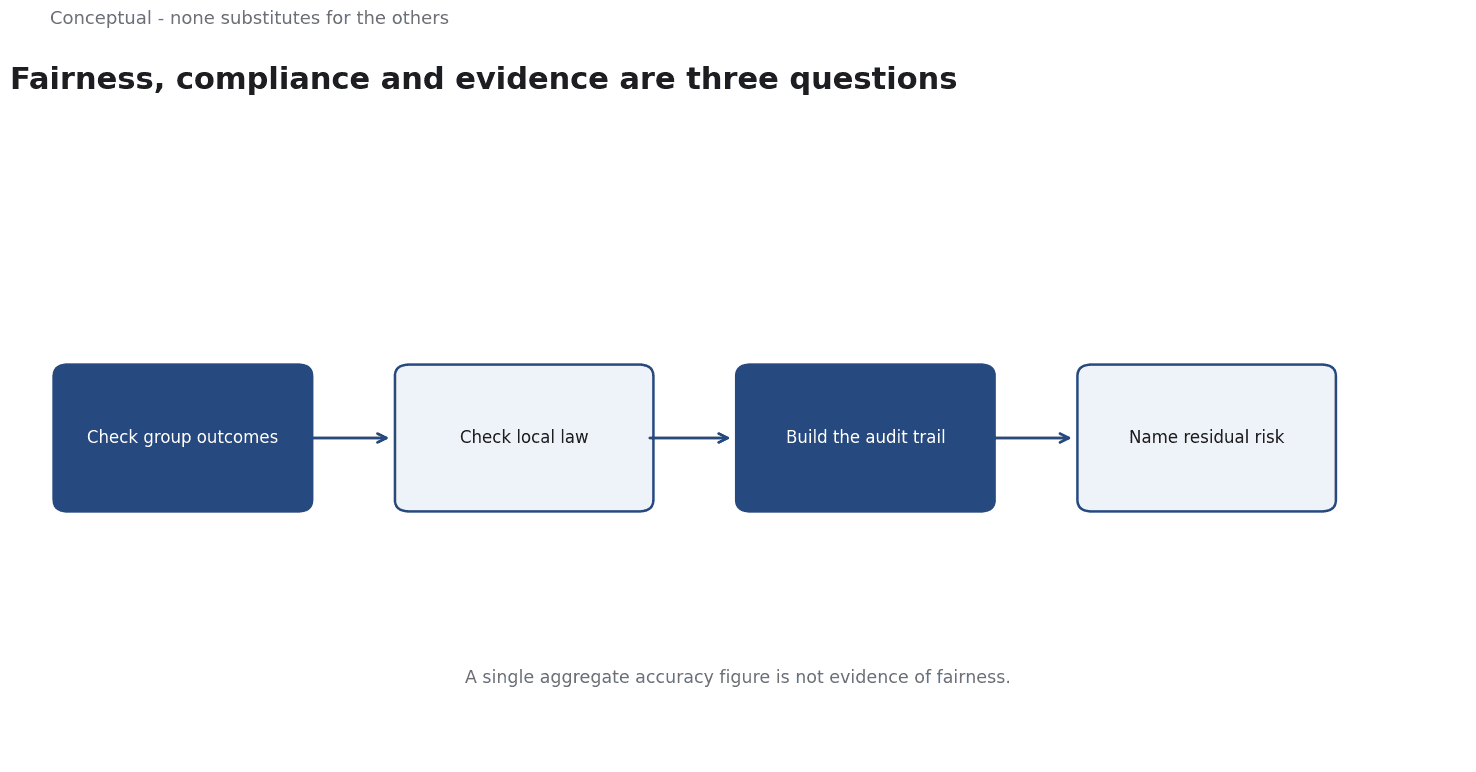
"Responsible AI" is a phrase broad enough to mean anything, which is why it is often used to mean nothing. The subject becomes tractable when it is split into three questions that have different answers and different owners: what the system does to different groups, what the law in a given place requires, and what evidence the organisation can produce when asked.
Direct answer:
The three questions are distinct and none substitutes for the others.
Fairness criteria can conflict, so a team must choose which one its system satisfies and say why. Compliance is jurisdiction-specific and dated, so "we are compliant" is a claim about a place and a time. And documentation — model cards, datasheets, risk records — is the artefact that makes either claim reviewable. The NIST AI Risk Management Framework is described as "intended for voluntary use and to improve the ability to incorporate trustworthiness considerations into the design, development, use, and evaluation of AI products, services, and systems": a framework for producing evidence, not a certificate.
Fairness is a choice among incompatible criteria
The central technical fact is uncomfortable: the main mathematical definitions of fairness cannot all be satisfied at once when base rates differ between groups.
Barocas, Hardt and Narayanan's Fairness and Machine Learning is the standard reference for the trade-offs, and its accompanying material discusses anti-discrimination law as something that "navigates tradeoffs" and has "limits". That framing is the right one. A team choosing a fairness criterion is not selecting the correct definition from a menu; it is making a decision about which kind of error it considers most harmful and for whom.
Three criteria are commonly confused:
- Demographic parity asks that positive outcomes occur at similar rates across groups.
- Equalised odds asks that true-positive and false-positive rates be similar across groups.
- Calibration asks that a predicted probability mean the same thing in each group.
When the underlying base rates differ, these cannot generally hold together. A system that satisfies demographic parity will usually fail calibration; one that is calibrated will usually show different positive rates. The choice has to be made in the context of the application — a lending decision and a job shortlist have different harms and different legal constraints — and the reasoning has to be recorded.
It is not. Mitchell et al.'s model cards exist precisely because aggregate evaluation hides group-level behaviour: they call for "benchmarked evaluation in a variety of conditions, such as across different cultural, demographic, or phenotypic groups... and intersectional groups" relevant to the intended application, along with disclosure of "the context in which models are intended to be used".
A worked example of the conflict
The incompatibility of fairness criteria is easier to see with numbers. Suppose a screening system is evaluated on two groups of 1,000 applicants each, and the underlying qualification rate is 20% in one group and 10% in the other — a difference the system did not create.
If the system selects 20% of each group to satisfy demographic parity, it selects 200 people from each. In the first group, where 200 applicants are qualified, it can be perfectly accurate; in the second, where only 100 are qualified, it must select 100 unqualified people to reach the same selection rate. Equal selection rates have produced very different error rates.
If instead the system calibrates — a score of 0.8 means an 80% chance of success in both groups — then a fixed threshold will select a larger share of the first group, because more of its members are qualified. Demographic parity fails, and it fails for a reason that is not the model's bias but the population's base rate.
A third choice, equalising true-positive and false-positive rates, requires different thresholds for the two groups, which is itself a contested decision: treating applicants differently by group to achieve equal error rates.
No amount of model improvement removes this triangle, because it follows from the base rates and the criteria rather than from the implementation. What an organisation can do is choose deliberately, measure the consequences of the choice, and be able to explain it — which is exactly what the documentation artefacts above are for.
The worked example also shows why "remove bias from the model" is an inadequate brief. The question is which outcome the system should produce, not only how it produces it. For the measurement framework behind these criteria, see Model Monitoring.
Compliance is not ethics
A system can be lawful and still be a bad idea, and it can be ethically defensible while operating in a jurisdiction that prohibits it. These are independent judgements, and conflating them causes bad decisions in both directions.
The legal reference has to be specific about place and date. The EU AI Act and the US regulatory approach differ in structure, and within a jurisdiction the rules for employment, lending, and healthcare differ again. The NIST framework explicitly describes itself as voluntary, which means it is not a legal safe harbour; it is a structured way of thinking about risk.
International comparison is genuinely difficult, which is part of why the OECD's AI Policy Observatory exists as a measurement programme. Cross-country data on adoption, firm-level effects and policy responses lets an organisation check its assumptions against something measured rather than against the regulatory mood in its own sector.
Three habits keep this straight:
- Name the jurisdiction and the effective date next to every compliance claim.
- Separate the legal answer from the design answer. If the law permits a use and the team still does not want to build it, that is a decision worth recording.
- Treat a compliance claim as time-limited. Rules change; a claim without a date will silently become false.
Documentation is the audit trail
Gebru et al.'s datasheets for datasets are built on an analogy with electronics: every component ships with a datasheet describing "operating characteristics, test results, recommended uses", and a dataset should document its "motivation, composition, collection process, recommended uses". The motivation is stark — the absence of a standardised documentation process "can lead to severe consequences in high stakes domains".
Model cards do the same job for the model. Together they produce something a reviewer can actually examine: what data was used, for what purpose, what was measured, on which groups, and what the system is not meant to do.
Three properties make documentation useful rather than decorative:
- It is produced during development, when the decisions are still available, not reconstructed afterwards.
- It names limitations, including the groups and conditions where performance was not evaluated.
- It has an owner who updates it when the system changes, because an outdated card is worse than none — it certifies a system that no longer exists.
The NIST RMF's structure — governance, mapping, measurement, management — is a convenient way of organising these artefacts into a programme rather than a folder.
Reasonable peoples’ disagreements and the governance answer
Most difficult cases are not failures of data or law; they are disagreements about values. What level of error is acceptable in a medical triage system? Should a model optimise for the average or the worst-served group? Who gets to decide?
There is no technical answer to these questions, and pretending otherwise is how "ethics" becomes a marketing function. The right response is procedural: make the decision explicit, name the person or body accountable for it, record the reasoning and the alternatives rejected, and revisit it when the system or the evidence changes.
This is the same argument that applies to Constitutional AI, where Bai et al. note that "the only human oversight is provided through a list of rules or principles". A principles list does not remove the human decision; it relocates it into an artefact that can be reviewed and versioned.
A deployment checklist
- Name the fairness criterion and the alternative you rejected, with the reason.
- Measure by relevant groups, including intersections where the application warrants it.
- State the jurisdiction and date of every compliance claim.
- Separate legal permissibility from design acceptability.
- Produce a datasheet and a model card during development, with named owners.
- Use a risk framework to organise the artefacts, not to imply certification.
- Record the value decisions, who owns them, and when they are next reviewed.
- Make limitations visible to the people who will use or be affected by the system.
For the framework detail, see AI Governance; for the underlying value choices, see AI Ethics.
A counterargument
The procedural answer has a limit the article does not press.
Naming who owns a value decision and recording the alternatives rejected, as the closing sections recommend, can make a choice reviewable without making it fair to the people who bear it; the incompatibility results in Barocas, Hardt and Narayanan describe a distribution of harm that procedure alone does not settle.
There is also a tension in treating documentation as a neutral audit trail: model cards and datasheets are written by the teams whose decisions they describe, and Mitchell et al. and Gebru et al. specify what they should contain rather than how they would be independently verified. A critic would argue the three questions are less separable than the framing suggests, since the evidence an organisation can produce is itself shaped by what the law in a jurisdiction requires.
References & Further Reading
- Solon Barocas, Moritz Hardt, and Arvind Narayanan, 2019. Fairness and Machine Learning: Limitations and Opportunities — The free textbook on fairness criteria and their incompatibility results.
- Margaret Mitchell et al., 2019. Model Cards for Model Reporting — The reporting template used to document intended use, evaluation, and limitations.
- Timnit Gebru et al., 2021. Datasheets for Datasets — The document format that makes a dataset's provenance and limits reviewable.
- NIST, 2023. AI Risk Management Framework | NIST — The governance framework referenced in AI risk and compliance work.
- OECD, 2026. The AI Wonk - oecd.ai — Cross-country measurement and policy data for AI adoption.