URL Structure for Small Teams
URLs are durable names, not a design exercise. Read the rules that matter, a worked example, and why a rewrite is a migration decision.
A small team often inherits a URL structure that grew with the site rather than being designed. The temptation is to redesign it for tidiness, which turns a naming question into a migration with redirect risk, as the URL-structure article advises on normalising hosts, paths, and parameters, as the site-migration checklist treats URL changes as infrastructure, as the canonical article warns about signals that are not commands.
Direct answer:
Choose a URL structure that is stable, readable, and consistent with how pages are grouped, and treat any change as a migration with redirects and verification.
RFC 9110 defines the URI context, and Google's SEO starter guide covers site structure. The boundary: a clean URL does not guarantee a ranking, which the publication standard states for SEO, and a redesign can break existing links, as Website Migration SEO: Infrastructure Checklist Before and After Launch warns, as the status article advises on correct responses.
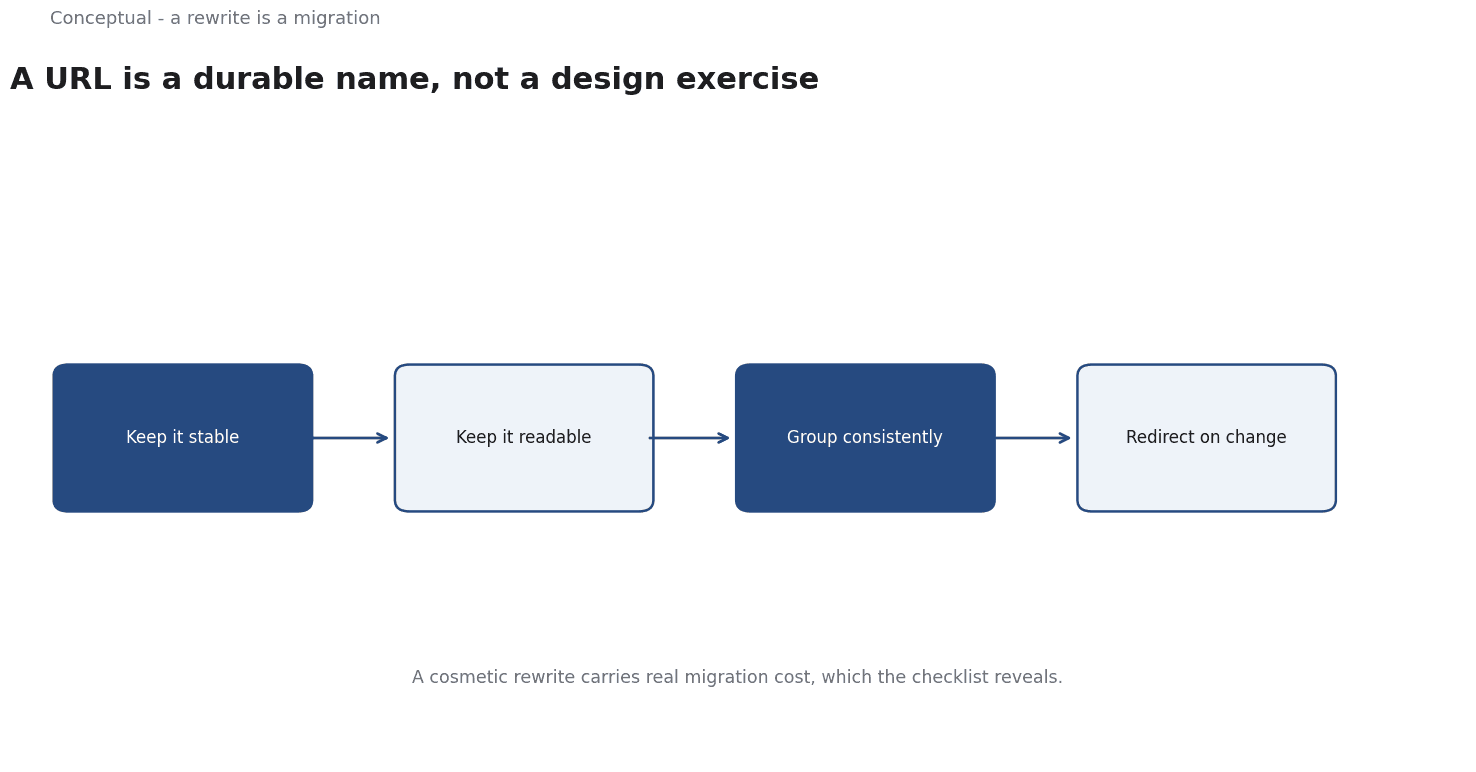
The rules
Normalise the host and scheme. One canonical host and one scheme avoid duplicate versions, which the URL-structure article advises, as the canonical article explains for signals, as the HTTPS article advises on certificate and redirect diagnosis.
Keep paths readable and stable. A path that describes the page survives better than an opaque identifier, which the URL-structure article advises, as the internal-linking article treats links as navigation, as the information-architecture article argues for grouping.
Control parameters. Tracking and filter parameters can create many versions of one page, which the URL-structure article advises normalising, as the faceted-navigation article warns about parameter variation, as the canonical article treats duplicate URLs as a signal problem.
Plan changes as migrations. A URL change needs redirects and a check, which the site-migration checklist requires, as the redirect article advises on chains, as the server-logs article recommends for verifying what was requested.
Three consequences follow. The structure should be decided once and documented, as the data-governance article requires for a dated definition, as the decision-memo article requires for a recorded judgement. It should be reviewed after a site change, as the monitoring article treats as a trigger. And it should be checked with logs, as the server-logs article recommends, as the diagnostic article advises for verification.
A worked example
The following is hypothetical and illustrative. A team considers changing product URLs from a path with a numeric ID to a readable slug.
Three checks decide. First, is the change necessary or cosmetic, as the decision-memo article asks, with the benefit stated, as the evaluation-rubric article requires for concrete criteria? Second, can every old URL redirect to its new counterpart without chains, as the site-migration checklist requires, as the redirect article advises? Third, do server logs confirm that requests resolve, as the server-logs article recommends, as the status article advises for diagnosing responses?
Three conclusions follow.
Redirects must be complete, as Website Migration SEO: Infrastructure Checklist Before and After Launch requires, as the canonical article warns about duplicates. And the change should be recorded with the verification, as the decision-memo article requires.
What URL structure cannot do
It cannot guarantee a ranking, which the publication standard states for SEO, as the status article treats a correct response as necessary but not sufficient.
It does not fix weak content, which the thin-content article treats as the prior requirement, as the content-marketing article argues for value first. And it cannot erase existing links, which the migration article treats as an infrastructure problem, as the internal-linking article advises on maintenance.
The counterargument that a tidy structure is worth any cost is fair for a new site and wrong for an established one, which the worked example shows, as Website Migration SEO: Infrastructure Checklist Before and After Launch warns about redirects.
A decision test
- Normalise host and scheme, as the URL-structure article advises.
- Keep paths readable and stable, as the URL-structure article recommends.
- Control parameters, as the faceted-navigation article warns.
- Treat any change as a migration, as the site-migration checklist requires.
- Verify redirects with logs, as the server-logs article recommends.
- Record the structure and the reason, as the decision-memo article requires.
- Review after a site change, as the monitoring article advises.
For the normalisation, see SEO URL Structure; for the change, see Website Migration Checklist.
References & Further Reading
- R. Fielding, M. Nottingham, and J. Reschke, 2022. HTTP Semantics (RFC 9110) — The normative definition of HTTP methods, status codes, and headers.
- Google, 2026. SEO Starter Guide: The Basics — The search engine's own description of what it needs from a site.