Value Proposition Writing Mistakes to Avoid
A value proposition is often a slogan mistaken for a strategy. Read the writing mistakes, how they obscure positioning decisions, and a testable rewrite.
A value proposition is often written as a slogan and then mistaken for a strategy. Teams fill a template with adjectives, declare that their product is better or innovative, and discover that customers cannot repeat what the statement means. The real problem is not wording polish; it is that the statement never made an explicit claim about who benefits and why.
Direct answer:
A value proposition is a statement of the benefit a product or service delivers and the reason a customer would choose it over alternatives, as the Wikipedia entry on the term frames it.
Marketing communications is the broader process by which that statement reaches an audience, and it shapes how the message is encoded and received. The boundary: a value proposition is a claim to be tested with customers, not a fact established by writing it down.
Delta: This article adds a decision map beyond the sources: it maps each writing mistake to the specific positioning decision it obscures, with claim status explicit.
The mechanism
Wikipedia's "Value proposition" entry describes the term as a statement that identifies the benefits a product or service offers to customers and why those customers should prefer it. The mechanism is a claim about value: the proposition names a benefit, names the audience that receives it, and implies a comparison with alternatives. The practical consequence is that any word in the statement that cannot be tied to a real benefit is a weak link. Removing it is not a copy edit but a clarification of what the business actually claims.
The same entry treats the value proposition as a tool used in strategy and marketing, connecting what a company offers to what a customer needs. The mechanism here is alignment: the statement sits at the boundary between product capabilities and customer problems. The practical consequence is that a proposition written without reference to a specific customer problem is untestable, because there is no audience whose response could confirm or refute it. A statement addressed to everyone can be believed by no one in particular.
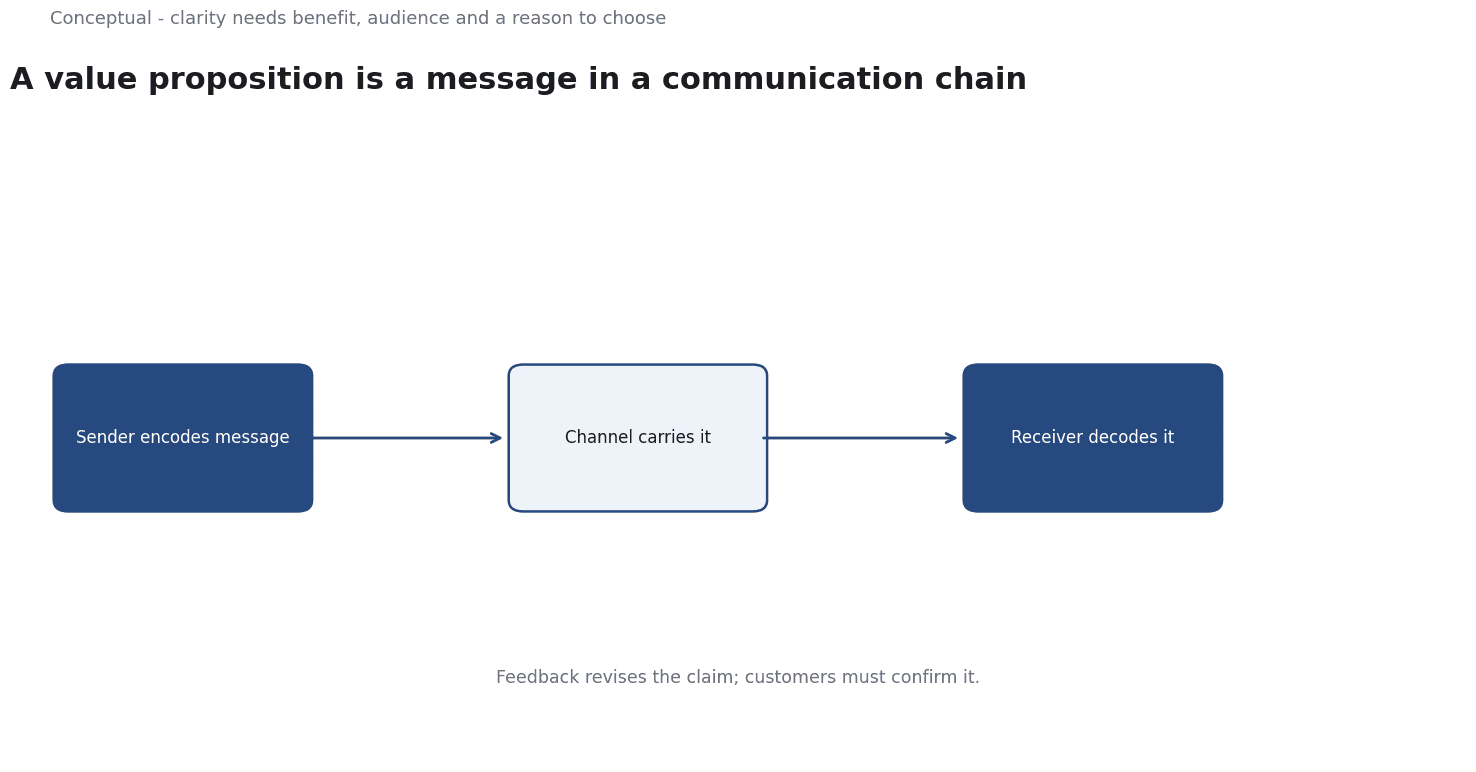
Wikipedia's "Marketing communications" entry describes the means by which organizations communicate with target audiences, including the choice of message, medium, and the feedback that returns from the audience. The mechanism is a communication chain: a sender encodes a message, a channel carries it, and a receiver decodes it. The practical consequence is that the value proposition is not a self-contained sentence; it is the message component of a larger system. A message that is clear on paper can still fail if the channel or the audience context distorts it, so writing cannot be separated from delivery.
The same entry notes that marketing communications draw on a mix of tools, and that consistency across them matters. The mechanism is repetition with variation: the same core proposition appears across channels, adapted to each. The practical consequence is that writing a value proposition is really writing a message that must survive translation into many formats. A statement that depends on a single clever phrase will not survive that translation. What survives is a plain claim about benefit, audience, and reason to choose.
A worked example
The following is hypothetical and illustrative. A small software team drafts a homepage proposition about an innovative platform that empowers teams to achieve more. Three checks are applied. First, the benefit is tested: the words name no specific outcome a customer can recognize. Second, the audience is tested: the word teams is too broad to identify whose problem is solved. Third, the comparison is tested: the statement implies superiority but gives no reason a customer would switch. The outcome is a rewrite that names a concrete outcome, a specific user, and a reason to prefer the product, followed by a message test in the channels the team uses. The limitation is that a clearer statement is still only a claim until customers confirm it.
Evidence status
| Claim | Status | Source | Verified | Recheck when |
|---|---|---|---|---|
| A value proposition states the benefit delivered and why customers choose it | source-reported | Wikipedia: Value proposition | 2026-11-18 | when the entry's definition changes |
| Marketing communications covers message, medium, and audience feedback | source-reported | Wikipedia: Marketing communications | 2026-11-18 | when the communication model is revised |
| Vague benefit and audience claims make a proposition untestable | inferred | Derived from the sources | 2026-11-18 | when customer research contradicts it |
Rows one and two report what the two entries state directly and can be checked against them. Row three is an inference: it follows from treating a proposition as a claim addressed to a specific audience, but neither source states it as a rule. Recheck conditions point back to the sources or to customer evidence, which keeps the status of each row explicit rather than implied.
What it cannot do
A well-written value proposition cannot substitute for a real difference. If the product delivers the same benefit as alternatives, a clearer sentence only makes the sameness more visible. The Wikipedia entry frames the proposition as a statement of why a customer should choose one offering; when there is no actual reason, the statement has nothing truthful to say. The limit is that writing clarifies a claim, it does not create the underlying value. A team can polish the wording indefinitely and still have nothing that distinguishes the product in a customer's mind.
There is a hidden cost in over-editing. Teams often polish wording repeatedly while avoiding the harder work of testing the claim with customers. Each round of copy changes feels productive and leaves the actual proposition unvalidated. The cost is measured in delayed learning: the team discovers late that the benefit it described was not the one customers valued. That delay is expensive because it postpones the moment when the proposition could have been corrected against real feedback.
A tagline is memorable and short; a value proposition must be specific about benefit, audience, and reason to choose. When a team writes a tagline and files it as the proposition, every downstream message inherits the vagueness. The practical symptom is marketing copy that sounds consistent but cannot answer a customer's basic question about why the product matters. Consistency is not the same as clarity, and a repeated vague message is still vague.
The boundary is that the two sources describe concepts, not a guaranteed outcome. Wikipedia defines what a value proposition and marketing communications are; it does not claim that any well-formed statement will persuade customers. Treating the format as a formula invites teams to believe that filling the slots is the work. The real work is verifying that each slot corresponds to something a customer recognizes. The sources give a vocabulary for the claim, not a guarantee that the claim is true in a particular market.
Because customer understanding changes, the proposition needs review. A statement that was accurate at launch can drift as the product and market shift. Marketing communications guidance emphasizes feedback from the audience, and that feedback is the trigger for revision. A team that treats the proposition as permanent will slowly describe a product that no longer exists; a team that reviews it against feedback keeps the claim aligned with reality. The discipline is to treat the statement as a living claim, not a finished piece of copy.
The counterargument that a concise, benefit-led proposition is fair for getting attention is incomplete for closing a sale: attention depends on message clarity, while choice depends on a demonstrated reason to prefer the product.
A decision test
- Name the specific benefit the product delivers in language a customer would use.
- Name the audience whose problem that benefit solves.
- State why a customer would choose this product over a realistic alternative.
- Remove words that cannot be tied to a concrete benefit or audience.
- Check that the statement can be written as a claim a customer could confirm or reject.
- Adapt the core message for each communication channel without changing its meaning.
- Review the proposition when customer feedback or the product changes.
These steps turn a vague goal about writing a better value proposition into checks that expose which part of the claim is weak. The mapping from writing mistake to positioning decision is what makes the review actionable rather than cosmetic. A team that runs these checks will find that the hard part is not the writing but the honesty of the answers.
For further reading, see Voice of Customer: Turning Feedback into Decisions.
References & Further Reading
- Wikipedia contributors, 2026. Value proposition - Wikipedia — The value a product promises to a buyer.
- Wikipedia contributors, 2026. Marketing communications - Wikipedia — The coordination of messages across channels and the distinction between consistent and identical communication.