What a Field Study of Generative AI at Work Actually Found
A close reading of a 5,179-agent customer-support study: the measured productivity gains, differences by experience, and limits on generalizing the result.
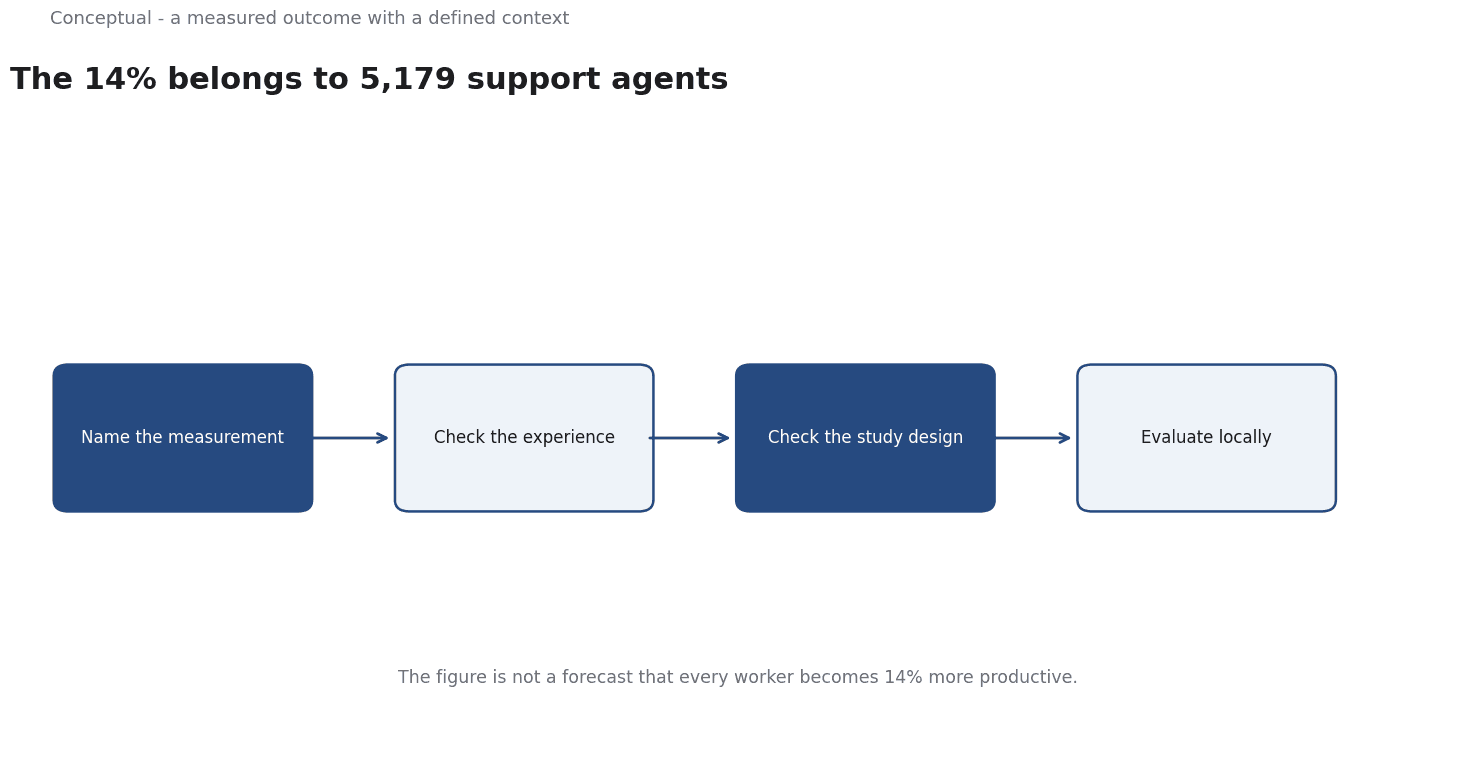
One often-cited study of generative AI at work reports a 14% average increase in customer-support productivity. That figure is useful—but only if the population, outcome, and study design stay attached to it. It is not a forecast that every employee, occupation, or company will become 14% more productive after adopting an AI assistant.
Direct answer:
In a field study of 5,179 customer-support agents, access to a generative-AI conversational assistant increased issues resolved per hour by 14% on average.
The paper reports a 34% improvement for novice and lower-skilled workers, with minimal impact for experienced and highly skilled workers. The evidence concerns one company’s customer-support setting and one tool introduction; it does not establish the effect for other jobs, workflows, or tools. The NBER paper describes the setting and measured outcomes.
What the researchers measured
Erik Brynjolfsson, Danielle Li, and Lindsey Raymond studied the staggered introduction of an AI-based conversational assistant to customer-support agents. Their primary productivity measure was the number of customer issues resolved per hour. The NBER working-paper page reports a sample of 5,179 agents and summarizes the average effect as 14%, with larger gains among novice and lower-skilled workers.
This is a measure of throughput in a specific job context. It is not equivalent to revenue per employee, profit, customer lifetime value, or a general measure of work quality. The authors also report other outcomes—including customer sentiment, employee retention, and evidence suggestive of worker learning—but those should not be silently collapsed into the headline throughput result.
The paper’s published version appeared in the Quarterly Journal of Economics in 2025. The NBER page links the publication and records a November 2023 revision of the working paper. When citing the result, use the paper’s study description rather than repeating the number without the setting or outcome.
Why the experience split matters
The average combines people with different levels of experience and skill. In the paper’s summary, the biggest measured gains occur among novice and lower-skilled workers, while experienced and highly skilled workers see minimal impact. That pattern is consistent with the authors’ suggested explanation: the assistant may help less experienced workers draw on practices reflected in stronger workers’ interactions.
The mechanism is a proposed interpretation, not a universal law of AI assistance. A tool may be most useful when it supplies knowledge or guidance that a worker has not yet accumulated. In a workflow where experts already have that knowledge, the same assistant may add less. Whether that explanation transfers depends on the task, tool, training data, interface, and how workers use its suggestions.
For managers, this argues against evaluating an AI rollout using only an organization-wide average. Examine results by tenure or relevant experience, but preserve the study’s caution: subgroup patterns from one setting do not guarantee the same pattern in another.
What this study cannot establish by itself
The paper does not prove that generative AI raises productivity by 14% in every industry. The agents worked in customer support, and the intervention was a particular conversational assistant introduced in a particular operational environment. A different occupation may have different tasks, error costs, customer interactions, or opportunities for automation.
Nor is “issues resolved per hour” a complete measure of value. A deployment decision should also examine resolution quality, repeat contacts, escalation rates, customer outcomes, employee experience, and the full cost of implementation and oversight. Those are evaluation recommendations, not additional outcomes that this paper necessarily measured.
The authors report increased customer sentiment and retention, and suggestive evidence of worker learning.
A practical evaluation plan for another workplace
Use the study as a reason to test a local workflow, not as a plug-in forecast. Before deployment, define:
- The task and eligible population: which work is assisted, and who receives access?
- A primary outcome: for example, issues resolved per staffed hour, with a clear rule for what counts as resolved.
- Quality guardrails: reopens, escalations, corrections, customer satisfaction, or other task-appropriate measures.
- A comparison strategy: compare like periods or groups and account for workload, staffing, seasonality, and changes to the process. Where feasible, use a randomized or staged rollout designed to support causal interpretation.
- Subgroups chosen in advance: such as tenure or task type, so the analysis does not cherry-pick whichever group looks best afterward.
- Costs and failure handling: include tool cost, review time, training, privacy controls, and the consequences of incorrect recommendations.
Report the result as an observed change in the chosen metric under the measured conditions. If the experiment is not randomized, be clear about other changes that could explain the result. A local study may find a smaller effect, a larger effect, no effect, or a quality trade-off; each is useful evidence for that organization.
The useful conclusion
The most defensible takeaway is not “AI makes workers 14% more productive.” It is that one field study found a measurable average increase in issues resolved per hour after a specific support assistant was introduced, with substantial variation by worker experience. That is evidence that AI assistance can change performance in at least one real workflow—and evidence that an organization should measure its own outcomes rather than import the headline as a business case.
For a related discussion of how AI systems depend on training data, compute, and model scale, see Chinchilla and the Scaling Laws.
A counterargument
A reasonable critic would say the caution tips into dismissal: by stressing that the result is one company, one tool, and one throughput metric, the article leaves little reason to think AI assistance matters anywhere, even though it later calls the finding evidence that assistance can change performance in a real workflow. That tension is unresolved. The piece also relies entirely on the authors' own NBER and QJE summaries for both the numbers and the proposed learning mechanism, so it relays the study's interpretation rather than independently testing whether the 14% is causal or whether the experience split is robust.
A critic would argue that external validity should be weighed with evidence, not only flagged as a limitation.
References & Further Reading
- Erik Brynjolfsson, Danielle Li, and Lindsey R. Raymond, “Generative AI at Work,” NBER Working Paper 31161, April 2023, revised November 2023. The NBER record supports the study setting, sample, measured productivity outcome, reported average and subgroup effects, other reported outcomes, and publication history.
- Erik Brynjolfsson, Danielle Li, and Lindsey R. Raymond, “Generative AI at Work,” The Quarterly Journal of Economics 140(2), 889–942, 2025. Published version of the study; consult it for the full methods, analysis, and limitations.