What E-commerce’s Share of Retail Sales Measures—and What It Leaves Out
Read the U.S. Census Bureau’s e-commerce share carefully: its definition, seasonal adjustment, survey limits, and why it is not a measure of online shoppers or transactions.
“E-commerce is 17.1% of retail” sounds like a simple statement about how people shop. It is more specific than that: it is an estimate of sales meeting a government definition, divided by estimated total U.S. retail sales for a particular quarter. The denominator, seasonal adjustment, coverage rules, and survey uncertainty all affect what the percentage can tell you.
Direct answer: In its August 18, 2026 release, the U.S. Census Bureau estimated that e-commerce represented 17.1% of U.S. retail sales in the second quarter of 2026 on a seasonally adjusted basis. That estimate excludes price changes, covers employer retail businesses, and is preliminary. It is not the share of shoppers who bought online, the share of orders placed online, or a global e-commerce rate. The Census release states the definition and survey boundaries directly.
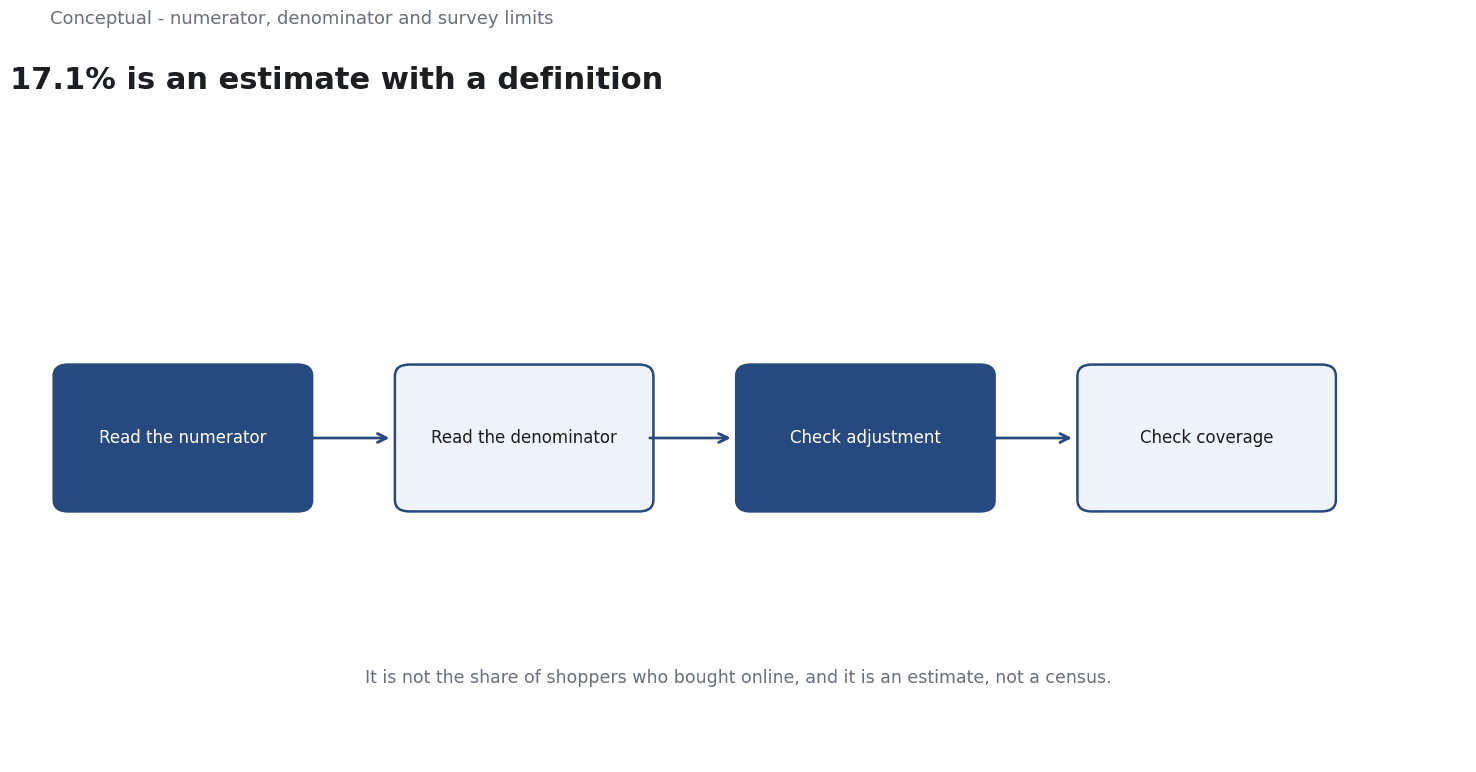
Start with the numerator’s definition
The Census Bureau counts a sale as e-commerce when a buyer places an order—or negotiates the price and terms—through an online system. The definition includes internet and mobile orders, EDI networks, email, and comparable systems. Payment does not have to happen online.
That means the statistic is about the ordering channel, not the payment method. A customer who orders by phone after browsing a website is not automatically part of the e-commerce numerator; a business-to-business EDI order may qualify even if it does not resemble a consumer checkout page. The measure also includes sales of goods and services within the bureau’s retail scope, not every digital service or online transaction in the economy.
The practical implication: do not relabel this measure “online payments” or “consumers shopping online.” Those are different quantities and need different data.
Know what the denominator includes
The quarterly report estimates e-commerce sales as a share of total U.S. retail sales. In Q2 2026, the seasonally adjusted estimates were $340.244 billion in e-commerce sales and $1,986.488 billion in total retail sales, producing the published 17.1% share. The same release reports an unadjusted share of 16.4%.
The two percentages are not contradictory. The adjusted series accounts for seasonal variation and trading-day and holiday differences; it is useful for comparing underlying movement between quarters. The unadjusted series reflects the sales recorded for that quarter without those adjustments. Retail sales are also not adjusted for price changes, so a rise in dollar sales does not by itself establish that the number of items sold rose by the same rate.
When using a share, keep numerator and denominator aligned: same period, same adjustment basis, same population, and same release vintage.
Treat the estimate as a survey estimate
The Census Bureau says the estimates use the Monthly Retail Trade Survey (MRTS) and administrative records. It selects approximately 10,800 retail firms, then weights and benchmarks the sample to represent more than two million employer retail firms. The sample is updated to reflect business births, deaths, and other changes.
This is an estimate, not a census of every transaction.
The report gives estimated measures of sampling variability and explains that other errors—such as nonresponse, coverage, recording, and processing errors—can also affect the result. For Q2 2026, the seasonally adjusted e-commerce share is reported as 17.1%; Table 2 lists a 0.3 percentage-point standard error for the share. The latest-quarter estimate is preliminary and may be revised.
These caveats matter when describing small changes. The release reports the share at 17.0% in Q1 2026 and 17.1% in Q2. The published rounded values show a modest increase; they do not justify a sweeping claim about a structural shift in shopping behavior. For year-over-year change, the report estimates adjusted e-commerce sales increased 12.2% while total sales increased 6.7%. Those are dollar sales growth rates, not inflation-adjusted volume growth rates.
Watch the coverage break in April 2025
The report’s footnote says that, before the annual benchmark report released in April 2025, the quarterly e-commerce estimates included nonemployer businesses. The current series excludes them and was revised to align with the Annual Integrated Economic Survey.
That is a comparability warning for anyone assembling a long time series. The Census Bureau says nonemployers were removed from the series, but a reader should still check the current series notes before making a trend chart that crosses the revision. A methodological change can alter the population represented even when the chart labels look consistent.
There are also explicit exclusions. The report says online travel services, financial brokers and dealers, and ticket sales agencies are not classified as retail for these estimates. The result is a measure of retail e-commerce under the Census Bureau’s definitions—not “all commerce conducted online.”
A quick checklist before citing the number
Before putting an e-commerce share in a presentation or article, record:
- Geography and period: U.S. retail, Q2 2026—not global commerce or an annual figure.
- Adjustment: seasonally adjusted (17.1%) or not adjusted (16.4%). Do not mix the two.
- Unit: dollar sales, not orders, customers, units, or inflation-adjusted volume.
- Definition: orders placed or terms negotiated through qualifying electronic systems; payment may occur elsewhere.
- Coverage: employer retail firms, with named categories excluded.
- Vintage and uncertainty: preliminary or revised status, sampling variability, and the April 2025 coverage change.
If the question is “How many people shop online?” this release is not the right numerator. If the question is “What share of U.S. retail sales does the Census Bureau classify as e-commerce in this quarter?” it is directly relevant—provided the definition and adjustment basis stay attached to the figure.
A different measurement of the same commercial shift — detected e-commerce sites rather than sales — is covered in What the Web Almanac’s E-commerce Adoption Number Measures.
A worked example
The following is hypothetical and illustrative. Consider an analyst drafting a slide who wants to write that "one in five shoppers buys online," citing the Census e-commerce share. Three checks revise that sentence. The first is the unit: the release measures dollar sales placed through qualifying ordering channels as a share of total U.S. retail sales, not shoppers, orders, or payment method, so "shoppers" names a different quantity. The second is alignment: the share is 17.1% seasonally adjusted and 16.4% unadjusted for Q2 2026 - keeping numerator and denominator on the same adjustment basis and release vintage avoids inventing a figure the report did not publish. The third is uncertainty and coverage: with a 0.3 percentage-point standard error and a preliminary estimate, the 17.0% to 17.1% move is within noise, and a long trend crosses the April 2025 nonemployer change. The outcome is bounded: the slide instead says that 17.1% of U.S. retail sales in Q2 2026 were classified as e-commerce on a seasonally adjusted basis, with no structural-shift claim.
A counterargument
A reasonable critic would argue that the article's definitional rigor comes at the cost of usefulness: by insisting the figure is only 'the share of U.S. retail sales the Census Bureau classifies as e-commerce,' it offers readers almost no usable signal about the shift to online buying, which is the question most people actually bring to the number.
The release reports a 0.3-point standard error and a preliminary estimate, so the 17.0% to 17.1% move is within noise, yet the piece's caveats can read as a reason to distrust the series rather than to use it carefully. The cited sources document exclusions (travel, brokers, tickets, nonemployers) but not their directional effect, so the article never says what the share systematically leaves out.
References & Further Reading
- U.S. Census Bureau, Quarterly Retail E-Commerce Sales: Second Quarter 2026, August 18, 2026. Primary source for the definition, Q2 sales and shares, survey design, sampling variability, preliminary status, seasonal adjustment, coverage exclusions, and April 2025 nonemployer change.
- U.S. Census Bureau, Monthly Retail Trade Survey: How the Survey Is Collected. Additional methodological context for the retail survey and estimates.