Zero-click Content Metrics that Matter
An answer can be useful without a click. Read what to measure, a worked example, and why a visit is not the only value.
Zero-click content is often treated as a threat to traffic, which misses that being the source of an answer has value of its own. The question-answering entry describes systems that answer directly, and web analytics covers measurable behaviour. The question is what value a no-click impression produced.
Direct answer: Measure zero-click outcomes by attribution opportunities — mentions, citations, and brand searches — alongside visits, and state which one the content was meant to produce. The sources describe the channel; the metric rule is a synthesis.
Delta: This article adds a claim-status table and a worked example, separating documented measurement from the local choice of objective.
The mechanism
Three points matter:
- Answers replace visits. The question-answering entry describes systems that respond directly. A reader may get the answer without visiting a site.
- Attribution is still observable. The analytics entry describes collection and interpretation. Mentions and branded searches can be tracked even when clicks are absent.
- The objective decides. A piece written to be cited has different success criteria from one written to convert. Naming the objective is the first measurement decision.
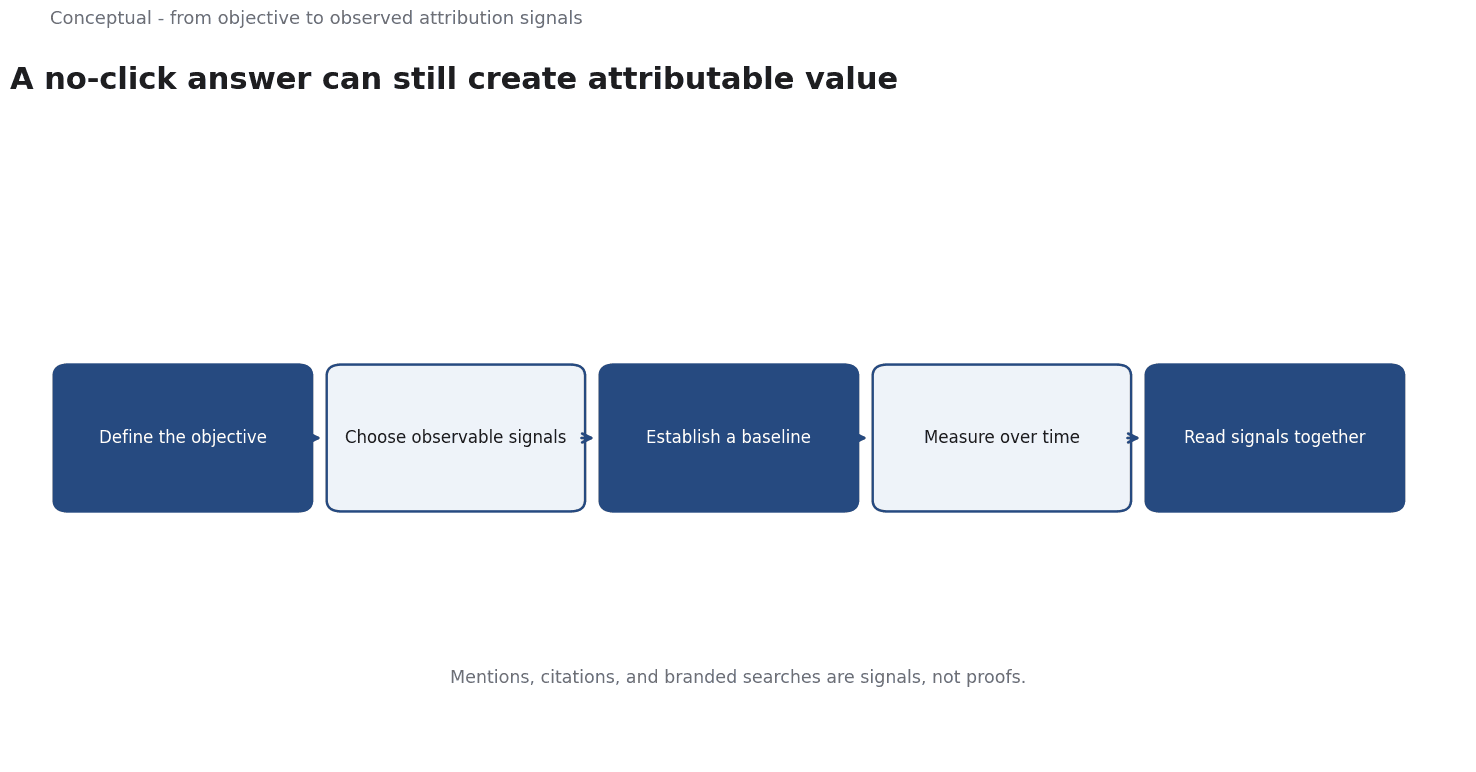
The sequence is: define the objective, choose observable signals, measure over time, then compare. The choice is local judgement, so it is inferred; the channel is source-reported.
A worked example
Illustrative. A reference page is frequently quoted by answer systems but receives few visits.
Three checks decide. First, was the page written to be a source, or to drive visits? Second, are there observable signals — mentions, branded searches, or citations — that show the answer was attributed? Third, did those signals change after publication, against a baseline?
The outcome is a qualified assessment rather than a traffic verdict. The scenario is hypothetical; the method is the contribution.
Why attribution is hard to observe
A mention in an answer rarely carries a link back to the source, which makes the effect difficult to measure directly. Branded searches and direct visits are indirect signals, and they can be caused by something else. Naming them as signals rather than proofs is what keeps the measurement honest.
The most useful approach is to watch several signals over time and look for changes that coincide with publication. A single signal can move for unrelated reasons; a pattern across several is harder to explain away. None of this provides the precision of a click, which is why the objective has to be stated first.
Evidence status
| Claim | Status | Source | Verified | Recheck when |
|---|---|---|---|---|
| Systems can answer questions directly | source-reported | Wikipedia, Question answering | 2026-11-18 | Technology changes |
| Behaviour can be measured and interpreted | source-reported | Wikipedia, Web analytics | 2026-11-18 | Platform changes |
| Choose signals from the content's objective | inferred | Derived from measurement practice | 2026-11-18 | Objective changes |
Why visits are not the only value
A page that is repeatedly cited builds recognition even without clicks.
Measuring only visits undervalues that effect and encourages content choices that chase traffic rather than authority.
Reading several signals together gives a fuller picture.
A zero-click strategy also has a trade-off with depth. Content delivered as a short answer may be useful and may build recognition, but it does not always give a reader the context needed to make a decision.
The measurement should therefore reflect the organisation's goal. A reference source will value citations; a consultancy may value the conversations that follow an answer. Choosing the signals before publishing prevents a team from declaring success on the metric that happens to be easiest to see.
A further consideration is that answer systems change how they attribute sources. A format that is cited today may not be cited after a product update, which makes any single period a weak basis for a long-term strategy. Recording the conditions under which a signal was observed helps a team notice when the relationship has changed.
The same applies to the content itself. An answer that is useful once may be superseded by a better one, and a page that was a source can lose that position. Treating recognition as something that must be maintained, rather than achieved once, is the practical implication for measurement.
The absence of a click is not the absence of an effect, but it does require a more careful measurement.
What it cannot do
It cannot prove that an answer system caused a branded search. It does not guarantee that attribution will lead to visits. And it cannot replace a clear content objective.
The counterargument that no click means no value is fair for direct conversion and incomplete for authority effects.
A decision test
- Define the content's objective.
- Choose observable signals.
- Establish a baseline.
- Measure over time.
- Read signals together.
- Record the decision and recheck date.
For the measurement context, see What AI Search Measures.
References & Further Reading
- Wikipedia contributors, 2026. Question answering - Wikipedia — Systems that answer questions directly.
- Wikipedia contributors, 2026. Web analytics - Wikipedia — Collection and interpretation of website behaviour data.