Accrual Analysis Mistakes to Avoid
Accruals move timing, not just amounts. Read the mistakes, a worked example, and why a clean profit can hide weak cash.
Accrual analysis is often treated as a mechanical adjustment, which hides the judgements it contains. The Wikipedia entry describes accruals as accounting for earned or incurred items before cash moves, and the income-statement entry structures the figures. The mistakes are about timing and estimates.
Direct answer: Read accruals with the cash conversion behind them, check the estimates, and compare across periods with consistent definitions. The sources define the accounting; the checks are a synthesis.
Delta: This article adds a claim-status table and a worked reconciliation, separating documented accounting concepts from the local judgement about whether an estimate is reasonable.
The mechanism
Three points matter:
- Timing is the substance. The accrual entry describes recognising items before cash moves. That makes the period boundary the place where judgement enters.
- Estimates vary. An accrual for an unbilled service depends on an estimate. A small change in the estimate can change reported profit.
- Cash is the check. The income-statement entry structures reported figures, but cash flow shows when money actually moved. The gap between them is informative.
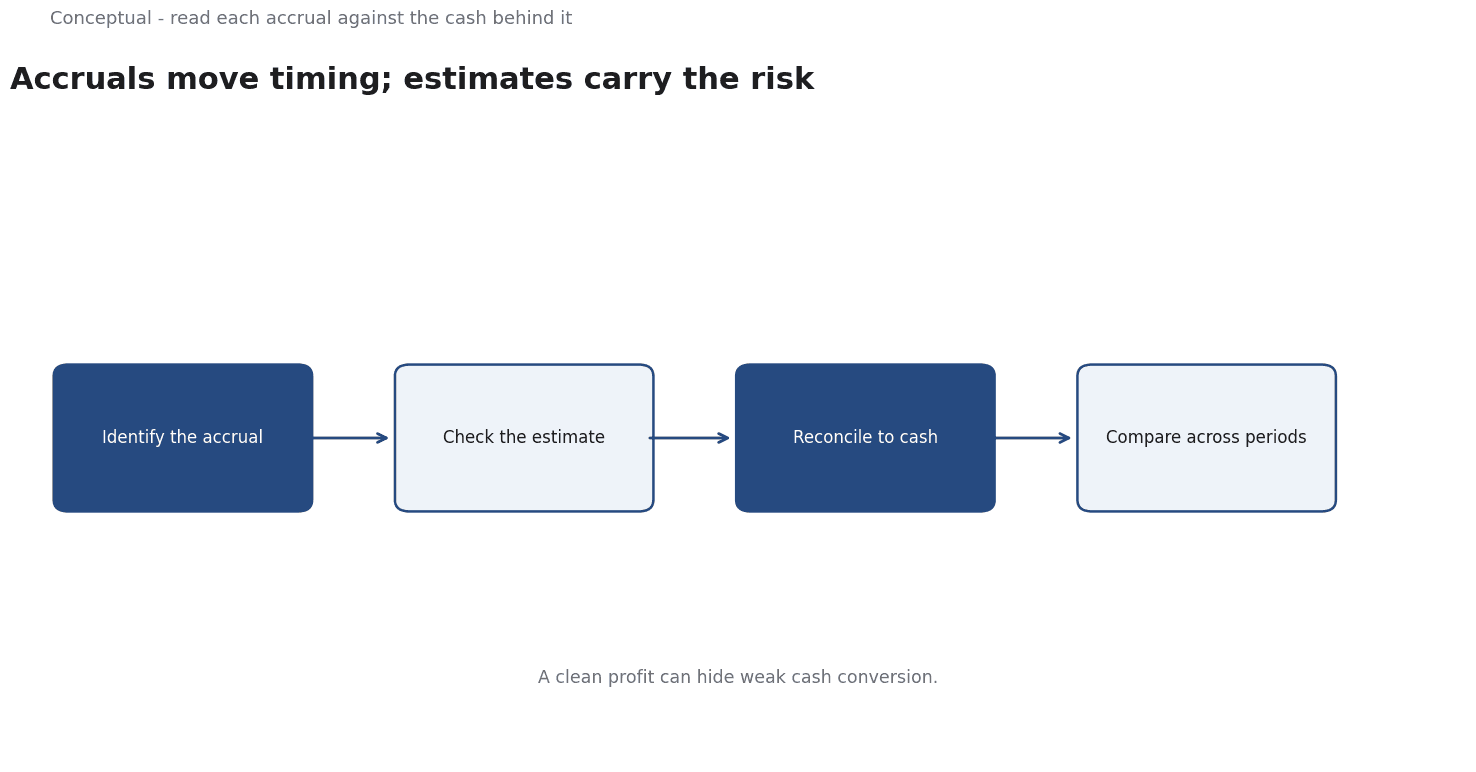
The sequence is: identify the accrual, check the estimate, reconcile to cash, then compare across periods.
Checking the estimate is judgement, so it is inferred; the accounting concepts are source-reported.
A worked example
Illustrative. A company reports higher profit while operating cash flow falls.
Three checks decide. First, did receivables grow because revenue was recognised before cash arrived? Second, were any accruals based on estimates that changed from the prior period? Third, does the pattern repeat across quarters, which would suggest a structural issue rather than timing?
The outcome is a qualified reading of the profit figure. The numbers are hypothetical; the reconciliation is the contribution.
Why the estimate deserves attention
An accrual is a number produced before the underlying transaction is complete. That means it depends on an estimate, and the estimate depends on assumptions that can change. A careful reader asks what would have to be true for the accrual to be reasonable, and whether that condition still holds in the next period.
The period boundary is the other place where errors enter. A cost incurred at the end of one period and recorded in the next changes both periods' figures without changing the underlying business. Comparing results across periods with inconsistent cutoffs produces a trend that exists only in the accounting.
Why the notes matter
The statement shows the number; the notes show the method. A change in estimate may be disclosed there, and it is often more informative than the headline figure. Reading the notes is not a separate task from analysis; it is where the assumptions become visible.
Evidence status
| Claim | Status | Source | Verified | Recheck when |
|---|---|---|---|---|
| Accruals recognise items before cash moves | source-reported | Wikipedia, Accrual | 2026-11-18 | Standards change |
| Income statements structure reported figures | source-reported | Wikipedia, Income statement | 2026-11-18 | Standards change |
| Reconcile accruals to cash and estimates | inferred | Derived from the concepts | 2026-11-18 | Policy changes |
Why a clean figure can mislead
A profit figure that ignores the timing of cash can look stable while the business depends on collecting receivables that never arrive. Reading accruals beside cash flow is the simplest correction, because it shows whether the reported performance has converted.
A final point concerns consistency.
Stating the policy and checking that it has not changed is a small step that protects the analysis from a common source of error.
The same caution applies across companies. Two firms can make reasonable estimates that differ because their customers or contracts differ, and a ratio built from their figures will reflect those differences. Comparing the methods before comparing the numbers is the only reliable order of operations.
The final discipline is to record what would change the assessment. A conclusion tied to a specific estimate should state that estimate and the condition under which it would be revised, so the next period starts from evidence rather than memory.
A recorded estimate with a date is more useful than a precise-looking figure with no history, because it lets the next reader see what has changed.
The notes should be read together with the statement, not after it as a separate step, because the assumptions explain the number that appears there.
What it cannot do
It cannot prove that an estimate is wrong. It does not replace an understanding of the business. And it cannot remove the need to read the notes, where the assumptions live.
The counterargument that a standardised figure is comparable is fair across consistent policies and incomplete when estimates differ.
A decision test
- Identify the material accruals.
- Check the estimates behind them.
- Reconcile to operating cash flow.
- Compare across periods.
- Use dated figures.
- Record the assessment and its limits.
For the quality question, see Earnings Quality.
References & Further Reading
- Wikipedia contributors, 2026. Accrual - Wikipedia — The timing difference between accounting recognition and cash movement.
- Wikipedia contributors, 2026. Income statement - Wikipedia — The structure of revenue, expenses and profit, and the difference between revenue and cash.