Activation Emails Costs Explained
Activation emails have costs beyond sending. Read where they come from, a worked example, and why more messages can mean less activation.
Activation emails are often treated as a cheap way to guide new users, which ignores the cost of attention and the risk of sending the wrong message. The Wikipedia entry describes email marketing, and A/B testing covers controlled comparison. The accounting should include both effects.
Direct answer: Send activation messages when they change a specific behaviour, measure against a comparison, and count the cost of attention. The sources describe the channel and method; the rule is a synthesis.
Delta: This article adds a claim-status table and a worked example, separating documented channel facts from local choices about triggers.
The mechanism
The first cost is attention. The email-marketing entry describes campaigns, which compete with everything else in a recipient's inbox.
A message that arrives at the wrong time is not free; it uses attention that could have gone to something useful, and it can train the recipient to ignore future messages.
The second cost is relevance. A trigger based only on elapsed time will send the same message to users with different needs. The behavioural signal — what the user actually did — is a better basis, and it requires instrumentation that has to be built and maintained.
The third cost is measurement. A/B testing provides the logic of comparison, but an activation sequence has several messages, and each can affect the next. Measuring only the final click misses the interactions between them, which is why the sequence should be evaluated as a whole.
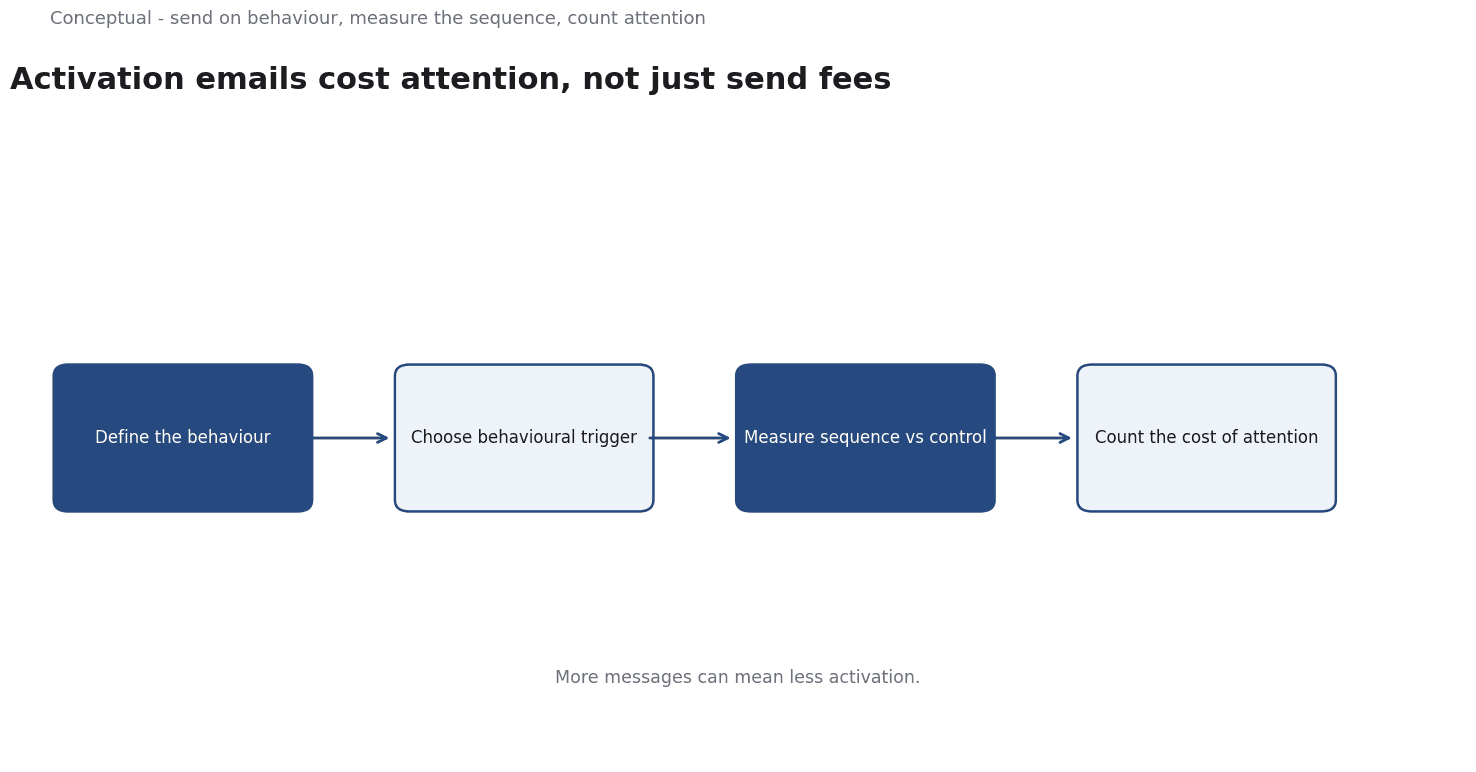
The sequence is: define the behaviour, choose a behavioural trigger, measure the sequence against a comparison, then count the cost of attention. The choices are local, so the conclusions are inferred; the channel is source-reported.
A worked example
Illustrative. A product sends three emails in the first week after signup.
Three checks decide. First, is each message tied to a behaviour the user has or has not performed? Second, does the sequence improve activation against a group that received no messages? Third, how many recipients unsubscribed, and what does that cost relative to the activation gained?
The outcome is a decision about the sequence, not just open rates. The scenario is hypothetical; the method is the contribution.
Evidence status
| Claim | Status | Source | Verified | Recheck when |
|---|---|---|---|---|
| Email campaigns are a measurable channel | source-reported | Wikipedia, Email marketing | 2026-11-18 | Platform changes |
| Controlled comparison supports effect claims | source-reported | Wikipedia, A/B testing | 2026-11-18 | Method changes |
| Measure the sequence and count attention | inferred | Derived from the channel | 2026-11-18 | Sequence changes |
Why more messages can reduce activation
Each additional message adds cost without a corresponding benefit, and the sequence becomes noise.
A further cost is the maintenance of the triggers themselves. A behavioural signal depends on an event being recorded correctly, and a change to the product can break that event silently. The sequence then sends messages based on stale or missing signals, which is worse than sending none. Checking the events on a schedule is part of the work.
The comparison also has a limit. A group that receives no messages provides a counterfactual, but the two groups may differ in ways that affect activation, which is why assignment should be random and the result read over a sufficient window. A short test can show a difference that disappears later.
Messages also interact with one another. A user who receives a tip before understanding the product may ignore a later message that would have helped, and the sequence can be worse than a single well-timed email. Testing the whole sequence is the correction, not testing each message in isolation.
A message that arrives after a user has solved the problem is a cost with no corresponding benefit.
The trigger should be checked when the product changes, since a behaviour that mattered last month may no longer predict activation.
What it cannot do
It cannot create motivation that is not there. It does not replace a product that delivers value. And it cannot guarantee that a comparison is perfect.
The counterargument that more emails mean more chances to activate is fair for reach and incomplete for attention.
A decision test
- Define the activation behaviour.
- Choose behavioural triggers.
- Measure the sequence against a comparison.
- Count unsubscribes and attention.
- Remove messages without an effect.
- Record the decision and recheck date.
For the sequence context, see Lifecycle Messaging.
References & Further Reading
- Wikipedia contributors, 2026. Email marketing - Wikipedia — The mechanisms and measurement of email campaigns.
- Wikipedia contributors, 2026. A/B testing - Wikipedia — Controlled comparison of two variants.