Earnings Quality: Accruals, Estimates, and Red Flags
Reported profit is a number built from judgements. Read how to assess its quality, a worked example, and what the cash flow reveals.
Two companies can report the same earnings and have very different economic performance. One collected cash from customers; the other recorded revenue that has not been paid. Earnings quality is the question of how much reported profit reflects the underlying business rather than accounting timing and estimates.
Direct answer:
Assess earnings quality by comparing profit with operating cash flow, examining accruals, and reading the estimates behind revenue recognition, provisions, and asset values.
The financial-statement article provides the structure, and the revenue-recognition article explains why timing is a judgement. The boundary: a low-quality number is not necessarily fraudulent — accounting standards permit estimates — and a high-quality number is not a guarantee of future performance, as the valuation article treats any forecast as conditional.
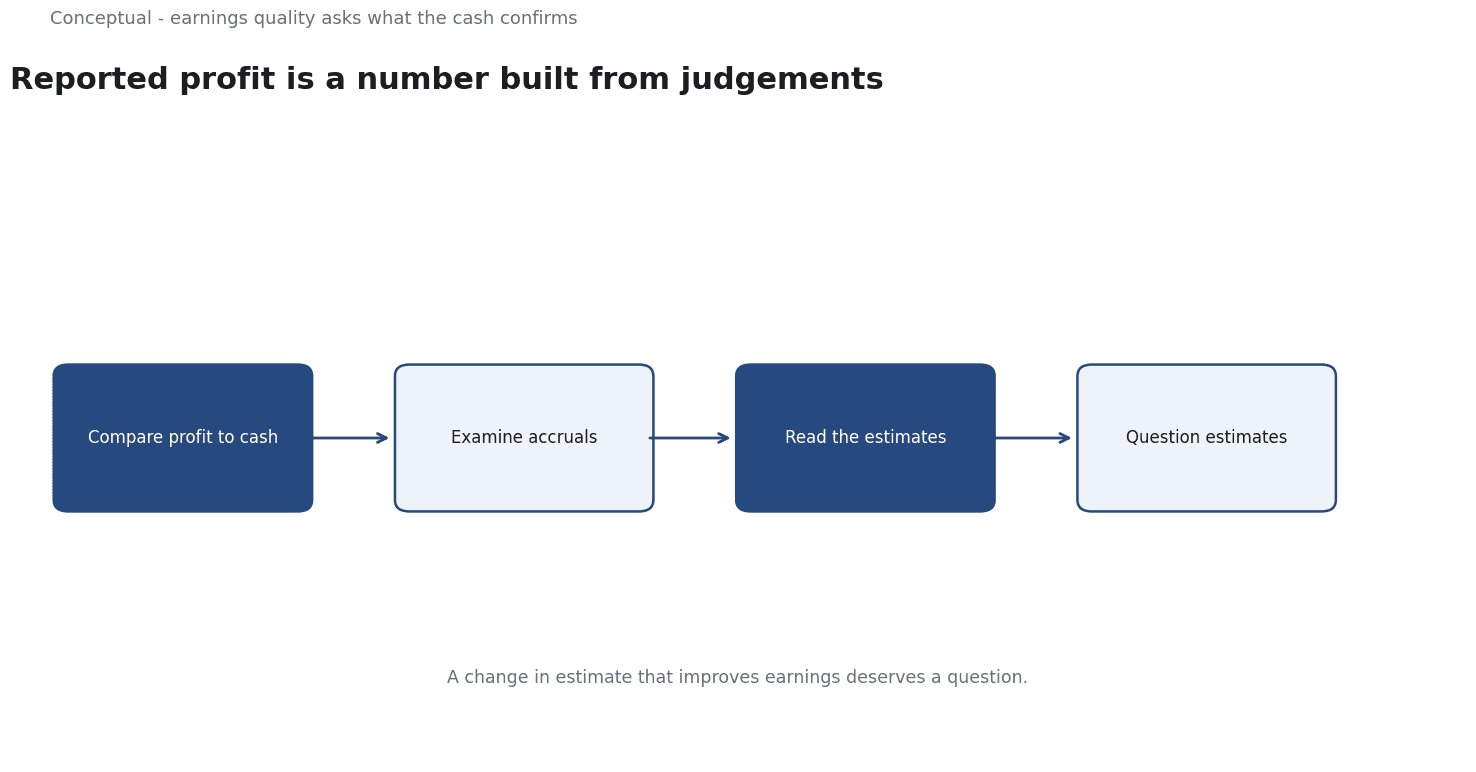
Where quality is lost
Accruals. Revenue recognised before cash arrives and expenses recorded before cash leaves create a gap between profit and cash, as Free Cash Flow Explained With an Example explains. A persistent gap is a signal to investigate, which the working-capital article treats as a cash-conversion problem.
Estimates. Bad-debt provisions, depreciation lives, and revenue recognition for long contracts require judgement, which the revenue-recognition article treats as a disclosure question.
One-off adjustments. "Adjusted" figures that exclude recurring costs can turn a poor result into a good one, as the EBITDA article explains for what a metric leaves out. The pattern of adjustments matters more than any single one.
A worked example
The following is hypothetical and illustrative. A company reports net income of 50 million, up from 30 million, and headlines a 67% growth rate.
Three checks decide whether the growth is real. First, operating cash flow is 10 million, down from 25 million. The gap suggests receivables or inventory absorbed the profit, which the cash-flow article explains for the reconciliation. Second, revenue recognition changed: the company now recognises a milestone upfront rather than over the contract, which the revenue-recognition article treats as a judgement requiring disclosure. Third, adjusted earnings exclude 12 million of restructuring costs that appeared in each of the last three years, which the EBITDA article treats as a recurring item mislabelled as one-off.
Three conclusions follow. The headline growth is low quality, which the cash flow revealed. The estimate change should be compared with the prior policy, as the financial-statement article advises for comparability. And the decision should be recorded with the evidence, as the decision-memo article requires.
Reading the notes, not just the ratio
The comparison of profit with cash is a diagnostic, not a conclusion. A gap can arise from legitimate growth — more sales on credit because demand is rising — which the working-capital article treats as a cash-conversion-cycle question. It can also arise from aggressive recognition or provisions thatchanged, which the revenue-recognition article treats as a disclosure issue. The notes are where the difference is explained, and an unexplained gap is more concerning than a large but documented one, as the financial-statement article advises.
The pattern across periods matters more than any single year. A company whose accruals are consistently positive while cash lags is building a receivable balance that will eventually need to convert or be written off, which the bad-debt discussion in the financial-statement article covers. A company with one unusual quarter and a long history of clean conversion is a different case, as the monitoring article treats trend as the signal. A single ratio cannot distinguish them.
For an investor, the practical output is a set of questions rather than a verdict. What changed in the estimate, who approved it, and does the cash flow support the story, as the decision-memo article requires for a recorded judgement? An answer built from those questions is more defensible than a score computed from one ratio, which the evaluation-rubric article argues for explicit criteria.
What earnings quality cannot do
It cannot prove fraud, which requires evidence and investigation, as the risk-assessment article treats allegations as claims needing proof. It cannot tell you the future, which investor education states explicitly for any financial measure. And it does not replace an understanding of the business: a company with low accruals and poor demand is still a poor investment, which the company-analysis article treats as the prior question.
The counterargument that cash flow is always better misses the point.
Cash timing can be managed around a period end, as Free Cash Flow Explained With an Example explains for working capital, and a single quarter of strong cash is not evidence of quality, as the monitoring article treats trend as the signal.
A decision test
- Compare net income with operating cash flow over several periods, as Free Cash Flow Explained With an Example recommends.
- Read the revenue-recognition note and any changes, as Revenue Recognition: What Investors Watch in the Notes requires.
- List every adjustment and check whether it recurs, as the EBITDA article advises.
- Examine provisions and depreciation lives for changes, as the financial-statement article suggests.
- Compare with peers using consistent definitions, as the comparables article requires.
- Label conclusions as evidence, not allegations, as the risk-assessment article advises.
- Record the assessment, as the decision-memo article requires.
For the reconciliation, see Free Cash Flow Explained; for the accounting basis, see Revenue Recognition.
References & Further Reading
- Wikipedia contributors, 2026. Financial statement - Wikipedia — An overview of the four financial statements and the purpose of each; a secondary reference used here with primary documents where available.
- U.S. Securities and Exchange Commission (Investor.gov), 2026. Introduction to Investing — Primary regulator guidance on market mechanics and investor protection.