Affiliate Program Design: Terms, Tracking, and Trust
Affiliates are paid for outcomes, which makes the rules and the tracking the product. Read the design, a worked programme, and the fraud controls.
An affiliate programme outsources acquisition to partners paid on a result. That alignment is attractive and creates a specific problem: the result must be defined and measured precisely, or the programme pays for the wrong behaviour. The terms and the tracking are not administration — they are the mechanism.
Direct answer: The affiliate-marketing overview provides the channel context, and the attribution guidance explains why a credit rule is not a causal measurement. The boundary: affiliate credit is assigned by a rule, not proof of incrementality, and abuse is a design problem, as the referral-fraud article argues for similar programmes.
Design an affiliate programme around a verified conversion, clear terms about what earns a commission, reliable tracking with a defined attribution window, and fraud controls.
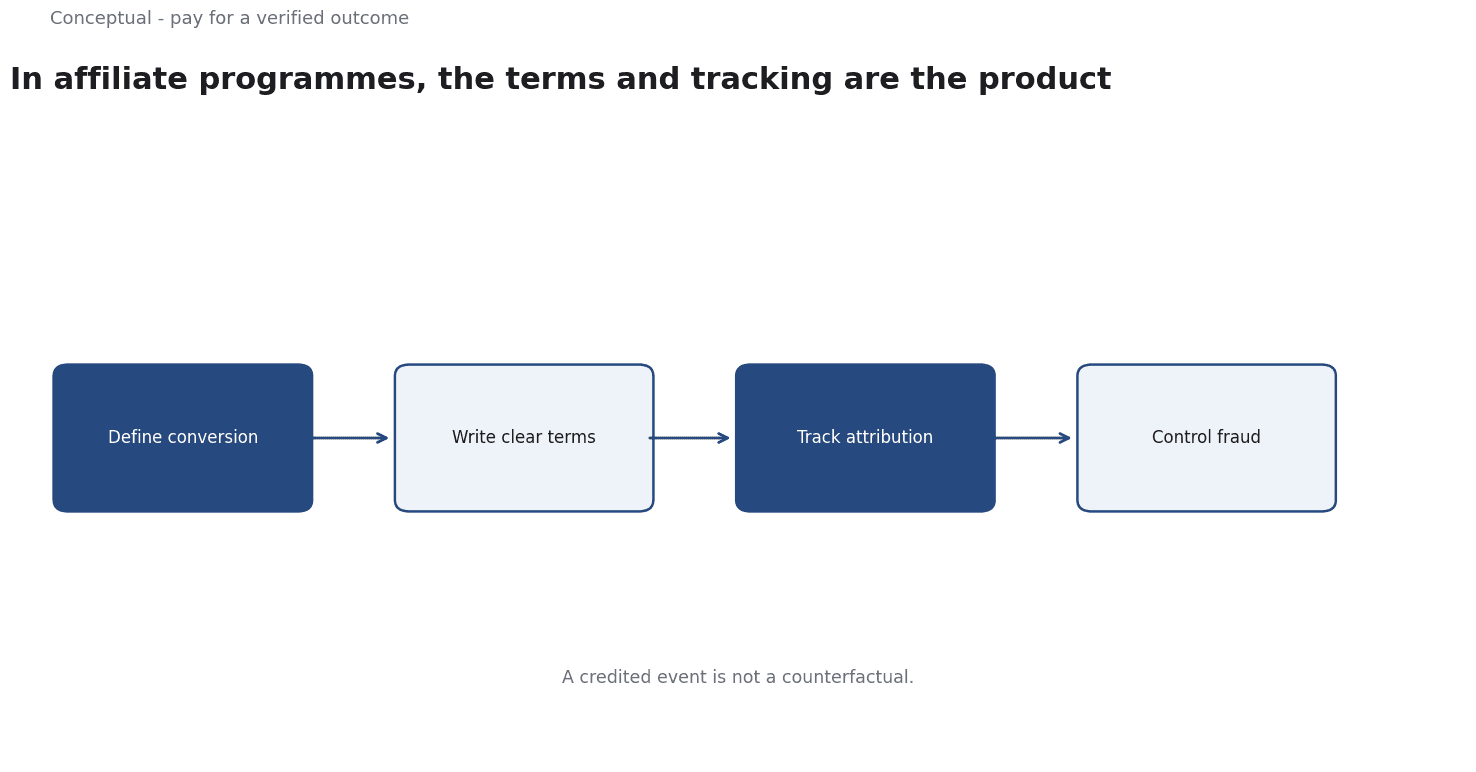
Three design decisions
What earns a commission? A click is cheap to fake; a completed purchase with a return window passed is harder. The trigger should match the value the business keeps, as the unit-economics article explains for contribution margin.
What is the attribution window? A buyer who clicks today and purchases in three weeks may or may not be credited, depending on the rule. The window should be stated, as Marketing Attribution: Multi-Touch Models, Incrementality, and Budget Allocation explains for credit rules, and kept consistent.
What are the terms? What partners may say, what channels they may use, and what happens on a refund should be explicit, as the influencer-contract article treats disclosure and terms as a trust question.
A worked programme
The following is hypothetical and illustrative.
A company pays 10% commission on a 100 product when a referred customer completes a purchase and keeps it 30 days. Design checks:
- Trigger — commission after the return window, which reduces payouts on returned orders, as the returns article explains for reverse flows.
- Window — a 30-day cookie with a stated rule for repeat clicks, which the attribution article treats as a credit convention.
- Terms — no bidding on the brand's own name, no coupon sites without permission, and a disclosure requirement, as the influencer-measurement article covers disclosure.
Measured over a quarter:
- 2,000 commissions earned.
- 80 blocked for self-referral or duplicate-payment signals, which the referral-fraud article treats as a boundary control.
- A holdout of similar traffic showed that 25% of credited purchases would have occurred anyway, as the geo-experiment guidance recommends for comparison.
Three conclusions follow:
- The naive view would credit 2,000 sales; the incrementality estimate is closer to 1,500.
- Fraud controls belong at the trigger, which the risk-assessment article requires.
- Commission must fit margin, as the unit-economics article explains, or the programme buys losses.
Communicating with partners
A programme's terms are only as good as partners' understanding of them. Three practices reduce disputes:
A one-page summary. State the trigger, the window, the rate, and the prohibited channels in language a partner can scan, which the marketing-automation article recommends for clear rules.
A visible dashboard. Partners should be able to see credited conversions and the status of a payout, as the observability article argues for signals where decisions happen.
A dated changelog. When terms change, record what changed and when, which the keep-a-changelog convention supports for any maintained interface.
These practices protect the trust the channel depends on, which the reputation article treats as a public asset.
The relationship with partners is the channel's real asset. A programme that pays promptly, tracks transparently, and enforces its rules consistently attracts partners who bring qualified customers rather than cheap traffic. One that disputes commissions or changes terms without notice loses those partners to competitors, and the visible complaints damage trust with the wider audience, which is a cost that never appears in the commission ledger.
What affiliate programmes cannot do
They cannot prove incrementality.
They cannot control partner behaviour fully. Terms and monitoring reduce misuse but depend on enforcement, which the reputation article treats as a public trust question.
They cannot replace a strong offer. Partners amplify a proposition; they do not create one, as the value-proposition article argues.
The counterargument — that affiliates are cheap because they are performance-based — misses the cost of mis-attribution and refunds, which the cost estimator article treats as real expenses on any channel.
A decision test
- Set the trigger at a verified, retained outcome, as the returns article recommends.
- State the attribution window and keep it consistent, as Marketing Attribution: Multi-Touch Models, Incrementality, and Budget Allocation requires.
- Write clear terms on channels, claims, and disclosure, as the influencer-contract article advises.
- Add fraud controls at the trigger, with a cap per partner, as the referral-fraud article recommends.
- Measure incrementality with a holdout where the spend is material, as the geo-experiment guidance suggests.
- Price commission against margin, as the unit-economics article requires.
- Review partner behaviour with an owner, as the governance checklist requires.
For the channel context, see Influencer Marketing Measurement; for the tracking, see Marketing Attribution.
References & Further Reading
- Wikipedia contributors, 2026. Affiliate marketing - Wikipedia — Commission-based promotion, tracking links and codes — the mechanism behind promo-code attribution.
- Google Ads Help, 2026. About attribution models - Google Ads Help — First-party documentation of attribution models and their limits.