Influencer Marketing Measurement: Codes vs Holdouts
A promo code measures the people who were going to buy anyway. Read why codes and links overstate impact, and when a holdout is worth the cost.
An influencer campaign reports 400 redemptions from a promo code. The obvious conclusion is that the campaign drove 400 sales. The harder question is how many of those customers would have bought at full price anyway — because a discount code gives them a reason to use the code they already discovered you through.
Direct answer:
Promo codes and affiliate links measure attributed transactions: sales that passed through a trackable path.
They do not measure the number of sales that would not have happened without the campaign. Influencer marketing's measurement problem is a version of the general attribution problem, and affiliate links and commissions — the tracking mechanisms described in standard marketing references — optimise for observable conversions rather than incremental ones. The boundary: a holdout or matched comparison estimates incrementality, but it costs design effort and may be impractical for small campaigns.
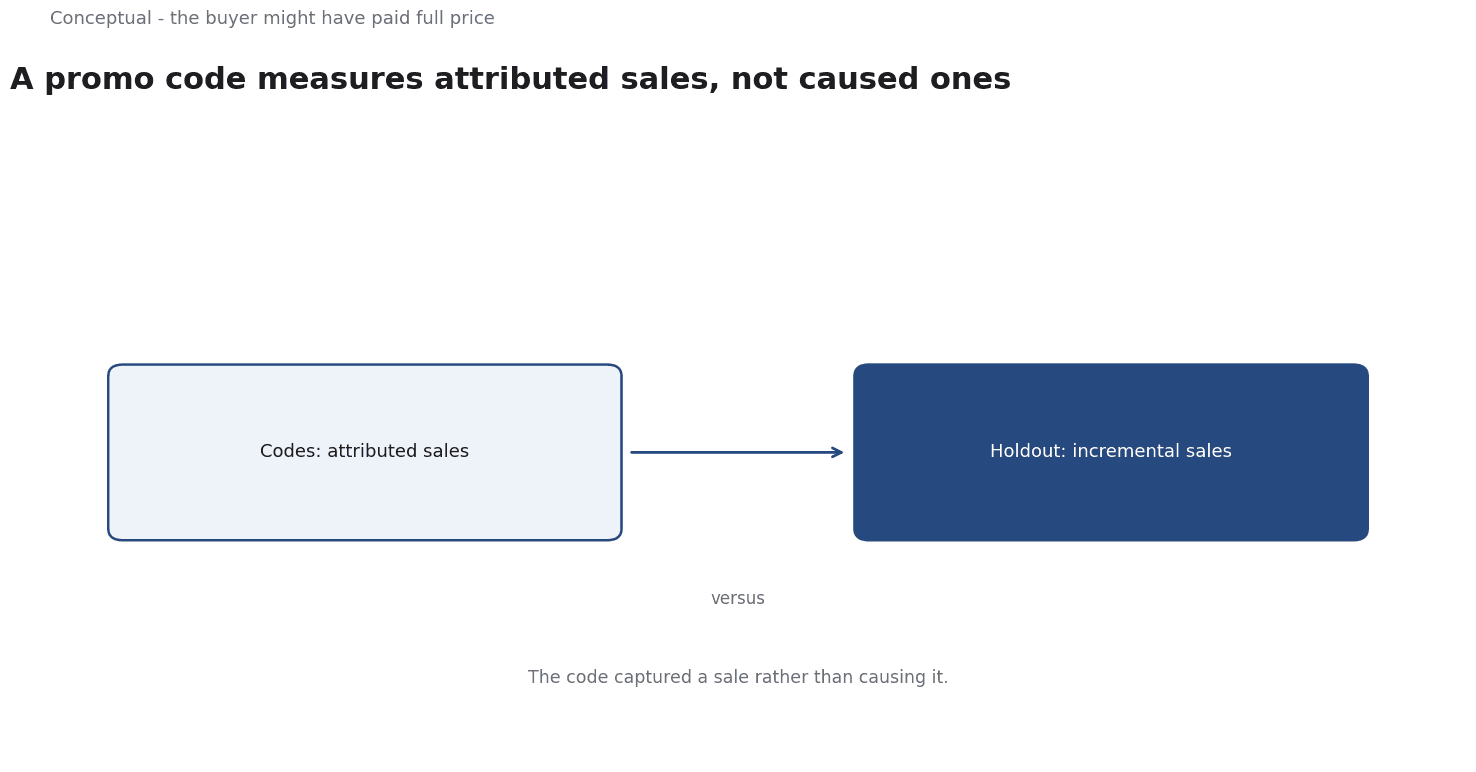
What codes and links actually measure
Affiliate marketing works through commission-based promotion with tracking links and codes. That mechanism is good at answering: which creator produced a tracked conversion, and what did it cost per conversion?
It cannot answer: would the customer have converted without the creator?
Three sources of over-attribution are common:
Existing intent. A customer who already follows your brand and was planning to buy will happily use a discount code.
Discount's own effect. A 15% code can change the behaviour of someone on the fence. The resulting sale is real, but attributing it to the creator's influence conflates the creator with the discount.
Cross-channel contamination. A person sees the creator, then searches for your brand, then buys through a different link. If the creator's code is not used, the sale is invisible to the campaign report; if it is used at the last moment, the creator gets full credit for a journey that involved several channels.
Wikipedia's overview of influencer marketing covers formats and platforms; it does not supply a causal measurement method, because that is a design question rather than a channel description.
A worked example of attributed versus incremental sales
The following numbers are hypothetical and illustrative.
A campaign with one creator costs 20,000. It generates 400 code redemptions at an average order value of 100 and a gross margin of 40% — 40 per order. Reported gross margin from attributed sales: 400 × 40 = 16,000. Reported return: -4,000, which would make the campaign look like a loss.
Now measure incrementality with a holdout: two matched audiences, one exposed to the creator and one not, with similar size and characteristics.
- Exposed group: 10,000 people, 200 purchases.
- Holdout group: 10,000 people, 120 purchases.
- Incremental purchases: 80, or 0.8% of the exposed group.
Incremental gross margin: 80 × 40 = 3,200. Against a cost of 20,000, the campaign lost 16,800 on Incremental basis — worse than the attributed view suggested.
Three decisions follow:
- The code number was flattering. It counted 400 purchases; only 80 appeared attributable to the campaign. If the discount itself drove purchases in both groups, the holdout captures that too, which is the correct basis for the decision.
- A different creator or offer may work. With this result, the correct action is to stop this campaign and test a different format — not to optimise the code.
- Holdouts have a cost. Designing matched groups, keeping them separate, and accepting the statistical noise takes effort. For a 20,000 campaign it may be worth it; for a 500 campaign the measurement would cost more than the decision is worth.
The method matters more than the numbers: compute the counterfactual before judging the return, or accept that you are measuring attribution and label it honestly.
When a holdout is and is not practical
Practical when the audience can be split — a paid amplification component, a distinct landing page population, or a platform that supports conversion-lift studies. The larger the campaign, the more the measurement cost is worth paying.
Impractical when the creator's value is brand building over a long horizon, when audiences cannot be separated, or when the campaign is too small to detect a difference above the noise.
In those cases the honest approach is to report the metric you have — attributed conversions — and explicitly label it as an upper bound on impact, rather than converting it into a return figure the design cannot support.
Choosing a measurement design
Four options sit on a cost-to-credibility ladder:
Promo-code reporting. Cheapest and least credible for causal claims. Good for tracking which creator a redeemer mentioned; poor for deciding whether to run the campaign again.
Affiliate-link reporting. Slightly broader, because it captures conversions without a code. Still measures the tracked path only, and still credits the last link used.
Platform lift studies. A middle option offered by large ad platforms. More credible than code tracking because it uses a comparison group, but the platform both sells the inventory and reports the result, so the design and its interpretation deserve scrutiny.
Randomised holdout. The strongest design when the exposed and unexposed groups are genuinely comparable and kept separate. It costs the most to set up and is the only option here that estimates what would have happened without the campaign.
The right choice depends on the size of the decision. A small test with a creator does not justify a holdout; a six-figure campaign with a disputed return does. Reporting the method alongside the number lets the reader discount appropriately.
What the attribution literature adds
The general distinction between attribution and incrementality applies here: attribution allocates credit among touchpoints by a rule; incrementality asks what would have happened without the intervention. A promo code is a single-touch rule with a strong bias toward the last clickable touchpoint.
Platform-reported lift is not independent evidence. A platform that sells the advertising has an interest in reporting a favourable result, and its model is not the same as a randomised holdout. Treat it as one input and prefer a designed comparison when the decision is material.
The counterargument — that holdouts are too academic for a fast-moving channel — is fair. The response is proportionality: use codes for operational tracking, and reserve holdouts for the campaigns large enough that a wrong decision is expensive.
A decision test
- Label the metric — attributed conversions or incremental sales.
- For material spend, design a holdout or matched comparison before launch.
- Separate the creator's effect from the discount's effect where possible.
- Check for existing intent by comparing buyers' prior relationship with your brand.
- Treat platform lift as a claim, not independent proof.
- Use codes for tracking, not as the sole basis for a return calculation.
- Match measurement effort to spend — do not overbuild for a small campaign.
For the general measurement problem, see Marketing Attribution; for campaign design, see Demand Generation vs Lead Generation.
References & Further Reading
- Wikipedia contributors, 2026. Influencer marketing - Wikipedia — An overview of influencer marketing formats, platforms and measurement challenges; secondary reference.
- Wikipedia contributors, 2026. Affiliate marketing - Wikipedia — Commission-based promotion, tracking links and codes — the mechanism behind promo-code attribution.