AI for Contract Review: What to Automate and What to Escalate
AI can find clauses and flag deviations, not decide legal risk. Read the split, a worked triage, and why escalation is a feature.
Contract review is an attractive target for AI: the documents are long, the language is repetitive, and a first pass takes experienced time. The useful division of labour is clear — let the model find and compare clauses, and let a lawyer decide what the clauses mean for this deal. Blurring that line produces confident summaries that miss the point.
Direct answer: Anthropic's use-case guides cover legal summarisation, and the document-processing article covers the extraction mechanics. The boundary: a model can flag that a clause differs from the standard, but it cannot judge whether that difference is acceptable given the commercial context, which is a legal and business decision.
Automate clause identification, comparison against a template, and extraction of key terms; escalate deviations, unusual language, and anything with material legal consequence to a qualified reviewer.
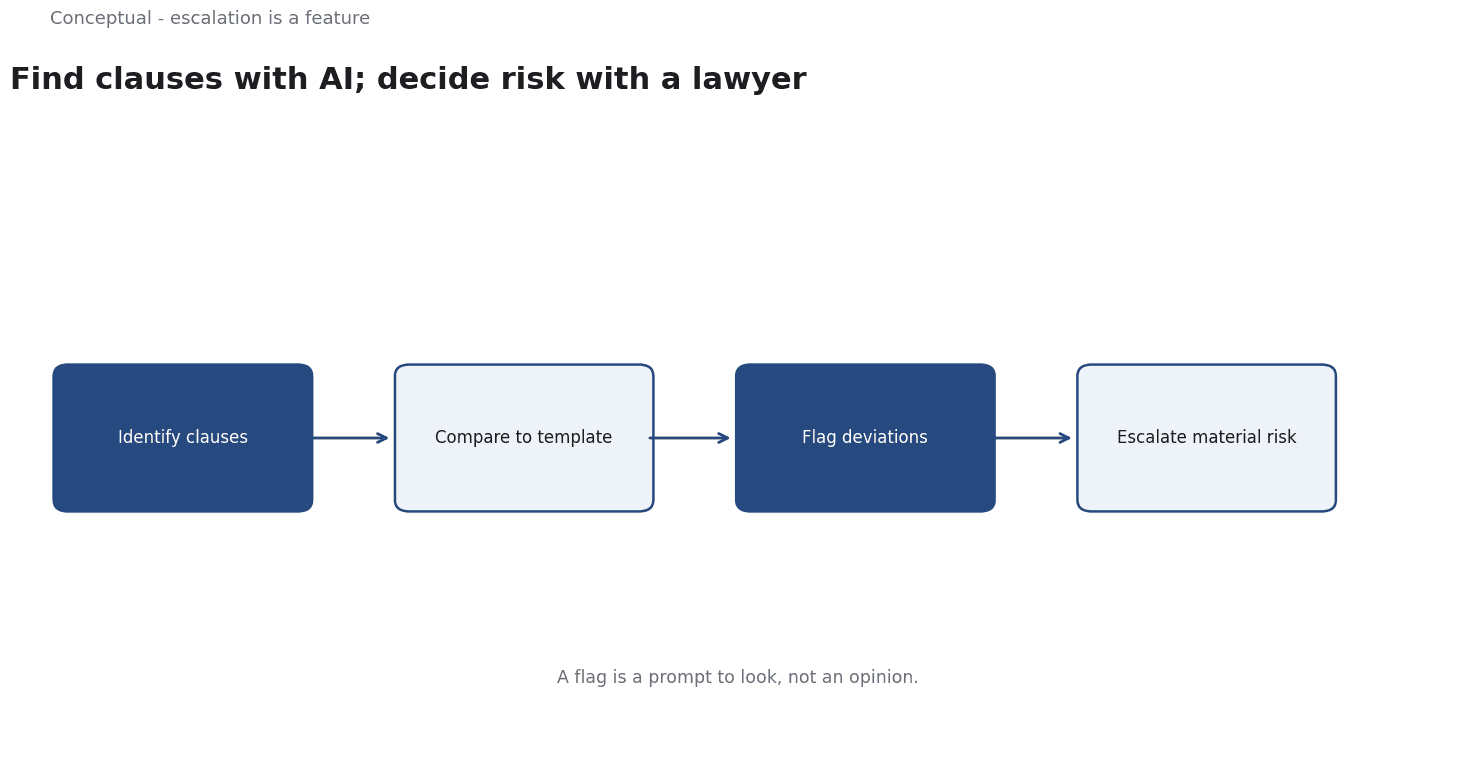
What to automate
Clause identification. Locate the termination, liability, indemnity, and governing-law clauses in a document. This is a retrieval-and-extraction task, as AI for Document Processing: Classification, Extraction, Redaction describes.
Template comparison. Flag where a clause deviates from the approved standard. The comparison is mechanical — does the text match the expected pattern — and the model can do it at scale.
Key-term extraction. Pull parties, dates, values, and renewal terms into a structured field, using a schema as the structured-output article explains.
First-pass summarisation. Produce a short abstract for a reviewer to orient themselves, with each claim linked to the source clause, as the reduce-hallucinations article recommends for grounding.
What to escalate
Any material deviation. A clause that differs from the template may be a negotiable point or a deal-breaker; that judgement needs context.
Unusual or novel language. If the model has not seen a clause form before, its confidence is not evidence of meaning. The benchmark discussion of coverage applies here, as the benchmarks article argues.
Cross-clause interactions. A liability cap and an indemnity clause may interact in a way that is only visible when read together, which the document-processing article notes as a systemic limitation.
High-value contracts. The cost of an error scales with the deal, so the review threshold should scale too, as the risk-assessment article explains.
A worked triage
The following is hypothetical and illustrative.
A team reviews 500 vendor contracts a quarter. The AI pipeline:
- Extracts key terms and identifies the standard clauses.
- Compares each against the template and flags deviations with the source text.
- Produces a one-page summary for the reviewer.
Outcomes on a sample quarter:
- 350 contracts have no material deviations and go through a light review.
- 120 have one or two flagged clauses and go to a lawyer with the clauses highlighted.
- 30 have unusual language or high value and receive full legal review.
Three checks decide whether the triage is safe:
- False-negative audit. Have a lawyer review a random sample of the 350 "clean" contracts. If a material deviation was missed, the comparison threshold is too loose, which the evaluation-rubric article explains for false negatives.
- Citation accuracy. Check that each flagged clause is quoted correctly, which the reduce-hallucinations article treats as a core check.
- Review time. Measure whether the 120 flagged contracts actually take less time with highlights, or whether reviewers re-read everything, which the workflow-automation article covers.
Three conclusions follow:
- The value is in triage, not in replacing review.
- False negatives are the dangerous error, so audit the clean bucket.
- Legal retains the decision on every material clause, as the human-in-the-loop article argues.
What contract AI cannot do
It cannot give legal advice.
It cannot read commercial intent. Whether a liability cap is acceptable depends on the deal's value and alternatives, which are not in the document.
It stays current only if the template does. A comparison against an outdated template produces misleading flags, which the monitoring article covers as a change trigger.
The counterargument — that experienced lawyers will not use such a tool — is an adoption problem, not a capability problem.
A tool that reduces the time to find clauses while keeping the decision with the lawyer is often welcomed, as the contract-review use-case guide suggests.
A decision test
- Automate identification and comparison, not judgement.
- Cite the source clause for every extraction and flag.
- Escalate material deviations and unusual language.
- Audit the clean bucket for false negatives.
- Scale review thresholds with deal value.
- Keep the template current with an owner.
- Measure review time and missed-clause rate, as the evaluation article recommends.
For the extraction mechanics, see AI for Document Processing; for the governance, see AI Governance.
References & Further Reading
- Anthropic, 2026. Guides to common use cases - Claude Platform Docs — Production use-case guides for ticket routing, customer support agents, content moderation, legal summarization and commerce agents.
- Wikipedia contributors, 2026. Income statement - Wikipedia — The structure of revenue, expenses and profit, and the difference between revenue and cash.