AI for HR: Screening, Onboarding, and Bias Controls
HR AI touches people's livelihoods. Read the uses, a worked screening example, and why bias controls are a design requirement.
AI in human resources ranges from harmless — drafting an onboarding email — to consequential — ranking job applicants. The difference is the impact on a person and the legal and ethical obligations that come with it. A useful principle: the more a system affects someone's opportunity, the more explicit its controls and oversight must be.
Direct answer: Use AI for bounded HR tasks such as summarising applications against a defined rubric, drafting onboarding material, and flagging inconsistencies — with human decision-making, bias testing, and documented criteria for anything affecting employment. Anthropic's use-case guides cover relevant patterns, and O*NET provides occupation and skill descriptions for defining what a role requires.
The boundary: a model can rank or summarise, but the decision and its justification must remain with a person, as the AI-ethics and governance articles argue for high-impact domains.
Three uses
Screening support. Summarise applications against a defined rubric — the requirements of the role, stated as observable criteria. The rubric must come from the job, not from the model's assumptions about a "good candidate", which the O*NET task descriptions help ground.
Onboarding. Draft material, answer routine questions, and track completion. This is low-risk, as the workflow-automation article explains, provided the content is accurate.
Consistency checks. Flag where two candidates were assessed against different criteria or where a required step was skipped, which the internal-audit logic of the data-governance article supports.
A worked screening example
The following is hypothetical and illustrative.
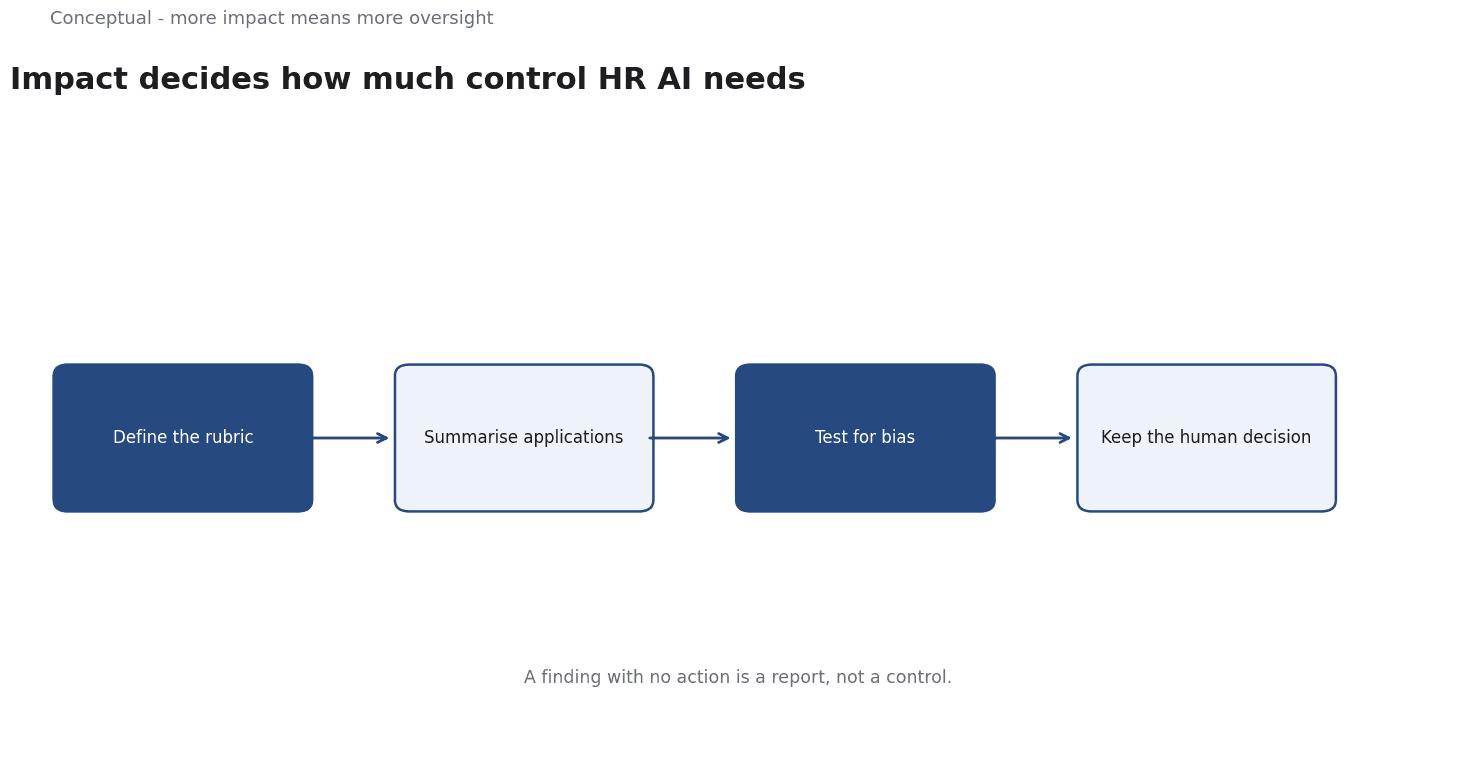
A team uses AI to summarise 500 applications against a five-point rubric derived from the job description. The workflow:
- Define the rubric from the role's actual tasks, with each criterion observable in an application.
- Produce a structured summary per candidate with the evidence for each criterion, as the structured-output article explains.
- A recruiter reviews the summaries and makes the decision.
Three checks decide whether it is defensible:
- Rubric relevance. Does each criterion predict performance in the role, rather than reflecting a proxy for something else? The future-of-work article argues for tying skills to real tasks, which O*NET descriptions support.
- Bias testing. Are outcomes distributed differently across protected groups at the summary or ranking stage? The model-monitoring article covers detecting bias drift, which the responsible-AI article treats as a core obligation.
- Human decision quality. Does the recruiter engage with the evidence, or defer to the summary? The human-in-the-loop article explains why a rubber-stamp review is not a control.
Three conclusions follow:
- The rubric is the control, not the model — a bad criterion produces biased summaries consistently.
- Bias testing is ongoing, because inputs and models change, which the monitoring article covers.
- The decision stays with a person, who can be accountable for it, as the governance checklist requires.
Making bias testing real
A commitment to fairness is not a control; a measurement is. Three practices make bias testing operational:
Choose the outcome to test. Decide whether you are checking summary scores, ranking positions, or final decisions, as the model-monitoring article distinguishes the layers. Testing only the final decision can miss a biased upstream signal that a person then amplifies.
Test at intervals and after changes. Distributions shift as applicant pools and models change. The monitoring article recommends scheduled checks with defined triggers, which the governance checklist reinforces for high-impact systems.
Act on findings. A test that shows a disparity needs an owner, a remediation, and a retest, which the incident-response article describes for other failure modes.
These practices are demanding, which is why high-impact uses should start small — low-stakes onboarding before consequential screening, as the risk-assessment article recommends.
What HR AI cannot do
It cannot define job relevance. That is a decision about the work, grounded in task analysis, which O*NET's occupational data supports but does not make for you.
It cannot remove bias. It can encode or amplify it, which the AI-ethics article explains. Bias controls are active work, not a property of the tool.
It cannot be accountable. Responsibility for an employment decision belongs to a person and an organisation, as the responsible-AI and regulatory-compliance articles argue.
The counterargument — that humans are biased too — is true and misses the point.
A system that scales a decision needs more scrutiny, not less, because its errors are systematic and repeatable, which the risk-assessment article explains.
A decision test
- Define criteria from the role's tasks, not assumptions.
- Keep the decision with a person who can justify it.
- Test outcomes across relevant groups on a schedule and after changes.
- Show the evidence for each summary or ranking, as the explainability article recommends.
- Audit for rubric drift when job descriptions change, which the monitoring article covers.
- Document the process with an owner, as the governance checklist requires.
- Check current employment law in your jurisdiction, which the blockchain-adjacent regulatory discussions treat as a date-sensitive question more generally.
For the oversight design, see Human in the Loop by Design; for the ethical frame, see Responsible AI.
References & Further Reading
- Anthropic, 2026. Guides to common use cases - Claude Platform Docs — Production use-case guides for ticket routing, customer support agents, content moderation, legal summarization and commerce agents.
- U.S. Department of Labor, 2026. O*NET OnLine — The standard occupational taxonomy used to compare roles across industries.