AI for Marketing Content: Drafting, Testing, and Brand Voice
AI can draft and vary copy at scale. Read where it helps, how to test it, and why brand voice needs rules rather than vibes.
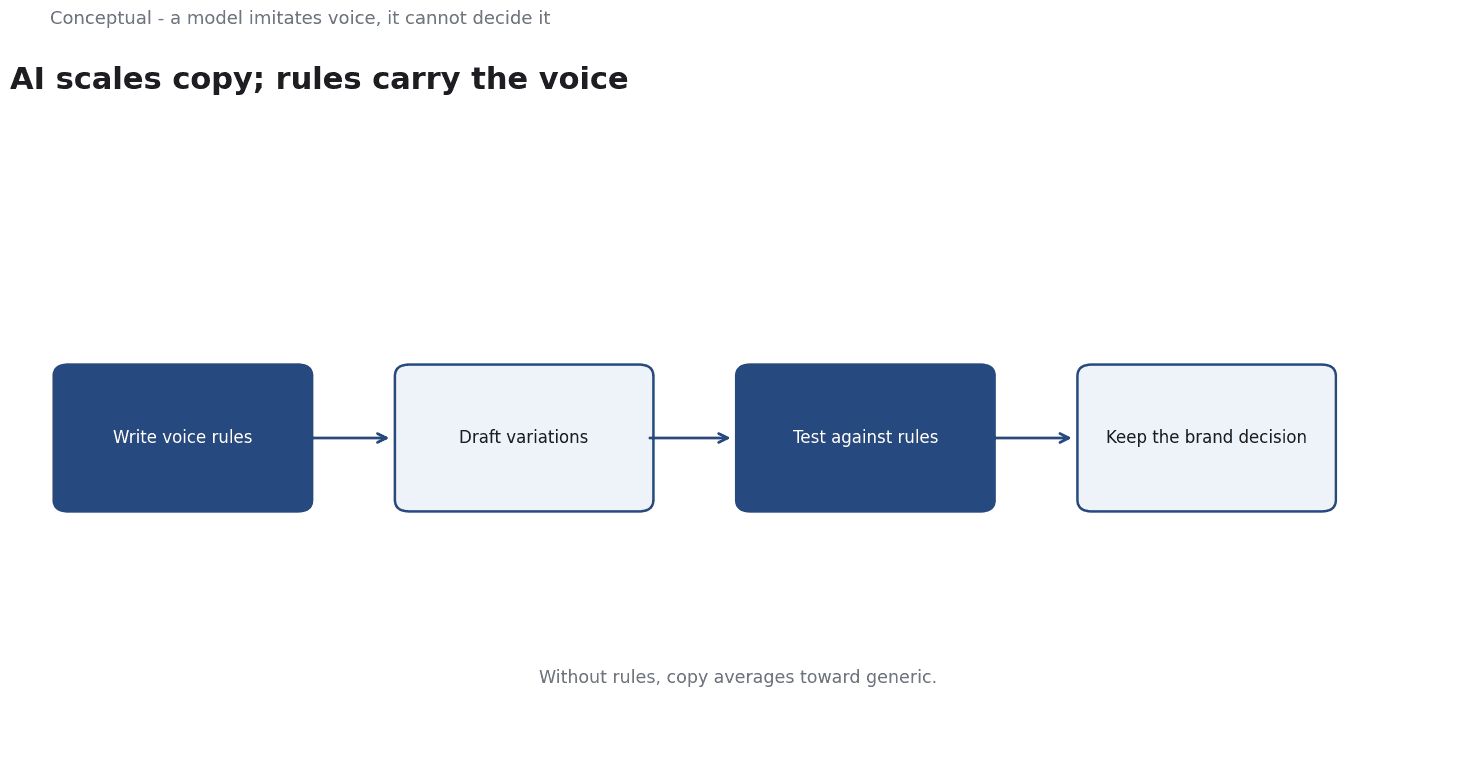
Marketing teams adopted AI drafting faster than most functions, and the results are mixed. The tool is good at producing volume and variation, which is useful when a campaign needs many versions of a message. It is weak at knowing what the brand should sound like, because voice is a set of decisions a model can only imitate from examples.
Direct answer: Use AI to draft first versions, generate variants for testing, and check consistency against a defined voice guide — with a person editing and a measured test deciding what ships. Anthropic's use-case guides cover content patterns, and brand-management principles treat voice as part of a maintained identity.
The boundary: a model can mimic a voice, but it cannot decide what the brand stands for, which the value-proposition article explains as a strategic choice.
Where it helps
First drafts. Produce a starting version quickly so a writer edits rather than faces a blank page. The draft is a proposal, not final copy, which the human-in-the-loop design recommends.
Variants for testing. Generate several versions of a headline or message for an A/B test. The value is volume, and the test decides which wins, as the A/B testing article explains — not the model's confidence.
Repurposing. Adapt one piece across channels while keeping the underlying claim consistent, as the content-repurposing article describes.
Consistency checks. Compare a draft against a voice guide and flag deviations, which a structured rubric makes measurable, as the evaluation-rubric article argues.
Where it fails
Invented specifics. A model can add a plausible number or claim that is not true, which the reduce-hallucinations article treats as a core failure to guard against.
Voice drift.
Causal claims. A draft that says a feature "caused" a result the data only correlates with is a problem the correlation-vs-causation article covers.
A worked workflow
The following is hypothetical and illustrative.
A team drafts a product announcement. The workflow:
- Provide the model with the brief, the value proposition, and three examples of approved copy.
- Generate five opening variants with explicit constraints: no unverified numbers, no causal claims, a stated length range.
- Screen each against a voice rubric — four dimensions scored 0–2, as the evaluation-rubric article recommends.
- Have a writer edit the top two, then test them in a controlled send.
Three checks decide whether it works:
- Fact audit — does every claim trace to the brief? A generated number without a source is rejected, as the reduce-hallucinations article explains.
- Voice consistency — does the copy match the rubric better than a human-only baseline? If not, the examples or rules need work, which the brand-guidelines article covers.
- Test outcome — does the winner of the controlled send actually perform better, as the subject-line article argues for downstream metrics rather than opens.
Three conclusions follow:
- The model generates options; people and tests decide.
- Voice must be specified, not assumed, which the brand-voice article explains.
- Fact-checking is a separate step that does not disappear because the copy reads well.
Giving the model a voice to imitate
Voice imitation depends on what you show the model. Three inputs matter:
Approved examples, with context. Provide copy that was actually published and explain why it was approved, not just the text. The brand-voice article argues that guidelines need concrete examples, which is equally true for AI prompts.
Explicit anti-patterns. State what the brand does not do — no superlatives, no invented urgency — as the brand-guidelines article recommends. A model can only avoid what it has been told to avoid.
The value proposition, not adjectives. Give the model the specific promise and audience from the value-proposition article. "Innovative solutions" gives it nothing to say; a concrete outcome gives it material to work with.
These inputs are a one-time investment that improves every draft. A team that skips them will spend more time editing generic copy than it saved generating it.
What AI content tools cannot do
They cannot define the brand. Positioning is a strategic decision, as the brand-positioning article argues.
They cannot guarantee performance. No structure guarantees conversion, which the CRO article makes explicit.
They cannot replace editorial judgement. A piece can be fluent, on-voice, and still say nothing useful, which the content-marketing article treats as the central quality question.
The counterargument — that readers cannot tell AI-generated copy — misses the point.
The risk is not detection; it is publishing a plausible claim that the brand cannot support, as the content-detection article explains for the limits of provenance tools.
A decision test
- Brief with a sourced value proposition, not adjectives.
- Provide approved examples of the voice.
- Constrain generation — no unverified numbers or causal claims.
- Score against a voice rubric before human editing.
- Fact-check every claim against the brief.
- Test variants with a controlled send and a downstream metric.
- Keep editorial accountability with a person, as the governance checklist requires.
For the voice guide, see Brand Voice Guidelines; for testing, see A/B Testing.
References & Further Reading
- Anthropic, 2026. Guides to common use cases - Claude Platform Docs — Production use-case guides for ticket routing, customer support agents, content moderation, legal summarization and commerce agents.
- Wikipedia contributors, 2026. Brand management - Wikipedia — The discipline of maintaining a brand across touchpoints; secondary reference used for channel consistency.