AI for Real Estate Metrics that Matter
Property AI is judged by decisions about value and risk. Read the metrics, a worked example, and why a smooth estimate can still be wrong.
AI in real estate is often evaluated by the precision of a valuation, which hides whether the estimate supports a decision. The real-estate entry describes the structure of property markets, and Damodaran's framework insists on explicit assumptions. The metrics should reflect the decision.
Direct answer: Measure AI real-estate tools by the quality of the decision they support, with error reported by segment and assumptions made visible. The sources describe the domain; the rule is a synthesis.
Delta: This article adds a claim-status table and a worked example, separating documented market structure from local judgements about what matters.
The mechanism
The first point is the decision. The real-estate entry describes property as an asset class with different segments, which means an estimate that is good for one property type may fail for another. Naming the decision — valuation, risk, or scheduling — is the first step.
The second point is assumptions. Damodaran's framework treats assumptions as explicit inputs, which applies to a model that estimates value from comparables. A smooth number built from hidden assumptions is harder to challenge than a rough range with stated inputs.
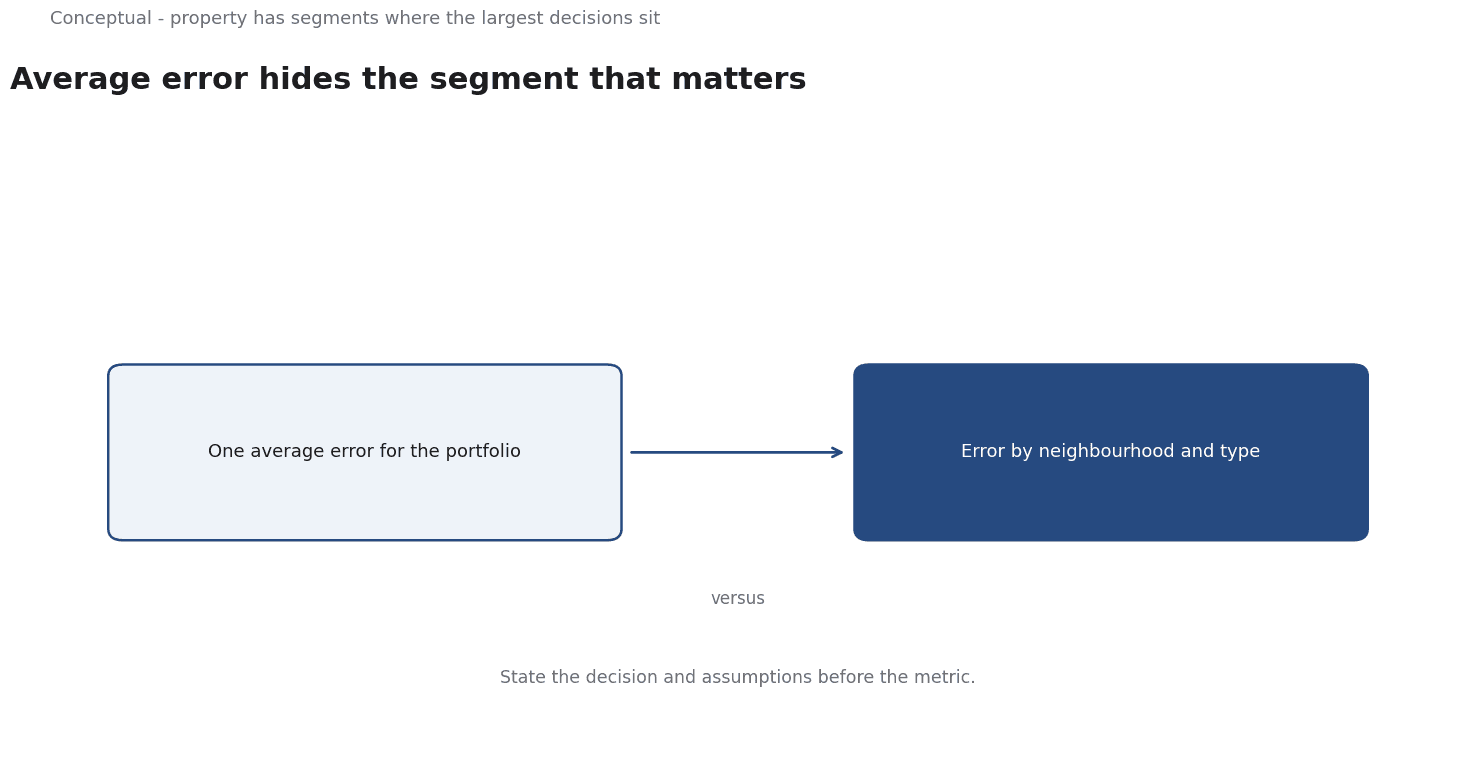
The third point is error by segment. A single average error can hide a systematic mistake in a particular neighbourhood or property type, and the segments where the model is wrong are often the ones where the decision is largest. Reporting error by segment is the control.
The sequence is: define the decision, state the assumptions, measure error by segment, then check the result on a real case.
The choices are local, so the conclusions are inferred; the domain is source-reported.
A worked example
Illustrative. A model estimates property values with a low average error and a team uses it to price a portfolio.
Three checks decide. First, which decision does the estimate support, and is the required precision stated? Second, are the assumptions about comparables and adjustments visible? Third, does the error concentrate in a segment that represents much of the portfolio?
The outcome is a qualified use rather than a blind trust. The scenario is hypothetical; the method is the contribution.
Evidence status
| Claim | Status | Source | Verified | Recheck when |
|---|---|---|---|---|
| Property markets have distinct segments | source-reported | Wikipedia, Real estate | 2026-11-18 | Definition changes |
| Valuation depends on explicit assumptions | source-reported | Damodaran Online | 2026-11-18 | Framework changes |
| Measure error by segment | inferred | Derived from both | 2026-11-18 | Market changes |
Why a smooth estimate can be wrong
A model can produce precise numbers across a portfolio while systematically mispricing one segment, and an average will not reveal it. The check by segment is the practical response, and it matters most where the portfolio is concentrated.
A further consideration is that property data is dated. A sale from an older period may not describe the current market, and a model that does not weight recency will be confident about a stale comparable. Recording the date of each input is part of the method.
The tool also cannot set the strategy. A valuation estimate informs a decision about buying or holding, but the decision depends on goals and financing that the model does not know.
The third limitation is that a model trained on one market may not transfer to another. Local rules, stock, and demand patterns differ, and an evaluation in one city says little about another. Testing locally is the control.
A model trained in one market may not transfer to another, which is why local validation matters.
Property data ages, and a stale comparable can make a confident estimate wrong.
The decision should be stated before the metric, since valuation and risk need different evidence.
Error by segment is more informative than an average across a whole portfolio.
The assumptions behind an estimate should be visible to the person using it.
A decision should be stated before the metric is chosen, since valuation and risk need different evidence.
Local evidence should precede a decision that relies on a model built elsewhere.
A dated input is more useful than a precise one with no date.
A recorded judgement with its assumptions is more useful than a number that appears certain.
The decision should also note what would change it, since a valuation describes the conditions it was built under.
A decision test
- Define the decision the tool supports.
- State the assumptions.
- Measure error by segment.
- Check the dates of inputs.
- Validate on a local case.
- Record the limits and recheck condition.
For the valuation basis, see Valuation.
A counterargument
The metrics are sensible, but a fair objection is that they presume a decision with a knowable ground truth, while the sources the article cites treat value as an estimate rather than an observation. Damodaran's framework makes assumptions explicit inputs, which means error by segment against comparable sales measures consistency with a market that may itself be mispriced, not correctness. The Wikipedia entry describes distinct segments but offers no rule for choosing which segmentation to report by, even though the article says judgements should be visible. In thin markets the dated-input check becomes decisive, yet neither source supplies a staleness threshold. The framing is incomplete where a metric appears able to settle a judgement about value that the cited framework explicitly leaves to assumptions.
References & Further Reading
- Wikipedia contributors, 2026. Real estate - Wikipedia — The structure of property markets and ownership.
- Aswath Damodaran, 2026. Damodaran Online: Home Page for Aswath Damodaran — Publicly maintained datasets for industry averages, WACC, and valuation.