How to Get Discounted Cash Flow Right
A DCF turns assumptions into a number. Read how to build one honestly, a worked example, and why precision can hide a fragile forecast.
Discounted cash flow is often judged by the precision of its output, which hides the assumptions that produced it. The Wikipedia entry describes the method, and Damodaran's framework insists that assumptions be explicit. The right way to build one is to make those assumptions challengeable.
Direct answer: Build a DCF from a clear forecast, a consistent discount rate, and an explicit statement of what would change the result. The sources describe the method; the discipline is a synthesis.
Delta: This article adds a claim-status table and a worked example, separating documented method from local judgements about growth and risk.
The mechanism
The first input is cash flow. The DCF entry describes discounting future cash to the present. A forecast that begins with revenue and works down to free cash flow is more transparent than one that begins with a desired value and works backwards, because each step can be checked.
The second input is the discount rate. Damodaran's framework treats the rate as a reflection of risk, which should be consistent with the cash flows being discounted.
The third input is the terminal value. A large share of many DCFs comes from the period beyond the explicit forecast, which makes the terminal assumptions the most consequential and often the least examined. Stating them separately is the control.
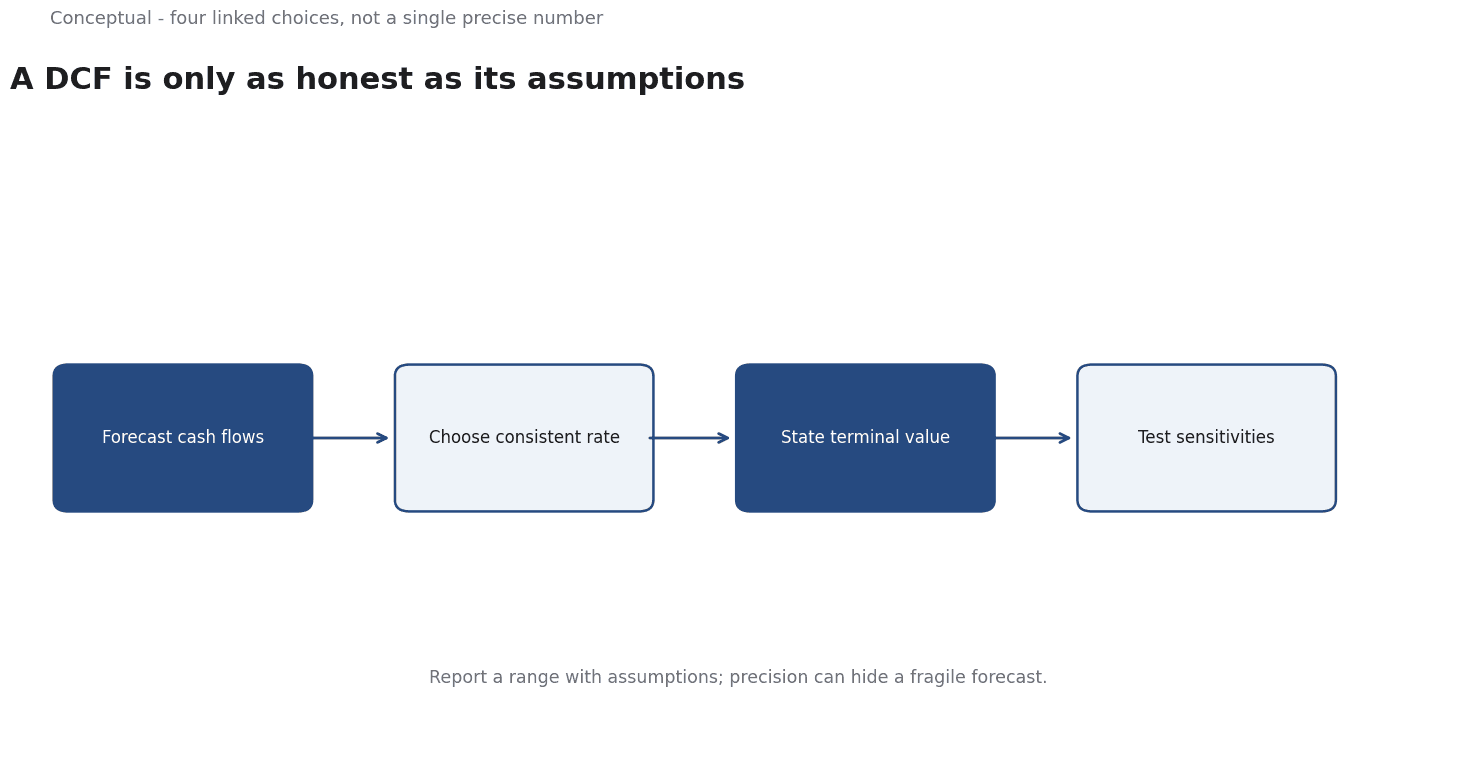
The sequence is: forecast cash flows, choose a consistent rate, state the terminal assumption, then test how much the result depends on each. The choices are local, so the conclusions are inferred; the method is source-reported.
A worked example
Illustrative. An analyst values a company with five years of forecasts and a terminal value.
Three checks decide. First, does each forecast step follow from an explicit assumption about volume, price, and margin? Second, is the discount rate consistent with the currency and risk of the cash flows? Third, how much of the total value comes from the terminal assumption, and what happens if it changes?
The outcome is a value with stated sensitivities. The scenario is hypothetical; the method is the contribution.
Evidence status
| Claim | Status | Source | Verified | Recheck when |
|---|---|---|---|---|
| DCF discounts future cash flows | source-reported | Wikipedia, Discounted cash flow | 2026-11-18 | Method changes |
| Assumptions should be explicit | source-reported | Damodaran Online | 2026-11-18 | Framework changes |
| Test sensitivity to key inputs | inferred | Derived from the method | 2026-11-18 | Business changes |
Why precision can mislead
A value calculated to several decimal places inherits the precision of its inputs, which are forecasts. Showing a range from alternative assumptions is more honest than a single precise figure, because it reflects what the analyst actually knows.
A further issue is that the discount rate and the cash flows must describe the same world. A rate derived from market data on similar companies assumes a risk profile, and the forecast should reflect that same level of uncertainty. Mixing a conservative forecast with a low rate produces an estimate that is confident for the wrong reasons.
The terminal value deserves its own review. Because it often dominates the total, a small change in the assumed long-term growth can move the result substantially, and that sensitivity should be shown rather than buried. A single figure without the sensitivity is hard to challenge.
None of this turns a DCF into a forecast.
It produces a structured estimate whose assumptions can be argued with, which is the most that the method can honestly promise.
A result should be reported with its assumptions, since a figure without them cannot be challenged.
The sensitivity table is often more informative than the headline value, because it shows where the argument is weakest.
The forecast and the rate should describe the same risk, which is a consistency check before any arithmetic.
A precise result built on weak inputs is less useful than a range built on honest assumptions.
What it cannot do
It cannot predict the future. It does not remove the need to understand the business. And it cannot make a bad assumption better.
The counterargument that a model is objective is fair for the arithmetic and incomplete for the inputs.
A decision test
- Forecast cash flows from explicit drivers.
- Choose a consistent discount rate.
- State the terminal assumption.
- Compute the value.
- Test sensitivity to key inputs.
- Record the assumptions and recheck date.
For the pitfalls, see DCF Pitfalls.
References & Further Reading
- Wikipedia contributors, 2026. Discounted cash flow - Wikipedia — The structure and use of discounted cash flow analysis.
- Aswath Damodaran, 2026. Damodaran Online: Home Page for Aswath Damodaran — Publicly maintained datasets for industry averages, WACC, and valuation.