AI HR Screening Checklist
Screening candidates with AI is a high-impact decision. Read the checklist, a worked review, and why the rubric is the real control.
AI screening tools are attractive because applications outnumber the time available to read them. The risk is that a tool trained on past hiring decisions reproduces their biases at scale, which the AI HR screening article treats as a central obligation, as the responsible-AI article argues for fairness as a design property. A checklist works only if it changes the decision, not merely documents the process, as the risk-assessment article requires for controls.
Direct answer:
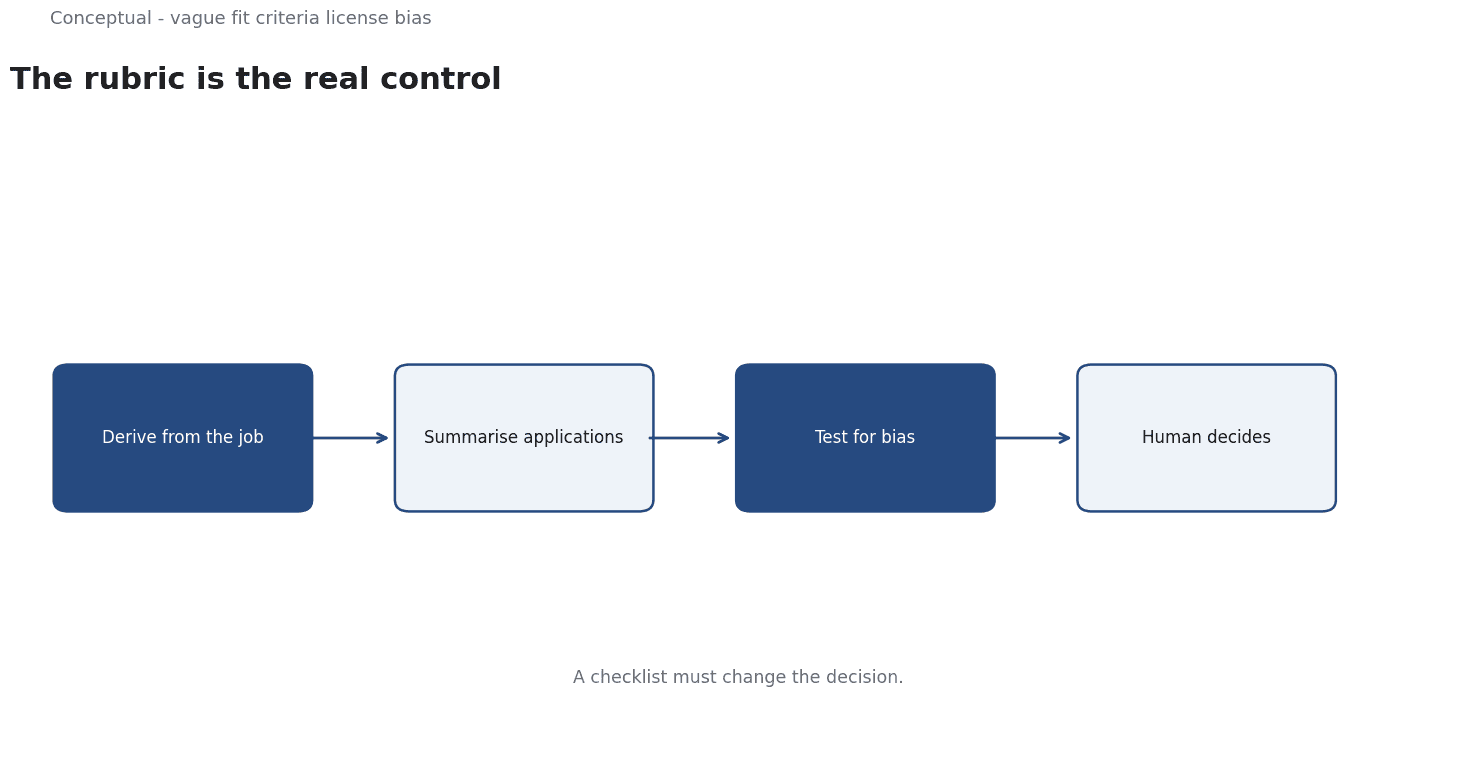
Use AI to summarise applications against a job-derived rubric, with a human decision, bias testing, and documented criteria.
Anthropic's use-case guides cover analysis patterns, and O*NET's task descriptions help define the role. The boundary: this is educational orientation, not legal advice — employment decisions have legal duties that vary by jurisdiction, as the AI Act article treats current law as requiring a dated check, as the term-sheet article treats formal obligations as consequential.
The checklist
Job-derived rubric. Define the criteria from the role's actual tasks, as O*NET descriptions support, which the hiring article treats as the substance of a fair process, as the value-proposition article argues for specific claims.
Structured output. Ask for a summary against each criterion with supporting evidence from the application, as the structured-output article explains for schema-enforced results, which the hallucination article treats as a control against invented detail.
Human decision. A person makes the decision and can explain it, which the AI HR screening article requires for accountability, as the human-in-the-loop article argues for meaningful review, not a rubber stamp.
Bias testing. Check outcomes across relevant groups at intervals and after changes, which the model-monitoring article treats as drift detection, as the responsible-AI article requires for fairness.
Records and notice. Keep the criteria, the tool version, and the decision, which the data-governance article requires for provenance, as the privacy article requires transparency about automated processing.
Three consequences follow. The rubric is the real control, which the structured-output article supports, as the evaluation-rubric article requires for concrete criteria.
And the tool should be reviewed after a job description change, as the monitoring article treats as a trigger.
A worked review
The following is hypothetical and illustrative. A team uses a tool to summarise 500 applications against five job criteria.
Three checks decide whether the process is defensible. First, rubric relevance: does each criterion predict performance in the role, which O*NET's task descriptions help ground, as the jobs-to-be-done article advises for situations? Second, grounding: does each summary point to evidence in the application, as the structured-output and hallucination articles require, with no invented detail? Third, bias: are outcomes distributed differently across groups, which the monitoring article requires you to test, as the responsible-AI article treats as an obligation?
Three conclusions follow. A tool that produces fluent summaries without grounding is a liability, as the hallucination article warns. A reviewer who accepts every summary has no meaningful control, as the oversight article argues. And the result should be recorded with the criteria and the version, as the decision-memo article requires.
What an AI screening checklist cannot do
It cannot decide who to hire, which the AI HR screening article treats as a human and legal responsibility, as the governance checklist requires an accountable owner. It cannot remove bias from historical data, which the model-collapse and data-quality articles treat as an upstream problem, as the responsible-AI article advises. And it does not replace a fair process, which the employment context requires, as the privacy article treats obligations as legal.
The counterargument that the tool saves time is fair and incomplete, which the worked review shows: speed is a benefit only when the controls hold, as the evaluation-rubric article argues for outcome measures.
A decision test
- Derive criteria from the role's tasks, as O*NET supports.
- Require evidence for each summary field, as the structured-output article advises.
- Keep the hiring decision with a person who can explain it.
- Test outcomes across groups at intervals, as the monitoring article recommends.
- Record criteria, version, and decision, as the data-governance article requires.
- Check current legal obligations with qualified advice, as the legal article advises.
- Review after a role or tool change, as the monitoring article requires.
For the ethics, see Responsible AI; for the role definition, see Engineering Management.
References & Further Reading
- Anthropic, 2026. Guides to common use cases - Claude Platform Docs — Production use-case guides for ticket routing, customer support agents, content moderation, legal summarization and commerce agents.
- U.S. Department of Labor, 2026. O*NET OnLine — The standard occupational taxonomy used to compare roles across industries.