Buyer Enablement for Beginners
A buyer needs evidence to defend a decision. Read how to enable one, a worked example, and why more content can make the choice harder.
Buyer enablement is often confused with giving a prospect more material, which ignores that the buyer has to make a decision others will review. The CRM entry describes systems that hold customer records, and the demand-generation entry covers stages before purchase. The beginning is understanding the buyer's task.
Direct answer: The sources describe the system and the stages; the method is a synthesis.
Enable a buyer by giving them the evidence they need to decide and to justify the decision internally.
Delta: This article adds a claim-status table and a worked example, separating documented context from local choices about what evidence matters.
The mechanism
The first point is the decision. The demand-generation entry describes stages before purchase, which include evaluation. A buyer in that stage needs to compare options against criteria, not read more about the seller, and the material should reflect that.
The second point is the internal audience. The CRM entry describes records of customer interactions, which are useful for understanding who is involved. A champion who must justify a choice to colleagues needs material those colleagues can read, which is different from material that persuades the champion.
The third point is clarity. A large library of documents increases the work of finding the relevant one, which can stall a decision. A small set of well-structured evidence is more useful than a comprehensive collection.
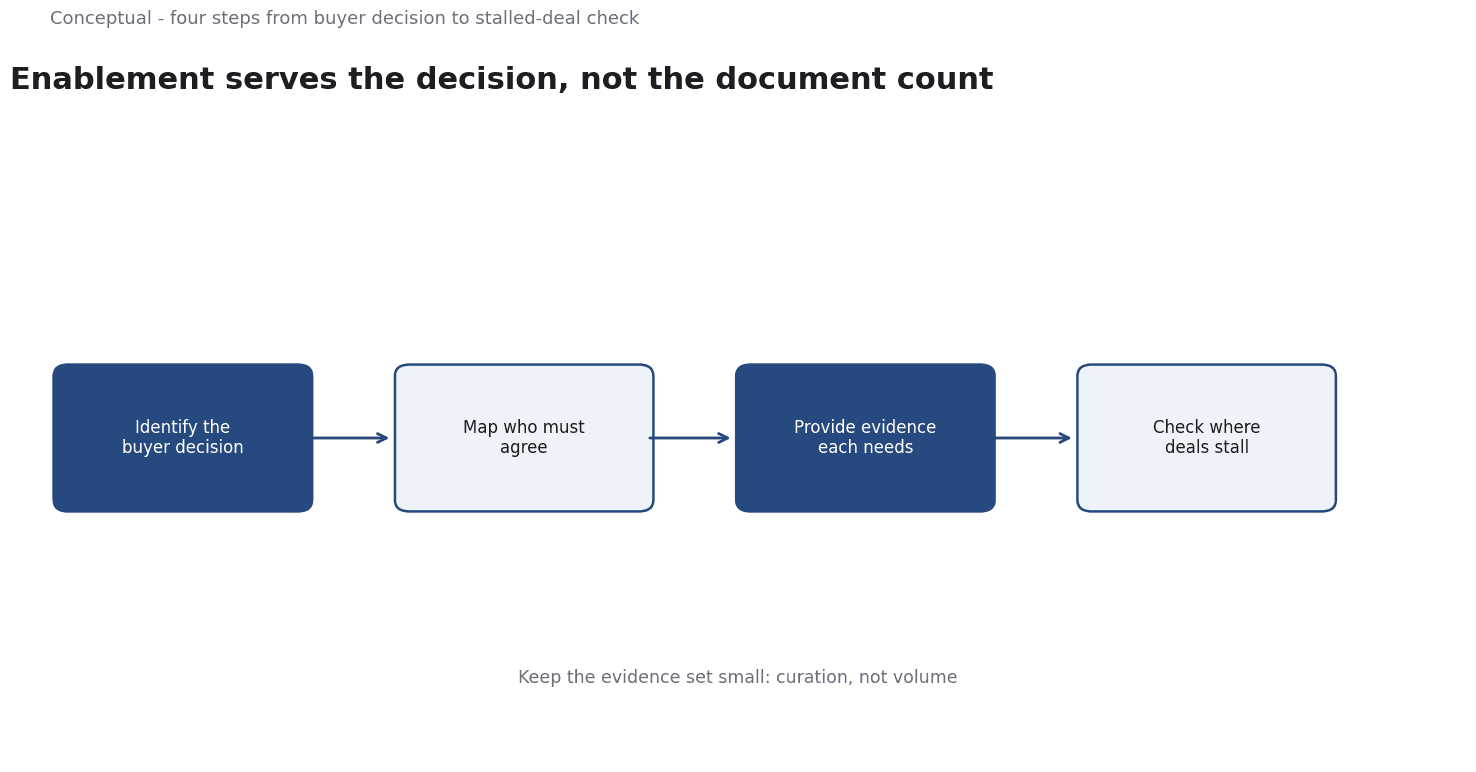
The sequence is: identify the decision, map the reviewers, provide the evidence each needs, then check where opportunities stall. The mapping is local work, so the conclusions are inferred; the context is source-reported.
A worked example
Illustrative. A deal stalls after a promising first conversation.
Three checks decide. First, which decision is the buyer trying to make at this stage, and who else must agree? Second, what evidence would those people need — a security answer, a cost case, or an implementation plan? Third, did the material provided answer a question the buyer actually had?
The outcome is a specific piece of evidence rather than another general document. The scenario is hypothetical; the method is the contribution.
Evidence status
| Claim | Status | Source | Verified | Recheck when |
|---|---|---|---|---|
| CRM systems hold customer records | source-reported | Wikipedia, CRM | 2026-11-18 | System changes |
| Buyers move through stages before purchase | source-reported | Wikipedia, Demand generation | 2026-11-18 | Definition revised |
| Enable the decision and its reviewers | inferred | Derived from both | 2026-11-18 | Buying process changes |
Why more content can slow a decision
A buyer who has to choose from many documents spends effort on selection rather than evaluation. Reducing the set to what the current decision requires is the practical help, and it is a curation task rather than a writing task.
A further constraint is that a seller cannot know every internal process of a buyer's organisation. Asking directly what is needed for the decision is more useful than guessing, and the answer should shape what is provided.
The evidence also has to be current. A figure that was accurate at the first conversation may be outdated by the time a reviewer reads it, and a dated record is more trustworthy than a polished document with no date. Reviewing the material before each stage is part of the work.
Finally, enablement cannot make a weak fit strong. If the product does not meet a criterion, more material will only make that clear later. Recognising the mismatch early is more useful than extending the process.
A dated piece of evidence is more trustworthy than a polished one with no date.
Listening to the buyer's actual question is more useful than adding more material.
The material should answer the reviewers' questions, not only the champion's.
A missing criterion will delay a decision whatever the volume of material.
The right evidence at the right stage is more useful than a larger library.
What it cannot do
It cannot replace a product that meets the criteria. It does not guarantee that a deal will close. And it cannot remove the need to listen to the buyer.
The counterargument that a prospect can never have too much information is fair for reference and incomplete for a decision that has to be made.
A decision test
- Identify the buyer's decision.
- Map who must agree.
- Provide evidence for each.
- Keep the set small.
- Track where deals stall.
- Record the approach and recheck date.
For the process, see Procurement Marketing.
References & Further Reading
- Wikipedia contributors, 2026. Customer relationship management - Wikipedia — Systems for managing customer relationships.
- Wikipedia contributors, 2026. Demand generation - Wikipedia — An overview of demand generation as a marketing discipline distinct from lead generation; secondary reference used with the lead-generation entry.