How to Get Procurement Marketing Right
Procurement buyers evaluate risk as much as value. Read the approach, a worked example, and why a consumer message rarely transfers.
Marketing to procurement is often treated as a longer version of consumer marketing, which misses that the buyer is evaluating risk. The Wikipedia entry describes procurement as how organisations acquire goods and services, and the demand-generation entry covers stages before purchase. The approach starts with the buyer's decision.
Direct answer: Market to procurement with evidence that reduces the buyer's risk — terms, references, and implementation detail — mapped to the decision they must defend. The sources describe procurement and buyer stages; the method is a synthesis.
Delta: This article adds a claim-status table and a worked example, separating documented process facts from local choices about evidence.
The mechanism
The first consideration is what the buyer is accountable for. The procurement entry describes an organisational process, not an individual preference. A buyer must justify a choice to others, which makes documentation and defensible criteria more valuable than persuasion. A message that helps them build that justification is useful; one that only generates interest is not.
The second consideration is the stages. The demand-generation entry describes the steps before a purchase. In procurement, those steps often include a formal evaluation, which means the evidence needed at each stage differs. Early material may need to establish credibility; later material must answer detailed questions about terms and delivery.
The third consideration is risk. A supplier that cannot answer questions about implementation, security, or continuity will be set aside regardless of enthusiasm. Reducing uncertainty is the work, and it is more specific than building awareness.
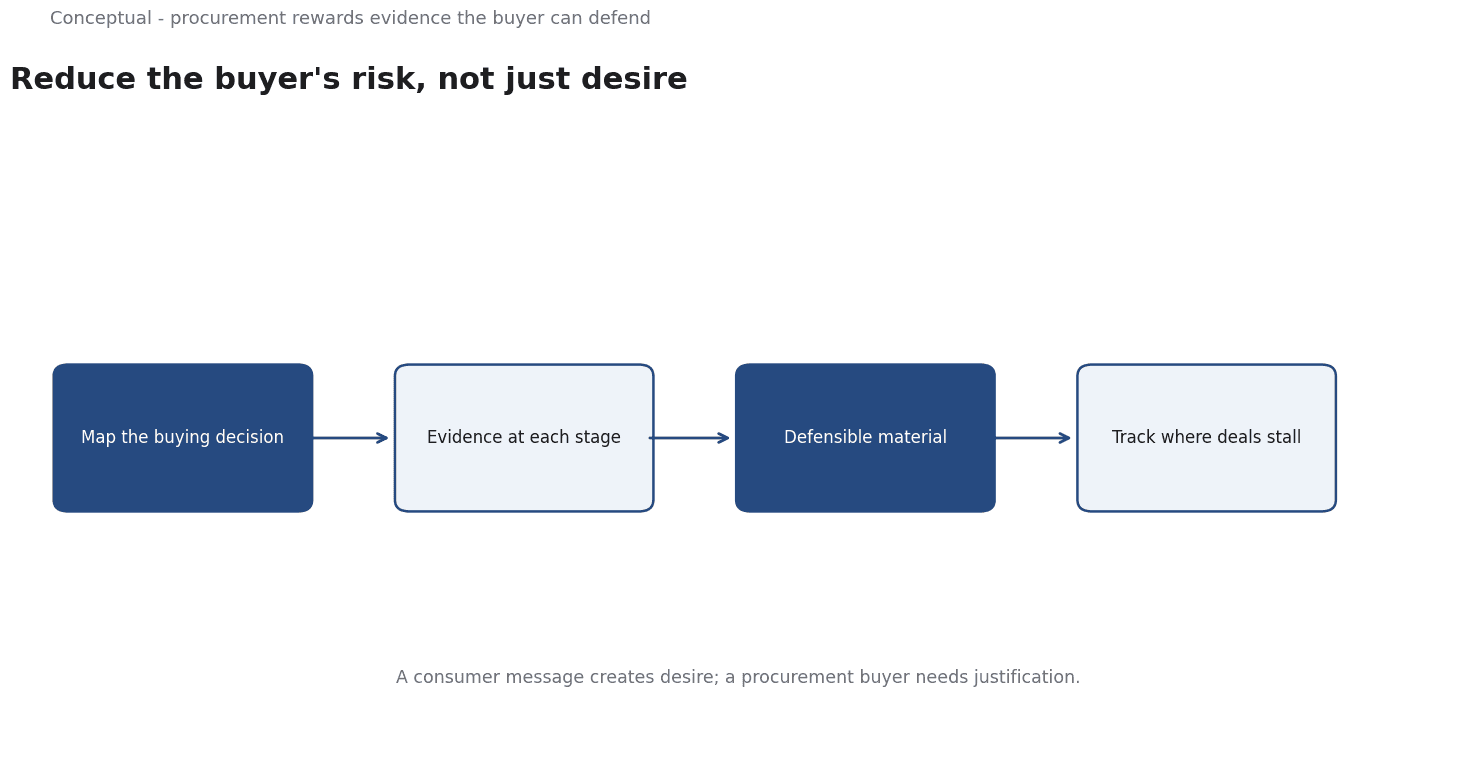
The sequence is: map the buying decision, identify the evidence needed at each stage, provide it in a defensible form, then measure progression. The mapping is local work, so the conclusions are inferred; the process is source-reported.
A worked example
Illustrative. A software vendor wants to enter a formal procurement process.
Three checks decide. First, what criteria will the buyer be judged against, and which of them can the material address? Second, what evidence — references, terms, implementation detail — exists for each criterion? Third, where in the process did previous opportunities stall, and what was missing at that point?
The outcome is a content plan tied to the buyer's decision. The scenario is hypothetical; the method is the contribution.
Evidence status
| Claim | Status | Source | Verified | Recheck when |
|---|---|---|---|---|
| Procurement is an organisational acquisition process | source-reported | Wikipedia, Procurement | 2026-11-18 | Definition changes |
| Buyers move through stages before purchase | source-reported | Wikipedia, Demand generation | 2026-11-18 | Definition revised |
| Provide evidence mapped to the decision | inferred | Derived from the process | 2026-11-18 | Criteria change |
Why a consumer message rarely transfers
A consumer message creates desire; a procurement buyer needs justification.
A final point is that procurement decisions are rarely made by one person. A message that persuades a champion but does not help them justify the choice to others will stall, which is why material should be written for the people who will review the decision.
The process also takes time, and a long cycle means the evidence can age. Dated material and a named owner for keeping it current prevent a proposal from being rejected because a figure or a term was out of date.
The evidence should be packaged for the reviewer who must defend the decision, not only for the champion who requests it.
A stalled opportunity is a useful signal about missing evidence, and the stage where it stalled is worth recording.
A supplier that answers the formal criteria but not the unwritten concerns will still lose the decision, which is a reason to learn what those concerns are.
The evidence should be dated, since a figure or a term that has changed will undermine trust at the point of decision.
The decision criteria should be restated at each stage, since a buyer's emphasis often shifts as the process advances.
What it cannot do
It cannot remove evaluation criteria. It does not replace a product that meets the requirements. And it cannot guarantee selection.
The counterargument that a strong brand is enough is fair for getting noticed and incomplete for a formal decision.
A decision test
- Map the buying decision.
- Identify evidence at each stage.
- Provide defensible material.
- Track where opportunities stall.
- Record the decision and recheck date.
For the buyer stages, see Demand Generation.
References & Further Reading
- Wikipedia contributors, 2026. Procurement - Wikipedia — How organisations acquire goods and services.
- Wikipedia contributors, 2026. Demand generation - Wikipedia — An overview of demand generation as a marketing discipline distinct from lead generation; secondary reference used with the lead-generation entry.