Carbon Markets Trade-Offs
Carbon markets price emissions, not certainty. Read the trade-offs, a worked example, and why a credit is not the same as a reduction.
Carbon markets are often described as a straightforward way to price emissions, which hides the differences between allowances and credits. The Wikipedia entry describes emission trading, and the commodity-market entry covers how markets organise exchange. The trade-offs concern what a traded unit actually represents.
Direct answer: Distinguish what each market unit represents, verify the underlying measurement, and state what a purchase does and does not achieve. The sources describe the mechanisms; the rule is a synthesis.
Delta: This article adds a claim-status table and a worked example, separating documented market structures from local judgements about what a unit means.
The mechanism
The first distinction is between allowances and credits. The carbon-market entry describes trading in emission allowances, which are permissions to emit within a cap. A credit typically represents an avoidance or removal elsewhere, which is a different claim and requires different verification.
The second distinction is measurement. The commodity-market entry describes how exchange is organised, but a market unit is only as meaningful as the measurement behind it. A tonne that was estimated rather than measured is a weaker claim, and the difference matters when the unit is used to support an assertion.
The third distinction is additionality. A reduction that would have happened anyway is not caused by a purchase, and a market unit that does not account for this overstates the effect. Asking what would have happened without the purchase is the causal-inference check.
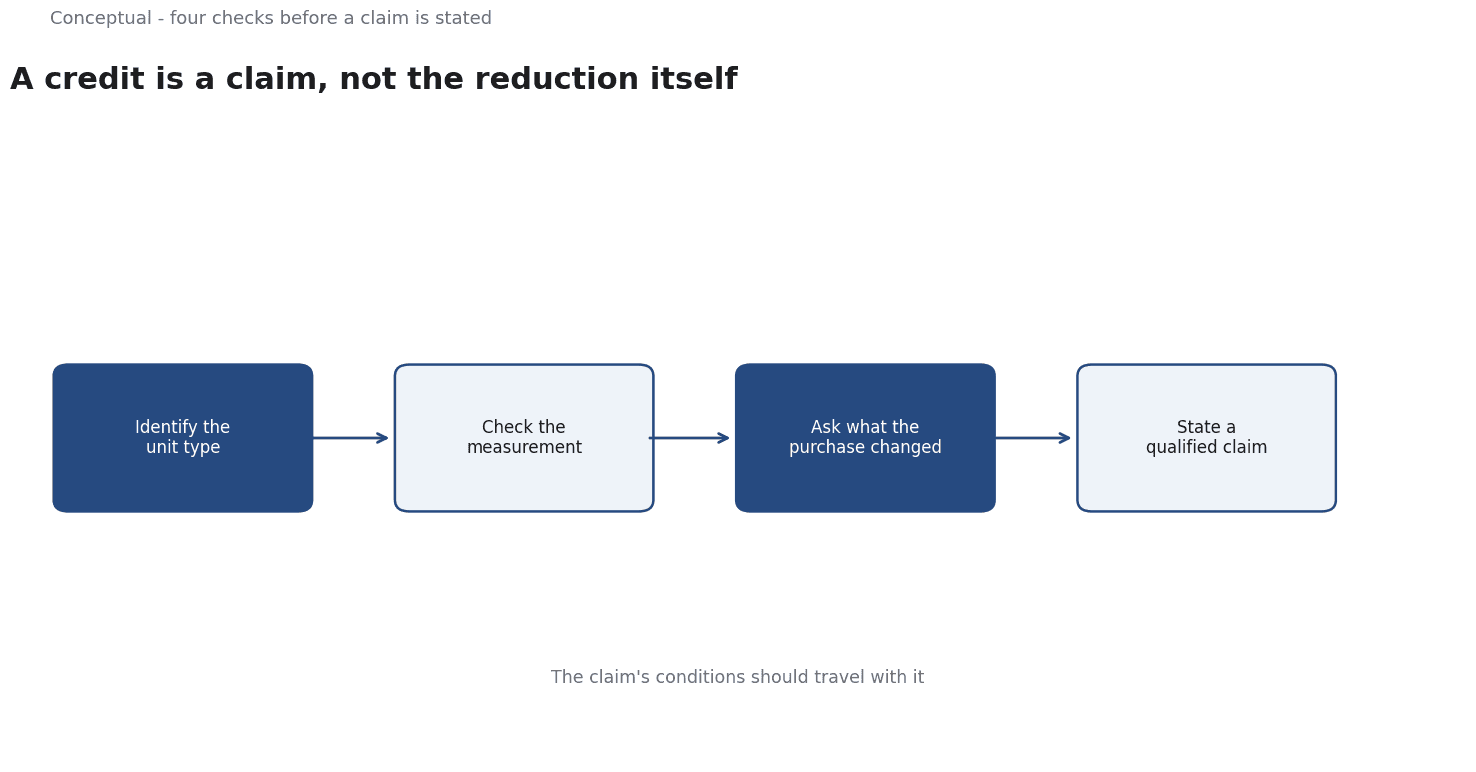
The sequence is: identify the unit, check the measurement, ask what changed because of the purchase, then state the claim. The judgement is local, so the conclusions are inferred; the structures are source-reported.
A worked example
Illustrative. A company buys credits to offset an emission.
Three checks decide. First, does the unit represent an allowance within a cap or a reduction elsewhere? Second, was the reduction measured or estimated, and by whom? Third, would the reduction have happened without this purchase?
The outcome is a qualified claim rather than a simple offset. The scenario is hypothetical; the method is the contribution.
Evidence status
| Claim | Status | Source | Verified | Recheck when |
|---|---|---|---|---|
| Emission trading uses allowances | source-reported | Wikipedia, Carbon emission trading | 2026-11-18 | Definition changes |
| Markets organise exchange between parties | source-reported | Wikipedia, Commodity market | 2026-11-18 | Definition changes |
| Verify the unit and state the claim | inferred | Derived from the structures | 2026-11-18 | Standards change |
Why a credit is not a reduction
A credit is a tradable claim, and the strength of the claim depends on what happened at the source.
A purchase transfers the claim; it does not by itself create the physical change.
A further consideration is that market rules differ between jurisdictions, which changes what a unit means and how it can be used. A claim that is valid in one system may not be valid in another, and a comparison should state which rules apply. Recording the scheme alongside the unit is part of a defensible assessment.
The measurement also has a time dimension. A removal that reverses after a fire or a change in land use is not permanent, and the claim depends on how long the storage is expected to last. Asking about the horizon is part of judging the unit, not an extra question for a later review.
None of this argues against the use of markets. It argues that a unit is a claim with conditions, and that the conditions should travel with the claim rather than being lost when it is traded.
A credit's conditions should travel with it, since the claim weakens when they are lost.
The permanence of a removal belongs in the claim, since it changes what the unit represents.
The rules of the scheme determine what a unit means, and they belong in any claim made with it.
A claim made with a credit should state what would have happened without the purchase.
What it cannot do
It cannot guarantee that an emission was avoided. It does not remove the need to reduce emissions directly. And it cannot make a weak measurement strong.
The counterargument that a market price settles the question is fair for the price and incomplete for the underlying claim.
A decision test
- Identify the unit type.
- Check the measurement and verifier.
- Ask what the purchase caused.
- Use dated records.
- State what the claim does and does not cover.
- Record the assessment and recheck condition.
For the market structure, see Commodity Markets.
References & Further Reading
- Wikipedia contributors, 2026. Carbon emission trading - Wikipedia — Markets for trading emission allowances.
- Wikipedia contributors, 2026. Commodity market - Wikipedia — Structure of markets for raw materials and commodities.