Career Ladders Costs Explained
A career ladder is a structure with running costs. Read where they come from, a worked example, and why a title is not the same as growth.
Career ladders are often discussed as a retention tool, which hides what they cost to run. O*NET's task descriptions help define levels of work, and re:Work treats management as a practice to examine. The cost is in the decisions and evidence a ladder requires.
Direct answer: Count the cost of defining levels, evaluating people against them, and maintaining fairness, then check whether the ladder changes decisions. The sources describe roles and practice; the cost rule is a synthesis.
Delta: This article adds a claim-status table and a worked example, separating role information from the local judgements a ladder demands.
The mechanism
Three costs matter:
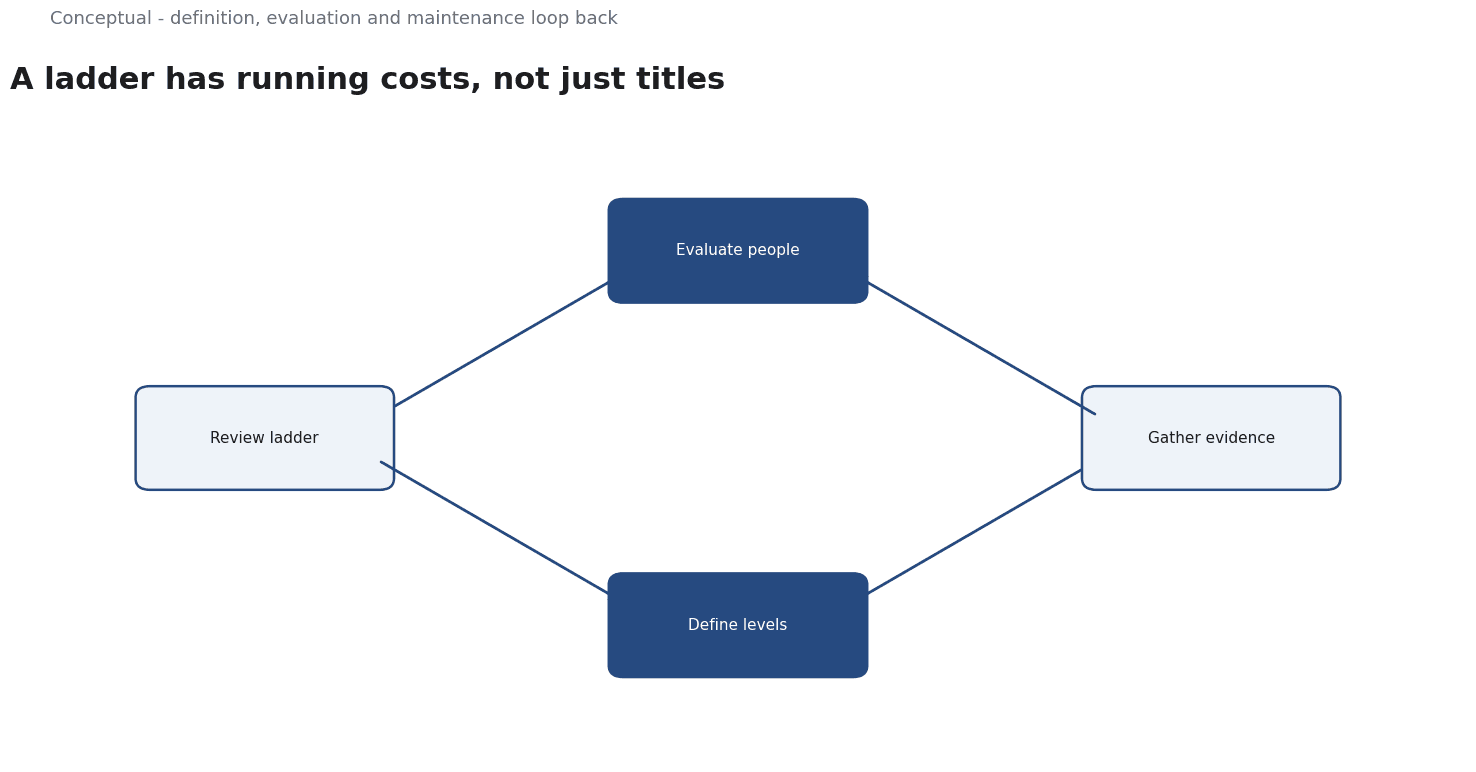
- Definition. A level must describe observable work. The O*NET descriptions help, but a local ladder still has to say what distinguishes one level from the next.
- Evaluation. Judging people against levels takes time and evidence. A ladder without consistent evaluation becomes a set of titles awarded by preference.
- Maintenance. Roles change, and a ladder that is not updated stops describing the work. The re:Work material treats management as something that needs attention.
The sequence is: define levels, gather evidence, decide, then review the ladder itself. The definitions are local judgement, so they are inferred; the role information is source-reported.
A worked example
Illustrative. A team introduces a ladder with three engineering levels.
Three checks decide. First, does each level describe work someone can observe, rather than years served? Second, can a manager point to evidence for a level decision that another manager would accept? Third, has the ladder been reviewed as the team's work changed?
The outcome is a decision about whether the ladder earns its cost. The scenario is hypothetical; the accounting method is the contribution.
Why the review belongs in the cost
A ladder that is never reviewed becomes a description of an older organisation. As the work changes, the levels stop matching what people do, and decisions made against them become arbitrary. Reviewing the ladder is therefore not a voluntary improvement; it is part of the cost of having one.
The review should ask whether each level still describes observable work and whether the evidence used to judge it is still available. A level that depends on a signal nobody records cannot be evaluated fairly, which is a defect in the ladder rather than in the people being assessed.
Evidence status
| Claim | Status | Source | Verified | Recheck when |
|---|---|---|---|---|
| Roles can be described by tasks | source-reported | O*NET | 2026-11-18 | Roles change |
| Management is a practice to examine | source-reported | Google re:Work | 2026-11-18 | Practice changes |
| Count definition, evaluation and maintenance | inferred | Derived from the role information | 2026-11-18 | Organisation changes |
Why a title is not growth
Promoting someone changes a title; it does not by itself give them new capability or new work.
A ladder that rewards time served rather than demonstrated work produces titles without development. The cost is paid by the team, which still needs the work done.
A ladder also cannot replace conversation. A person can meet every observable criterion and still need feedback on how they work with others, which is the part a structure captures poorly.
The structure also sends a signal about what the organisation values. If the levels reward only visible output, people will optimise for visible output, and the less visible work that holds a team together will be neglected. Reviewing the ladder therefore includes asking what behaviour it encourages, not only whether it is administratively correct.
The organisation should also state which decisions the ladder informs. If it is used for pay, promotion, and project assignment, the evidence needed is stronger than if it is only a guide for development. A ladder used for several decisions without clarity about each one produces arguments that are hard to resolve, because the same level means different things in different conversations.
Recording the purpose and the evidence standard keeps those conversations consistent. It also makes it easier to decide when a decision should be made outside the ladder, which is sometimes the right answer for work that the levels do not describe well.
A reviewer who cannot name the behaviour a level describes should treat that as a defect in the ladder.
That defect belongs to the structure, not to the person being assessed.
What it cannot do
It cannot guarantee retention. It does not remove the need for feedback. And it cannot make a poorly defined role clear.
The counterargument that a ladder is necessary for motivation is fair for clarity and incomplete when the levels do not describe real differences.
A decision test
- Define observable levels.
- Gather evidence for decisions.
- Keep evaluation consistent.
- Review the ladder as work changes.
- Count the time spent.
- Record the decision and recheck date.
For the management context, see Engineering Management.
References & Further Reading
- U.S. Department of Labor, 2026. O*NET OnLine — The standard occupational taxonomy used to compare roles across industries.
- Google, 2026. Google re:Work — A large company's published people practices, including hiring and growth frameworks.