Category Design Best Practices
Category design is a positioning decision, not a naming exercise. Read how a category maps to a value proposition, a worked example, and why a new label fails.
Teams often treat category design as a naming exercise: pick a distinctive label, add it to the deck, and expect the market to reorganize around it. The real problem is that a category is a claim about how buyers should frame a problem, and a label without a supporting value proposition changes nothing. A new term can describe a product without giving anyone a reason to choose it.
Direct answer: Define the category by the problem it names and the value proposition that makes it preferable to the alternatives. The product-category entry describes how categories group offerings; the value-proposition entry describes what makes an offering compelling. Choosing a category is a positioning decision, and that mapping is a synthesis.
Delta: This article adds a claim-status table and a worked example beyond the sources: it maps category choice to a positioning decision, with claim status explicit.
The mechanism
The product category entry describes categories as groupings of products that share characteristics and serve similar needs. That definition has a practical consequence for anyone trying to create a category: the grouping exists in the buyer's mind before it exists in a slide. A category is useful when it helps a buyer compare options and understand what a product is for. Inventing a label that does not correspond to a recognisable need adds a term rather than a category. The first task is therefore to identify the need that the proposed category names.
The value proposition entry describes the bundle of benefits that makes an offering attractive to a customer. This is the second requirement. A category without a value proposition is an empty container; a value proposition without a clear category may be hard to place among alternatives.
Category design works when the new grouping changes the terms of comparison in a way that favours the product that proposed it.
The practical consequence is that the category and the value proposition must be written together, because each gives the other meaning.
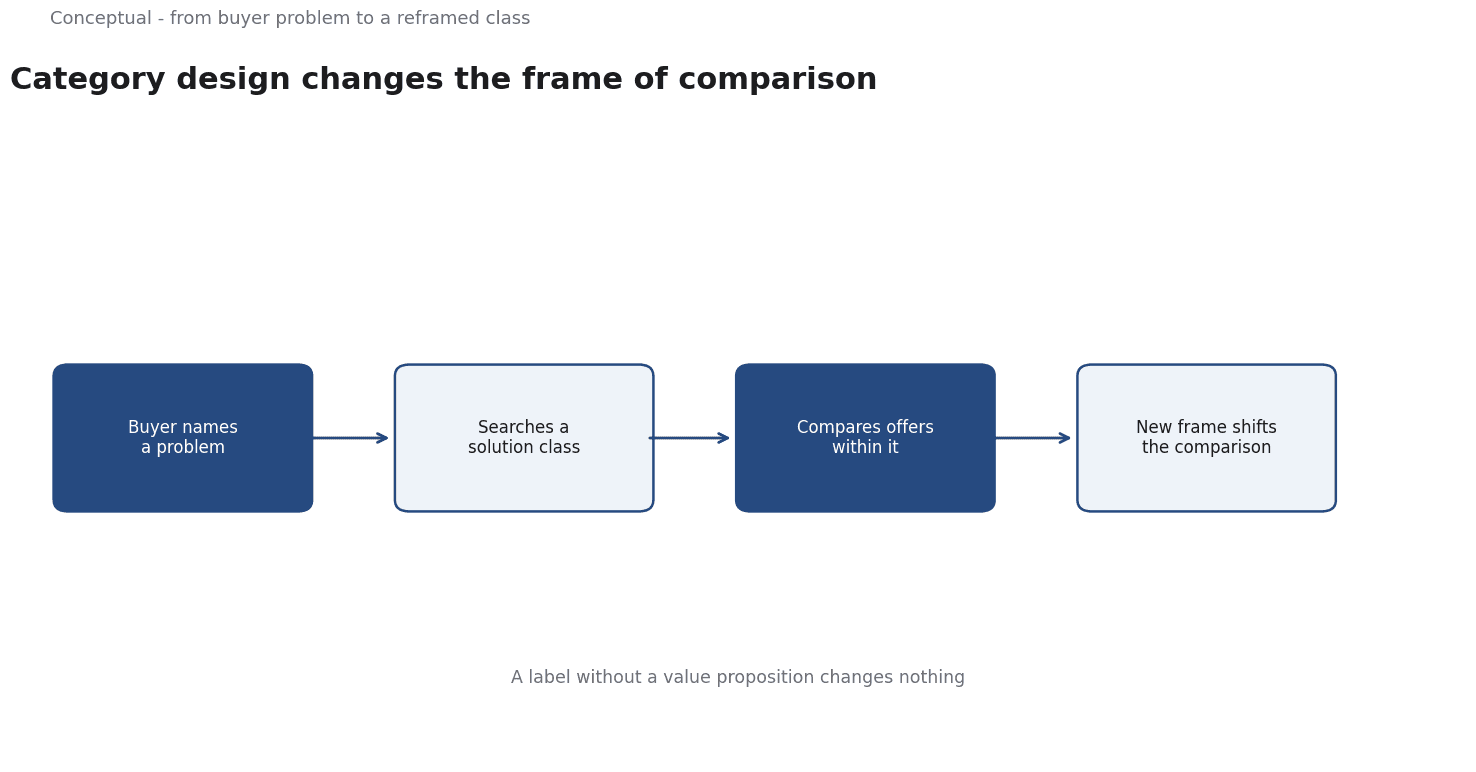
The mechanism is a chain of framing. A buyer perceives a problem, searches for a class of solutions, and compares the offers within that class. A category design intervention attempts to change the class so that the comparison favours a particular approach. That is a positioning decision, not a lexical one. It succeeds only if the buyer accepts the frame and the product delivers the benefit the frame promises. The sources describe categories and value propositions separately; connecting them is a local analytical step.
Because the connection is local, the claims that depend on it are marked inferred. The source-reported rows record what a category is and what a value proposition is. Everything about how a particular team should choose a category is a decision made in a specific market, and should be labelled as such.
A worked example
The following is hypothetical and illustrative. A software team sells a tool that existing buyers file under a broad, crowded category, and the team wants a new label. Three checks decide whether the label is a category or a slogan. First, does the proposed name correspond to a problem buyers already recognise, or does it describe only a feature? Second, does the product deliver a value proposition that is stronger within the new frame than within the old one? Third, can buyers state what the category excludes, so that the boundary is meaningful rather than elastic? The outcome is a positioning decision: adopt the label and build the value proposition around it if all three hold, or keep the existing category and improve the offer if they do not. No market data here is real; the sequence is the contribution.
Evidence status
| Claim | Status | Source | Verified | Recheck when |
|---|---|---|---|---|
| Categories group products that share characteristics | source-reported | Wikipedia, Product category | 2026-11-18 | Definition revised |
| A value proposition describes benefits that attract customers | source-reported | Wikipedia, Value proposition | 2026-11-18 | Definition revised |
| Map category choice to a positioning decision | inferred | Derived from the sources | 2026-11-18 | Buyer framing changes |
The source-reported rows define a category and a value proposition as separate concepts. Neither says how a firm should choose a category. The inferred row is the local addition, tying the choice to positioning. Recheck when buyer language shifts or a competitor reframes the same problem, because a category that once clarified comparison can become a term the market no longer uses.
What it cannot do
Category design cannot create a market by renaming an existing one. A label can change how buyers frame a problem, but it cannot manufacture the underlying need or the budget to address it. The product category entry describes groupings based on shared characteristics; it does not claim that naming produces demand. A team that launches a new category without evidence that buyers recognise the problem will have a term that appears in its own materials and nowhere else. The limit is that framing works on a problem that already exists.
There is a cost in educating the market. A new category requires explaining the frame before the product can be compared within it, and that explanation consumes attention that could go to the product's benefits. Established categories carry an inherited vocabulary that lowers this cost. The practical consequence is that category design is an investment whose payoff is delayed, and it is only justified when the new frame creates a durable advantage. A team that cannot fund the education will be paying for a label that never takes hold.
Buyers do not adopt the frame, comparison continues on the old terms, and the new term becomes internal jargon. A related failure is a category so broad that it excludes nothing, which provides no boundary and therefore no advantage. Both failures share a cause: the label was chosen before the value proposition was tested. The defence is to test whether the offer is genuinely stronger inside the proposed frame before committing to it.
The sources also bound the claim. They define what a category is and what a value proposition contains. They do not supply a method for predicting whether a market will accept a new frame, nor do they guarantee a positioning benefit. Any forecast of adoption is a local judgement based on buyer research and competitive context. Presenting such a forecast as if it followed from the definitions would overstate the evidence and blur the distinction the claim table is meant to preserve.
Finally, the decision needs review. Categories are social facts; they persist only while buyers use them. A frame that distinguished a product last year can become standard terminology, at which point it stops differentiating anything. A review does not require renaming; it requires asking whether the category still shapes comparison in the product's favour. When it no longer does, the value proposition may need to move to a different frame, or the product may need to compete on the original category's terms.
The counterargument that a distinctive name helps a product stand out is fair in a crowded listing and incomplete when the name carries no value proposition buyers can act on.
A decision test
- State the buyer problem the proposed category names.
- Check that buyers recognise the problem already.
- Write the value proposition within the new frame.
- Compare the offer inside and outside the frame.
- Define what the category excludes.
- Decide whether to adopt the label or the existing category.
- Record the claim status and the condition for recheck.
A decision test turns category design from a branding exercise into a positioning choice. It requires the team to name the problem, test the value proposition inside the new frame, and define the boundary. Running it before the label is chosen avoids the common error of inventing a term and searching for a reason to keep it. The recheck condition recognises that categories live in buyer language and can lose their force over time.
For further reading, see Voice of Customer: Turning Feedback into Decisions.
References & Further Reading
- Wikipedia contributors, 2026. Product category - Wikipedia — How product categories group substitutes and shape customer comparison; secondary reference.
- Wikipedia contributors, 2026. Value proposition - Wikipedia — The value a product promises to a buyer.