Cash Conversion Cycle Trade-Offs
A shorter cash conversion cycle is often treated as pure good. Learn what the measure combines, the trade-offs behind each part, a worked example, and its limits.
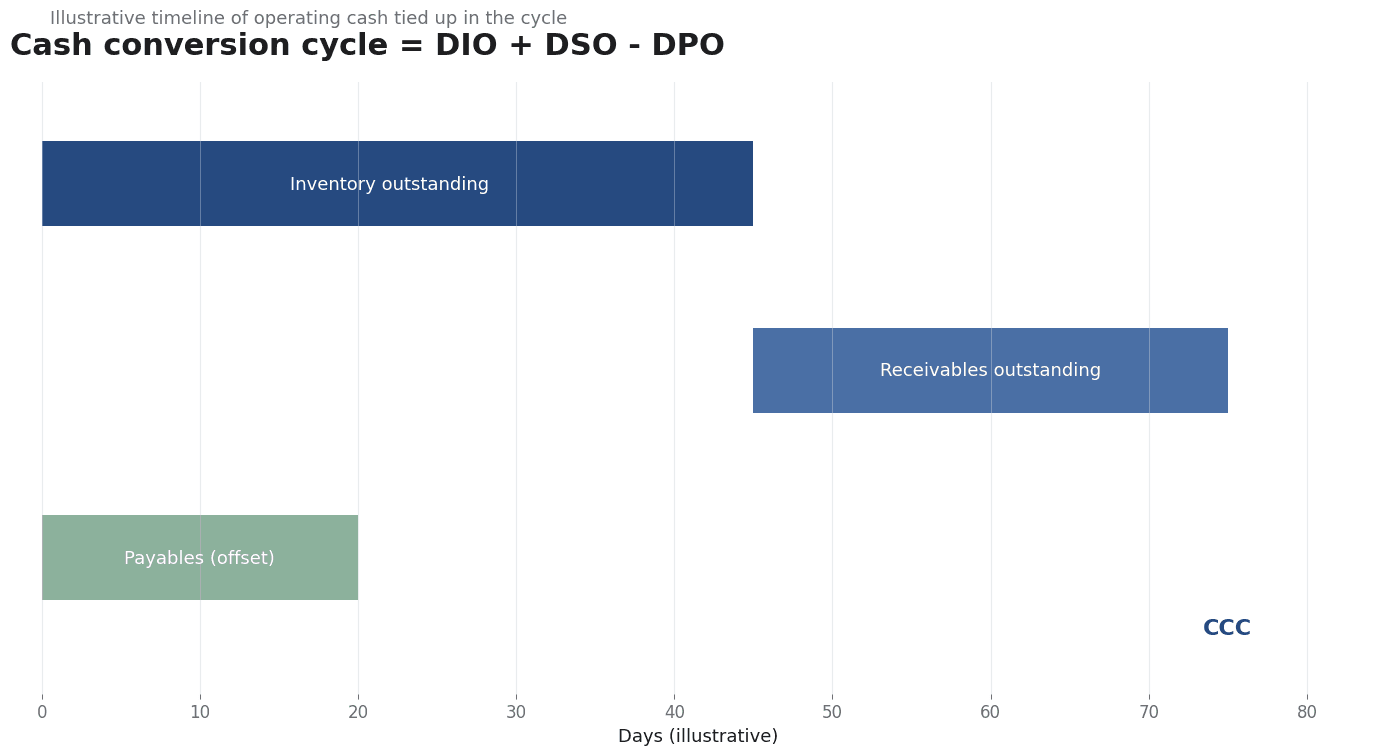
The cash conversion cycle is routinely presented as a measure to minimize, as if every day removed from it were free. In practice it is the net result of three decisions about inventory, receivables, and payables, each with a cost. The real problem is that optimizing the number without regard to those costs can damage the operations that generate the cash in the first place.
Direct answer: The cash conversion cycle combines the days a company holds inventory, the days it takes to collect receivables, and the days it takes to pay suppliers into one liquidity measure. Working capital, the current assets minus current liabilities behind these decisions, is the broader pool the cycle draws from. A shorter cycle generally means less cash tied up, but each component can only be pushed so far before supplier terms, stockouts, or customer relationships suffer.
Delta: This article adds an operational decision framing beyond the two Wikipedia sources: it maps each component of the cycle to the trade-off it hides, with claim status explicit.
The mechanism
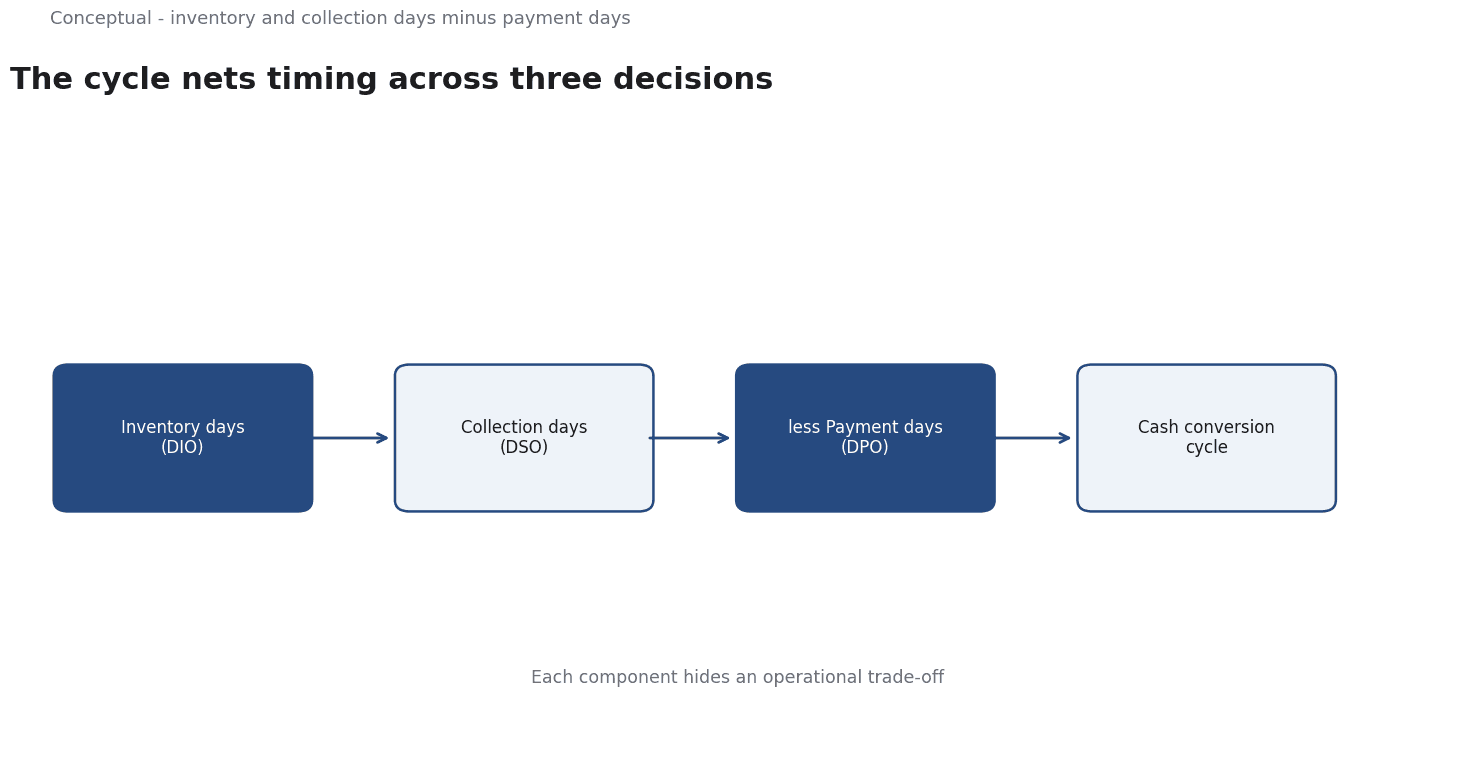
As the source describes it, the cash conversion cycle measures how long cash is tied up in the operating process before it returns from sales. It is assembled from three components: the days inventory is held before sale, the days sales outstanding before customers pay, and the days payable outstanding before the company pays its own suppliers. The first two are added and the third is subtracted, because payables finance part of the inventory and receivables period. The practical consequence is that a single number summarizes the timing gap between paying for inputs and collecting from customers.
Working capital provides the broader frame. Defined as current assets minus current liabilities, it captures the short-term resources available to run the business. The cash conversion cycle is a timing view of part of that pool: even a profitable company can run short of cash if the cycle is long and working capital is thin. The practical consequence is that the cycle and the level of working capital must be read together, since a short cycle with a small buffer behaves differently from a long cycle with a large one.
Each component hides a decision. Reducing inventory days can free cash but raises the risk of stockouts and lost sales. Reducing collection days can speed cash but may strain customers who rely on longer terms. Extending payment days can preserve cash but can damage supplier relationships and pricing.
The practical consequence is that the cycle is a scoreboard for choices made elsewhere, not an independent lever.
That is why the measure is a trade-off rather than a target. The sources present definitions and relationships, not a prescription that smaller is always better. A business can push one component down and another up, so the net effect on the cycle may be small while the operational damage is large.
A worked example
The following is hypothetical and illustrative. A distributor reports inventory days of 40, collection days of 30, and payment days of 20, giving a cycle of 50 days. Management sets a target of 35 days and proposes to reach it by stretching supplier payments from 20 to 35 days. Three checks decide whether this is sound. First, supplier impact: if earlier payment terms funded a discount or priority allocation, losing them may cost more than the cash saved. Second, persistence: a one-time extension of payment days shifts timing once, while a lasting cycle reduction requires a structural change. Third, total cost: if late payments risk penalties or supply disruption, the apparent gain is overstated. The outcome is a decision to examine inventory and collection days instead, where changes may carry lower relationship cost.
Evidence status
| Claim | Status | Source | Verified | Recheck when |
|---|---|---|---|---|
| The cash conversion cycle combines inventory, collection, and payment days | source-reported | Wikipedia Cash conversion cycle | 2026-11-18 | When finance reference definitions change |
| Working capital equals current assets minus current liabilities | source-reported | Wikipedia Working capital | 2026-11-18 | When accounting definitions are revised |
| Cutting the cycle by stretching payables can raise hidden supply and relationship costs | inferred | Derived from the sources | 2026-11-18 | When supplier terms or operations change |
The source-reported rows restate definitions the references give directly. The third row is a judgment about trade-offs inferred from those definitions and is not stated by the sources as a rule. Recheck the first two rows if the reference definitions change; recheck the inferred row when supplier terms, inventory policy, or collection practice shifts.
What it cannot do
The cash conversion cycle cannot tell you whether a change is good. It reports a duration, not a cost or a benefit. A shorter cycle achieved by cutting inventory to the bone and a shorter cycle achieved by negotiating better payment terms look identical in the number but have very different consequences. The measure is a diagnostic, and treating it as a target invites gaming.
The hidden cost sits outside the metric. Stretching payables preserves cash today but can forgo early-payment discounts, weaken supplier goodwill, and raise the risk of disrupted supply. Reducing inventory can trigger stockouts and lost sales that never appear in the cycle calculation. Tightening collections can push customers toward competitors. Each of these shows up elsewhere in the business, while the cycle improves, which is why a narrow focus on the number can raise total cost.
Delaying a single payment this quarter reduces the cycle at the measurement date but does not change the operating model, and the benefit reverses when the payment is made. A related failure is averaging: a cycle computed from period-end balances can be distorted by seasonal peaks, so a single snapshot may misrepresent the year.
The boundary is what the measure excludes. It says nothing about profitability, the cost of capital, or the risk profile of the decisions behind it. It is also sensitive to industry norms, since a cycle that is normal in one sector may be alarming in another, and comparisons across businesses require that context. A number without a benchmark is hard to interpret.
Because the components move with operations, the cycle needs regular review. Supplier terms, product mix, and collection behavior all change, and a review that decomposes the cycle into its three parts will spot which component is drifting. Without that decomposition, a change in the total is a signal with no explanation.
Counterargument:
The counterargument that a shorter cycle is always better is fair when cash is scarce and the components have slack and incomplete when the same reduction is bought with supply risk, stockouts, or damaged customer terms.
A decision test
- Decompose the cycle into inventory, collection, and payment days before setting a target.
- Identify which component can change without harming operations.
- Estimate the cost of each change, including discounts, stockouts, and relationship effects.
- Distinguish a one-time timing shift from a structural improvement.
- Compare the cycle against a sector-appropriate benchmark.
- Check that working capital provides an adequate buffer alongside the cycle.
- Review the components regularly and investigate any drift.
Use the cycle as a starting question, not a verdict. When a target is set, name which component will move and what it will cost. The discipline is to connect the number back to the operating decision, because a better cycle that weakens supply or customers is not an improvement.
For further reading, see Cash Flow Forecasting: A 13-Week Operating Model.
References & Further Reading
- Wikipedia contributors, 2026. Cash conversion cycle - Wikipedia — The days-inventory, days-receivable and days-payable formula for the cash conversion cycle.
- Wikipedia contributors, 2026. Working capital - Wikipedia — Current assets minus current liabilities, and why a growing business can be cash-constrained; secondary reference.