Consulting Mistakes to Avoid
Recurring mistakes in consulting engagements, from vague scope to handoff gaps, mapped to practical checks with explicit claim status.
Clients hire consultants for outside expertise and an independent view, yet engagements often end with unused decks and problems that remain unsolved. The real problem is a gap between the advice produced and the change the client can actually implement. Mistakes repeat because the incentives of advisor and client are rarely aligned by default, and because the handoff is treated as an afterthought rather than a design decision.
Direct answer: A consultant provides external expert advice, and management consulting focuses on analyzing business problems and proposing improvements to organizational performance. The bounded consequence is that value depends on how well recommendations fit the client's capacity to execute. Scope and handoff design therefore matter as much as the quality of the analysis itself.
Delta: This article adds a decision map beyond the sources: it maps the advisory role to engagement-design decisions, with claim status explicit.
The mechanism
The source on consultants describes an external professional engaged for specialized knowledge or an independent perspective. The practical consequence is that independence is a core part of the value: if the advisor becomes too embedded in internal politics or too dependent on a single client for future work, the objectivity that justified the engagement erodes. Protecting that position is not aloofness; it is what makes the advice credible in the first place.
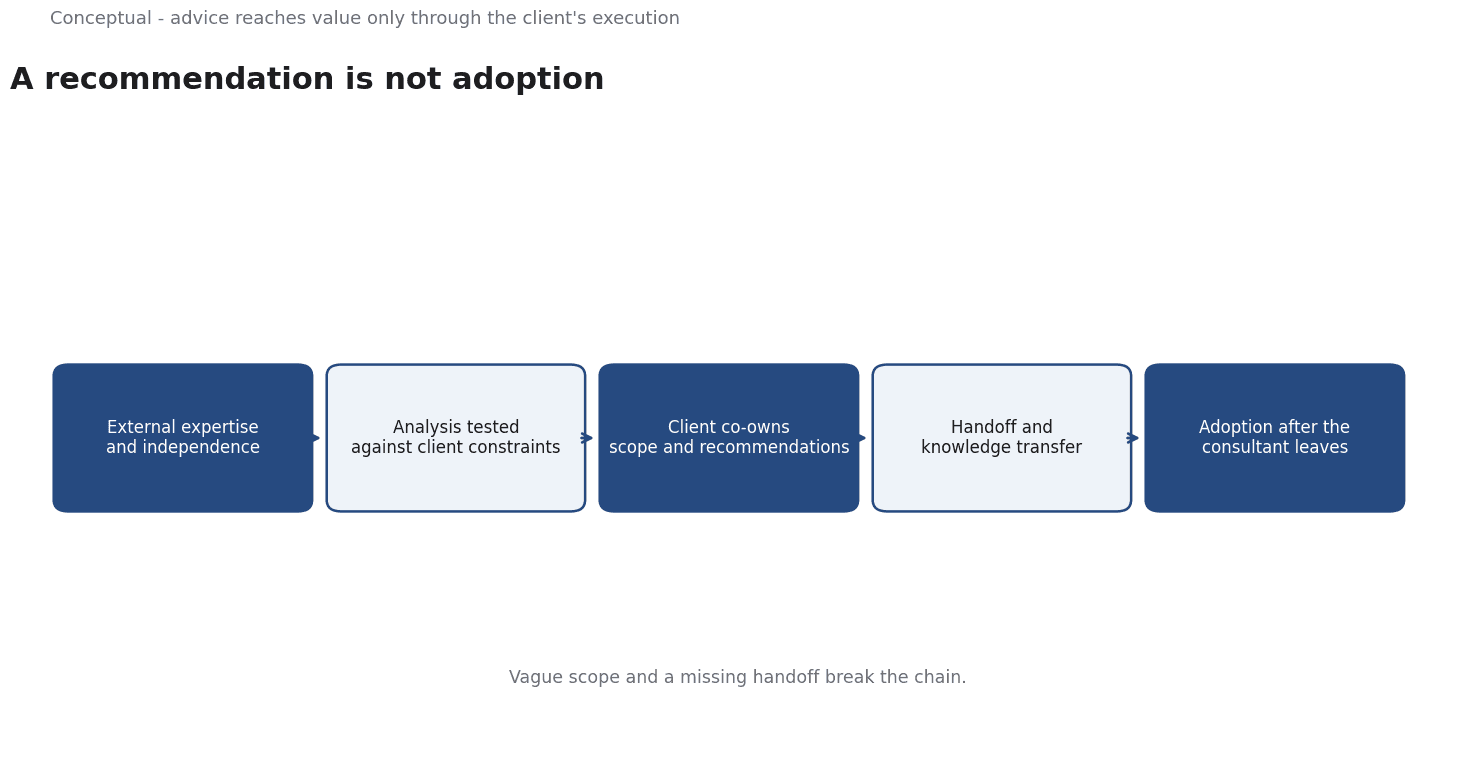
The source on management consulting frames the work as analyzing business problems and proposing strategies to improve performance. Deliverables are recommendations, and a recommendation is only as useful as its feasibility. Analysis that ignores staffing, systems, and timing constraints produces a document that looks rigorous but cannot be acted on. The mechanism therefore only creates value when analysis is joined to implementation reality.
Without client ownership, adoption stalls after the consultant leaves. Engagement design should name a client owner, involve client teams during analysis, and make the final recommendation something the client helped shape rather than something presented at the end.
A second mistake is unclear scope. When boundaries are vague, work expands through small requests that are never renegotiated, and the engagement drifts away from its original purpose. A third mistake is neglecting knowledge transfer. A good engagement leaves the client more capable than it was, which requires documenting methods and building client skill during the work rather than handing over a static file at the end.
A worked example
The following is hypothetical and illustrative. A mid-sized firm hires a consultant to reduce support costs, with an initial plan to recommend a new ticketing platform. Three checks shape the engagement. First, the scope is bounded with explicit deliverables, a fixed review point, and a named client owner who can approve decisions. Second, each recommendation is tested against the client's actual constraints, including staffing levels and existing systems, rather than against an ideal operating model. Third, a handoff plan is agreed up front, with documented processes and a short training session for the support leads. The first recommendation, a platform swap, fails the capacity check because no one can staff the migration. Outcome: the engagement is redirected to process changes co-owned by the client team, and the recommendations are adopted because the client helped build and can maintain them.
Evidence status
| Claim | Status | Source | Verified | Recheck when |
|---|---|---|---|---|
| Consultants provide external expert advice and an independent perspective | source-reported | Wikipedia Consultant | 2026-11-18 | the professional definition is revised |
| Management consulting analyzes business problems and proposes performance improvements | source-reported | Wikipedia Management consulting | 2026-11-18 | the scope of the field changes |
| Recommendations that ignore client capacity are less likely to be adopted | inferred | Derived from the sources | 2026-11-18 | engagement design or client context changes |
The reported rows reflect how the two sources define the profession and the field, and they are stable at that level of generality. The inferred row connects the advisory role to an adoption consequence and depends on how the client is structured. It should be rechecked when the engagement model or the client's execution capacity changes, since a recommendation that fits one organization may fail in another.
What it cannot do
Consulting advice is not execution. Consultants typically lack the authority to implement decisions and depend on client buy-in and line management to make changes stick. A strategy can be sound on paper and still fail because no one with decision rights owned it. Treating the final presentation as the finish line is the most common way an otherwise good engagement loses its value.
There are hidden costs beyond the fee. Long engagements consume client attention, and fee structures that reward hours can quietly reward complexity rather than resolution. The opportunity cost of pulling internal staff into interviews and workshops is real, and it is often omitted from the business case. When the engagement runs longer than planned, that cost grows without any corresponding increase in value.
Failure modes include dependency and generic advice. A client can become reliant on the advisor for decisions it should learn to make, and frameworks applied without attention to context can produce recommendations that sound standard but fit no one. Conflicts of interest also matter: relationships with vendors or implementation partners can shape which options are presented as attractive, even without explicit intent.
The boundary is narrower than it appears. Consulting is a weak fit for problems that require line authority to resolve, and it is not a substitute for action during an operational crisis. It also cannot replace internal capability building. Where the real gap is skill or staffing, an engagement that produces a report without developing people leaves the underlying problem untouched.
Because of these limits, the work needs ongoing review. Scope and conflict disclosures should be revisited as the engagement evolves, and recommendations deserve follow-up after the consultant leaves.
Adoption, not delivery, is the useful measure of success, and that can only be assessed once the client has had time to act on the advice.
Counterargument: "The counterargument that external advice is fair for structured analysis is incomplete for problems needing line authority or immediate operational action, where a report cannot substitute for decisions."
A decision test
- State the business problem and what a successful outcome would look like in measurable terms.
- Confirm that the problem needs external analysis rather than internal decision authority.
- Define scope, deliverables, and a review point, and name a client owner.
- Disclose potential conflicts, including vendor or implementation relationships.
- Test each recommendation against the client's staffing, systems, and timing constraints.
- Build knowledge transfer into the work through documented methods and client participation.
- Schedule a post-engagement review focused on adoption, not on deliverable completion.
The test keeps the engagement honest about what an outside advisor can and cannot deliver. When scope, ownership, constraints, and handoff are settled before analysis begins, recommendations have a realistic path into practice.
Skipping those steps may produce a polished report, but polish is not the same as a change the client can sustain.
For further reading, see Decision Memos That Survive Review.
References & Further Reading
- Wikipedia contributors, 2026. Consultant - Wikipedia — The role and economics of professional advisory work.
- Wikipedia contributors, 2026. Management consulting - Wikipedia — The structure of consulting engagements and their critics.