Cost of Capital for Private Companies: A Practical Estimate
WACC is a public-company convention that private firms must adapt. Read the inputs, a worked estimate, and why the number is a range.
A private company cannot observe its cost of equity from a share price, and its debt is rarely traded. The standard framework still applies, but every input has to be estimated from comparable evidence. That is a reason for care, not for abandoning the framework — a rough, explicit cost of capital is more useful than a discount rate chosen because it produces the desired valuation.
Direct answer: The weighted average cost of capital combines the after-tax cost of debt and the cost of equity in proportion to a company's capital structure; Wikipedia's WACC entry gives the standard weighting, and the cost-of-capital entry distinguishes debt from equity. Damodaran's published cost-of-capital data provides the practitioner's inputs. The boundary: for a private company, every input is an estimate from comparables, so the honest output is a range with stated assumptions, not a precise percentage.
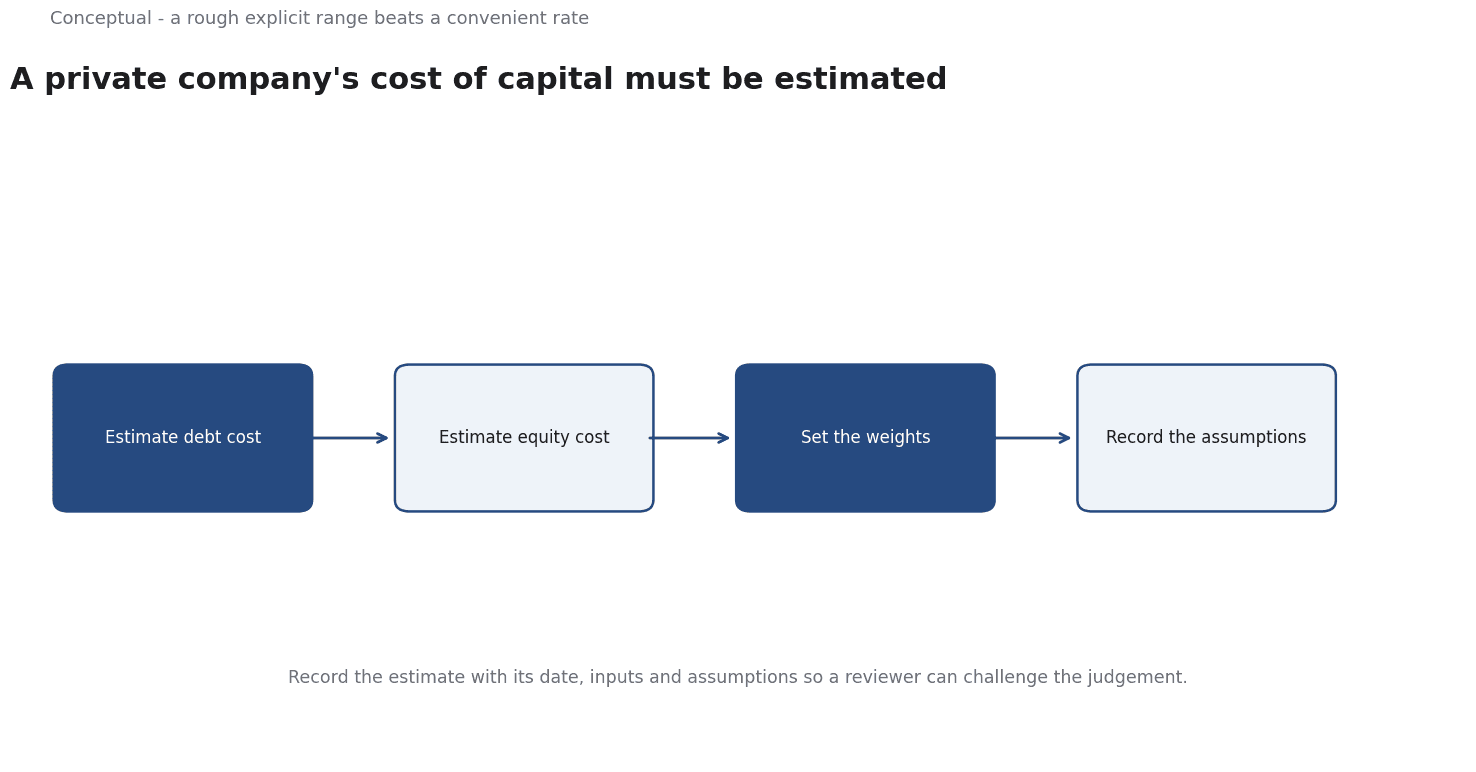
The two components
Cost of debt. The rate the company would pay to borrow. For a private firm this can be estimated from its actual borrowing rate, from the rates implied by its credit profile, or from a comparable public company's yield adjusted for the private firm's risk. Interest is tax-deductible in many jurisdictions, so the after-tax cost is lower than the quoted rate.
Cost of equity. The return equity investors require. The capital asset pricing model estimates it as a risk-free rate plus a beta multiplied by the market risk premium, with additions for company-specific risk. For a private company there is no observed beta, so it must be inferred from comparable public firms and adjusted — a step that requires judgement.
The weights come from the target capital structure: the proportion of debt and equity the business expects to carry, valued at market terms where possible.
Why private estimates diverge
Three differences matter:
No observable beta. A comparable public company's beta reflects its business risk and its financial leverage. Unlevering and relevering it for the private firm is standard practice, but the result depends on which comparables you chose.
Illiquidity and size. Private equity cannot be sold quickly, and smaller companies are typically riskier. Practitioners add a premium for these factors. The size of that premium is a judgement with a large effect on the result.
Debt is not priced by a market. A bank's rate reflects its view of the specific borrower and the collateral, not a market yield. One company's loan rate is a weak benchmark for another's.
A worked example of an estimate
The following numbers are hypothetical and illustrative.
A private industrial company targets 30% debt and 70% equity. Its marginal borrowing rate is 8%, and the corporate tax rate is 25%. Its comparable public firms imply an unlevered beta of 0.9; relevering for its structure gives roughly 1.1. Assume a risk-free rate of 4% and an equity risk premium of 5%, plus a 2% size and illiquidity premium.
After-tax cost of debt: 8% × (1 − 0.25) = 6.0%.
Cost of equity: 4% + (1.1 × 5%) + 2% = 4% + 5.5% + 2% = 11.5%.
WACC: 0.3 × 6.0% + 0.7 × 11.5% = 1.8% + 8.05% = 9.85%, roughly 10%.
Now test the assumptions:
- The size premium matters. If it is 1% instead of 2%, WACC falls to about 9.15%. A single judgement moves the discount rate by 0.7 points — enough to change a valuation materially.
- The capital structure is a target, not a fact. If the company actually carries 10% debt, the weighting changes. Use the structure the business expects to maintain, and say so.
- The tax assumption is jurisdictional. If interest is not deductible, the after-tax cost of debt is 8%, and WACC rises.
Three conclusions follow:
- Report a range, not 9.85%. The inputs do not support two decimal places.
- Show the sensitivity to the size premium and the risk-free rate, because those dominate the result.
- Use the rate consistently with the cash flows. Nominal cash flows require a nominal rate; real cash flows require a real rate.
Using the estimate in a decision
A cost-of-capital estimate is only useful when it changes a decision. Three applications are common:
Screening investments. A project should earn more than the cost of the capital it uses. If a proposed initiative returns 8% against a 10% WACC, it destroys value even though it is profitable in accounting terms. The WACC estimate decides whether the project proceeds.
Valuation. Discounted cash flow models use WACC as the discount rate. The range from the sensitivity analysis should become a range of values, not a single midpoint presented as the answer.
Performance measurement. Some companies compare divisional returns with a risk-adjusted hurdle rate. This is where the single-rate problem becomes visible: a low-risk division judged against a high group WACC looks better than it is, and a risky division looks worse.
In each case the estimate should be recorded with its date, inputs, and assumptions so that a reviewer can challenge the judgement rather than the arithmetic.
The arithmetic is rarely where these estimates go wrong.
Where the framework breaks
A single rate for a diversified company is wrong. A business with a stable utility division and a volatile software division has different risk profiles. Using one WACC across both subsidises the risky division and penalises the safe one. Divisional rates are more work and more honest.
Beta is a proxy for business risk, not a measurement of it. Comparable selection drives the result.
Early-stage companies break the model. A pre-revenue firm with no operating history has no reliable beta, no stable capital structure, and cash flows that are not well described by a constant discount rate. Scenario-based valuation is more useful than a precise WACC in that setting.
The counterargument — that an approximate discount rate is worse than none — is wrong in direction.
Every valuation embeds a discount rate; leaving it implicit is not avoiding the choice, it is hiding it.
A decision test
- Choose comparable companies and state why they are comparable.
- Unlever and relever beta for the target capital structure, documenting the steps.
- Estimate the cost of debt from actual or comparable borrowing, adjusted for tax.
- Add explicit size and illiquidity premiums with the reasoning stated.
- Compute WACC as a range across plausible premium assumptions.
- Match the rate to the cash flows — nominal with nominal, real with real.
- Use separate rates for materially different divisions where the risk differs.
For the wider valuation context, see Corporate Finance Essentials; for the data source, see Damodaran Online.
References & Further Reading
- Wikipedia contributors, 2026. Weighted average cost of capital - Wikipedia — The WACC formula weighting debt and equity costs by capital structure; secondary reference.
- Wikipedia contributors, 2026. Cost of capital - Wikipedia — The distinction between the cost of debt and the cost of equity, and the role of risk.
- Aswath Damodaran, 2026. Damodaran Online: Home Page for Aswath Damodaran — Damodaran's practitioner resources on valuation and cost of capital (stable home page; the WACC data file path is intermittently slow).