Core Web Vitals: a Decision Framework
Core Web Vitals are signals, not goals. Read how to decide what to fix, a worked example, and why a score alone does not set priority.
Core Web Vitals are often treated as a checklist to pass, which leads to fixing the easiest metric rather than the most important problem. The Web Vitals material defines the metrics, as the SEO starter guide covers the broader context, as the dashboard article argues for metrics tied to decisions, as the evaluation-rubric article requires for concrete criteria, as the publication standard forbids performance guarantees.
Direct answer: Use the vitals to decide what to fix by locating the failing metric, connecting it to a user journey, and estimating the cost of the fix. Web Vitals defines the metrics, and the SEO starter guide covers the context. The boundary: a good score does not guarantee a fast experience in untested conditions, which the web-performance article warns about realistic connections, as the risk article requires residual risk.
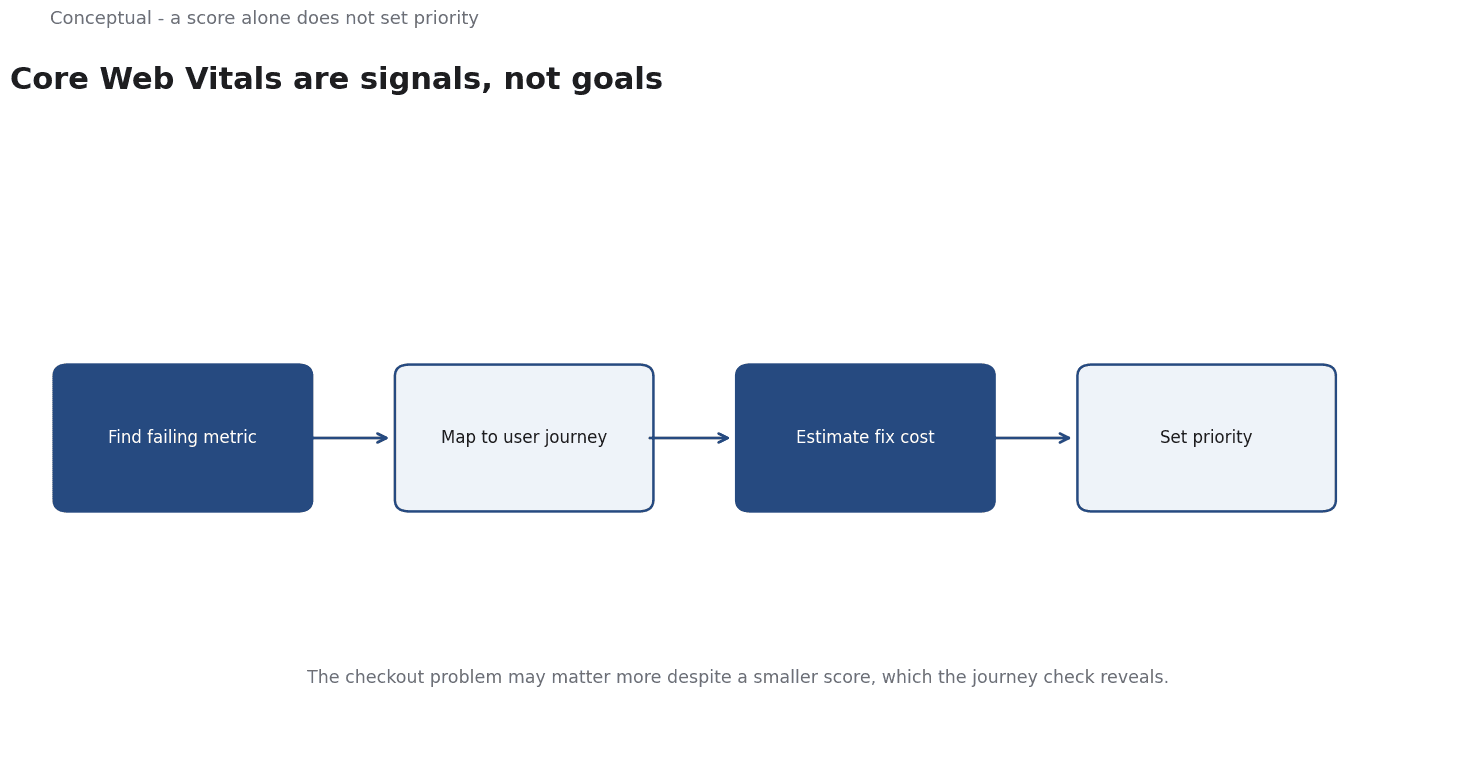
The framework
Locate the failing metric. Which of the vitals is poor, and on which pages, which the Web Vitals material defines, as the Core Vitals article advises, as the rubric article requires concrete criteria, as the dashboard article argues for metrics tied to decisions, as the observability article treats signals as evidence, as the data-governance article requires dated figures, as the monitoring article advises for review.
Connect to a journey. A metric matters when it affects a journey users take, which the web-performance article advises, as the customer-journey article recommends for evidence from real people, as the funnel article treats stage measures, as the analytics article recommends for observed behaviour, as the value-proposition article argues for the buyer's evaluation, as the decision-memo article requires for a question.
Estimate the fix. What will the change cost and what will it improve, which the cost estimator requires, as the web-performance article advises for finding the slow layer, as the LCP article advises for diagnosis, as the CLS article advises for layout, as the rubric article requires criteria, as the risk article requires residual risk, as the decision-memo article requires a reversal condition.
Verify after change. Did the metric improve on a realistic connection, which the web-performance article requires, as the monitoring article advises, as the observability article treats signals as evidence, as the data-governance article requires dated figures, as the decision-memo article requires for a record, as the risk article requires residual risk.
Three consequences follow. The metric comes before the fix, as the Web Vitals and dashboard articles advise, as the rubric article requires, as the observability article treats signals, as the data-governance article requires dated figures, as the monitoring article advises for review, as the decision-memo article requires for a record, as the risk article requires residual risk, as the web-performance article requires realistic conditions, as the customer-journey article advises for real people, as the funnel article treats stage measures, as the cost estimator requires for the fix.
A worked example
The following is hypothetical and illustrative. A site reports poor LCP on product pages and poor CLS on checkout.
Three checks decide the priority. First, which journey is affected, as the customer-journey and funnel articles advise, with observed behaviour, as the analytics article recommends? Second, what causes each metric problem, as the LCP and CLS articles advise, with a trace, as the tracing method recommends, as the web-performance article advises for the slow layer? Third, what does each fix cost, as the cost estimator requires, with a criterion, as the rubric article requires, as the decision-memo article requires for a record, as the risk article requires residual risk?
Three conclusions follow.
The checkout problem may matter more despite a smaller score, which the journey check reveals.
Causes differ by metric, as the LCP and CLS articles advise. And the decision should be recorded, as the decision-memo article requires.
What the framework cannot do
It does not measure the whole experience, which the Web Vitals material treats the metrics as a set, as the customer-journey article advises, as the rubric article requires criteria, as the observability article treats signals. And it cannot replace measurement, which the observability and data-governance articles require, as the monitoring article advises for review, as the decision-memo article requires for a record.
The counterargument that one score decides priority is fair as a summary and incomplete without the journey, which the worked example shows, as the dashboard and customer-journey articles advise, as the rubric article requires criteria, as the risk article requires residual risk.
A decision test
- Identify the failing metric, as Web Vitals defines.
- Connect it to a journey, as the customer-journey article advises.
- Find the cause, as the LCP and CLS articles advise.
- Estimate the fix, as the cost estimator requires.
- Test on realistic connections, as the web-performance article requires.
- Verify after change, as the monitoring article advises.
- Record the decision and residual risk, as the decision-memo and risk articles require.
For the definitions, see Core Web Vitals; for the diagnosis, see LCP Pitfalls.
References & Further Reading
- web.dev, 2026. Web Vitals — The Core Web Vitals thresholds and what each metric measures.
- Google, 2026. SEO Starter Guide: The Basics — The search engine's own description of what it needs from a site.