Corporate Finance Essentials: Capital Structure, WACC, and Investment Decisions
WACC is a model, not a measurement. Learn how capital structure choices work, where the discount rate comes from, and how sensitive the answer is.
Corporate finance is often taught as a formula sheet: discount a cash flow at the weighted average cost of capital, subtract net debt, and you have an enterprise value. The formula is correct and almost useless on its own, because every input in it is an assumption, and the arithmetic hides which assumptions matter.
Direct answer: Capital structure is a choice between funding a business with equity and debt, and it changes the firm's risk, its tax position, and its cost of capital. WACC is the number that folds that choice into a single discount rate. It is built from observable inputs — most importantly the risk-free rate, published daily by the Federal Reserve — and unobservable ones, such as the equity risk premium and the firm's own beta. The practical discipline is not to compute WACC more precisely; it is to know which inputs the decision is actually sensitive to, and to re-run it when the observable inputs move.
What capital structure actually changes
Debt and equity are not just different labels on the same money. Three things change when you lever the balance sheet.
Risk transfers to the debtholder. Equity holders receive whatever is left after creditors are paid, so they bear the residual risk; creditors are paid first and therefore take less risk, which is why they demand a lower return. Leverage raises the volatility of equity returns — it does not create value by itself, it redistributes the distribution.
Interest is deductible, principal is not. This is the source of the familiar argument for debt. A pound of interest reduces taxable profit; a pound of principal repayment does not. The benefit is real and it is finite: it is capped by the marginal tax rate, and it exists only while the firm is profitable.
Distress has a cost that grows with leverage. As the probability of default rises, the cost of both debt and equity rises, and the firm's flexibility falls — covenants, refinancing risk, and the requirement to keep investing through a downturn are all more binding when the balance sheet is stretched.
The net effect is that most firms land at an interior optimum rather than at either extreme, and the optimum moves with the business: a stable, cash-generative, asset-heavy firm can carry more debt than a young, loss-making, volatile one.
Where the discount rate comes from
The risk-free rate is the one input that is published rather than estimated. The Federal Reserve's H.15 release provides "Selected Interest Rates (Daily)", including Treasury yields, and these are the series used to anchor a discount rate to a dated observation.
Two properties of that source matter in practice. It is dated — a valuation that uses last quarter's rate is a valuation with a stale input, and the rate has moved materially within the last year alone. And it is short-dated by default: H.15 publishes a range of maturities, and which one you use is a decision you have to make, not a detail the data resolves for you.
The remaining components are assumptions. The equity risk premium is not observable and is estimated from long-run history; the firm's beta is a regression estimate that varies with the measurement window; the cost of debt depends on the firm's own credit spread at the moment of pricing. Each of these can be reasonable and the resulting WACC can still be off by enough to flip an investment decision, which is why sensitivity analysis matters more than the third decimal place.
WACC also embeds a capital structure, and that creates a circularity: the weight on debt depends on the firm's leverage, which depends on the valuation, which depends on the discount rate. Practitioners resolve it by iteration or by assuming a target structure, and the assumption should be stated.
The Federal Reserve's role in the discount rate
The Fed's monetary policy page lists the framework, the tools, and the reporting that move the risk-free rate: "Monetary Policy Principles and Practice", the "Monetary Policy Report", the "Beige Book", and "Federal Reserve Balance Sheet Developments". None of that is about your company, and all of it moves the number your valuation depends on.
The practical consequence for a finance team is that the discount rate is not yours to set. It is the market's price of money at a point in time, and the evidence for that price arrives on a schedule you do not control. A model that recomputes the risk-free rate monthly and re-ranks investment candidates is more honest than one that recomputes it annually and re-ranks nothing.
What the model cannot tell you
Two things are routinely asked of a DCF that it cannot deliver.
It does not tell you whether the business is good. A discount rate converts a set of forecasts into a present value.
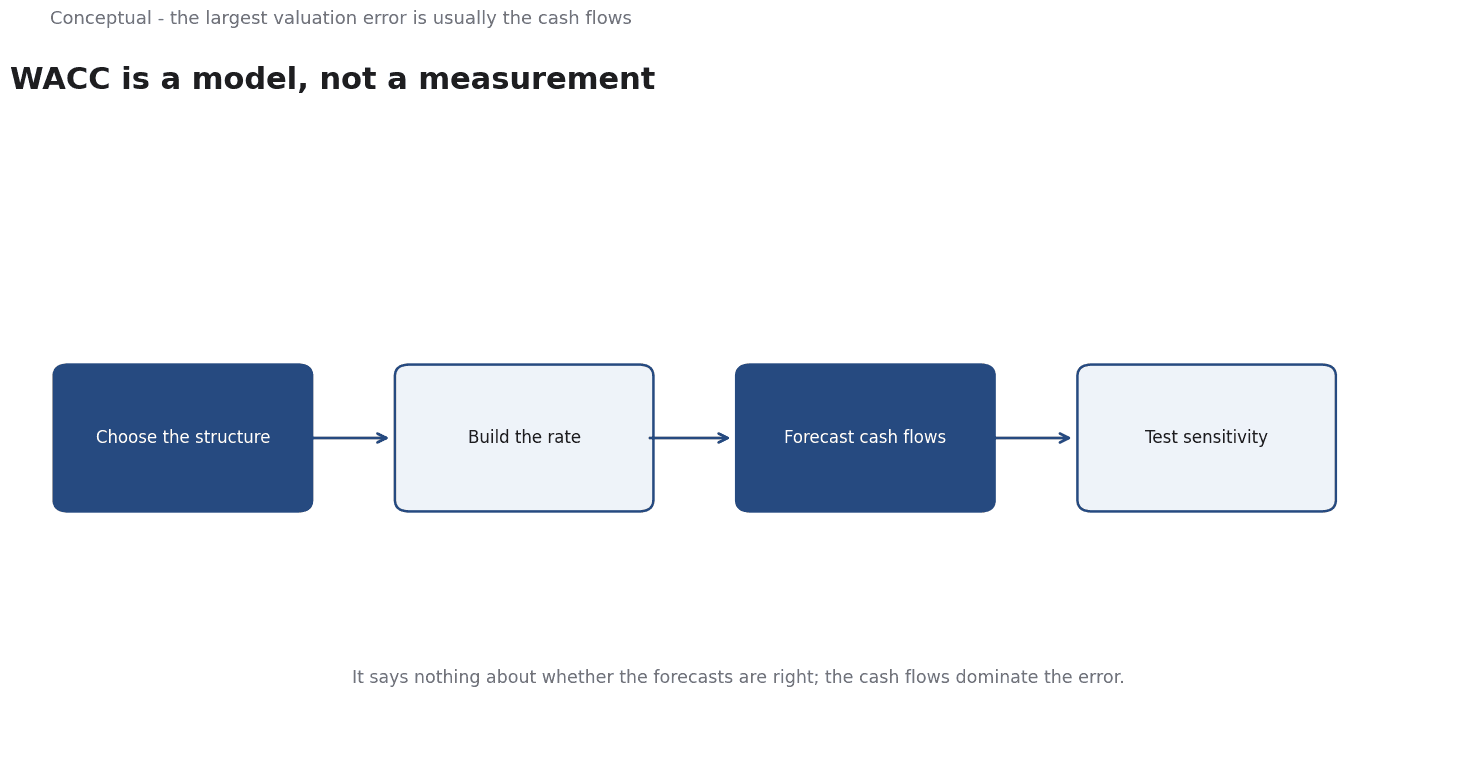
It says nothing about whether the forecasts are right, and the largest source of error in a valuation is almost never the discount rate — it is the cash flows.
It does not create a margin of safety. A point estimate of value with a sensitivity table is still a point estimate. What the table does give you is the honest information about which assumptions the answer rests on. If the value is unchanged when the equity risk premium moves from 4% to 6%, the premium was not driving the decision, and you can stop arguing about it. If the decision flips, you have found the assumption to negotiate.
The regulatory framing is worth keeping in view too. The SEC's investor guidance exists because these numbers travel — into prospectuses, into financing documents, into board papers — and a number presented without its assumptions is a liability rather than an analysis.
A sequence that works
- Date the risk-free rate. Take it from the latest H.15 release and record the observation date next to the number. A valuation without a date is not auditable.
- Choose the maturity deliberately, and match it to the duration of your cash flows rather than to the easiest number to find.
- State the capital structure assumption used for the weights, and note that it is a target rather than an observation.
- Run the sensitivity table before the base case, and read it as a map of what to argue about and what to measure.
- Separate the cash-flow judgement from the rate judgement. If the decision is driven by revenue assumptions, a rate discussion is a distraction.
- Recompute the observable inputs on a schedule — monthly for a live pipeline, quarterly for a strategic review — and re-rank when they move.
For the market mechanics these valuations are embedded in, see Stock Market Fundamentals; for the demand-side economics of the same rates, see Interest Rates and Their Effect on Technology Companies.
A worked example
The following is hypothetical and illustrative. A finance team is re-ranking two investments and plans to present a single WACC to a board. Three checks follow the sequence. First, date the risk-free rate: take it from the latest H.15 release and record the observation date, since a valuation with last quarter's rate has a stale input, and choose a maturity that matches the cash-flow duration. Second, run the sensitivity table before the base case: if the decision does not flip when the equity risk premium moves, that input is not what to argue about, while the largest error is more likely in the cash flows than in the rate. Third, state the capital structure assumption for the weights as a target rather than an observation, and note the circularity between leverage, valuation, and discount rate; the Fed's policy reporting moves the rate on its own schedule. The bounded outcome is a recommendation with a dated input, a stated structure, and a disclosed sensitivity, as the SEC's investor guidance expects; if the ranking flips on an assumption, the team identifies that assumption instead of defending a point estimate.
A counterargument
A reasonable critic would turn the article's ranking of errors against its prescription. It says the largest valuation error almost never comes from the discount rate but from the cash flows, yet three of its six steps concern dating and re-ranking the risk-free rate, an input it calls published rather than estimated.
If cash flows dominate, the observability of H.15 is no reason to make it the centre of the workflow.
The leverage argument has a source problem too: the claim that leverage redistributes returns, followed by an "interior optimum" set by tax shields and distress costs, is a theoretical position none of the cited references supports. H.15 publishes rates, the Fed page documents policy tools, and the SEC guidance covers disclosure, not the existence of an optimal capital structure.
References & Further Reading
- Board of Governors of the Federal Reserve System, 2026. H.15 — Selected Interest Rates (Daily) — The daily release of selected interest rates, including Treasury yields — the reference series for cost of capital work.
- Board of Governors of the Federal Reserve System, 2026. Monetary Policy — The Federal Reserve’s monetary policy framework, tools, and reporting, including the Monetary Policy Report and the Beige Book.
- U.S. Securities and Exchange Commission (Investor.gov), 2026. Introduction to Investing — Primary regulator guidance on market mechanics and investor protection.