Coupon Strategy for Beginners
A coupon reduces the price at the register, but strategy decides who gets it. Read the mechanism, a worked example, and the limits of discount-led growth.
A beginner often treats a coupon as a simple way to sell more: cut the price and the units will follow. The real problem is that a coupon is not a uniform price cut but a conditional offer, and the condition decides who responds and what the business gives away. Used without that distinction, a promotion can train customers to wait for the next code and erode the full-price demand it was meant to grow.
Direct answer: A coupon is a redeemable offer that reduces the price a customer pays, while a discount is a reduction from a listed or normal price. Wikipedia's coupon entry defines the redeemable instrument and its common forms, and the discount entry explains the mechanics and uses of a price reduction. The boundary: a coupon is a targeted condition on price, not proof of incremental demand or a substitute for a product customers already value at full price.
Delta: This article adds a decision framing beyond the sources: it maps the mechanics of coupons and discounts to the specific question of when a promotion buys profitable behavior rather than just a cheaper sale, with claim status explicit.
The mechanism
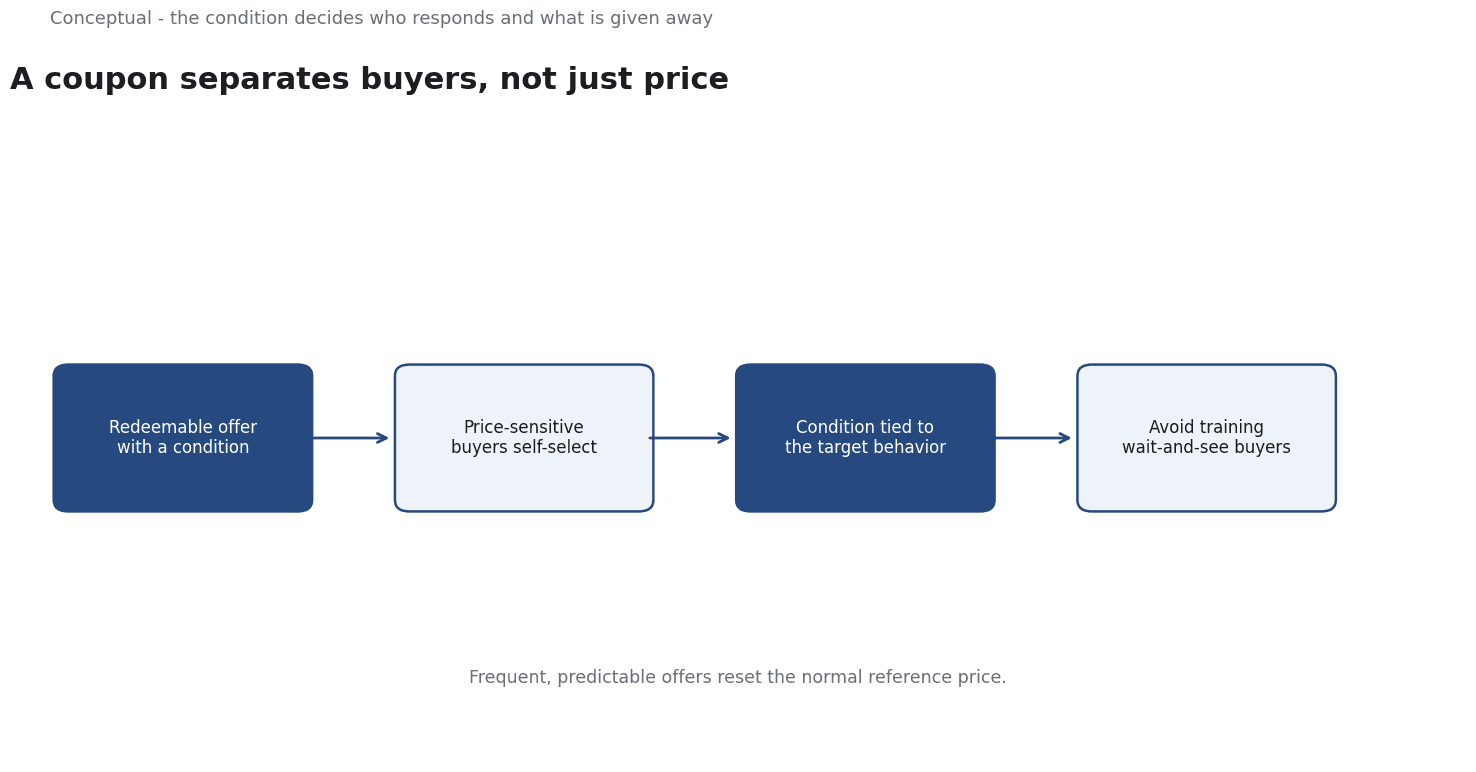
The coupon entry describes an instrument that can be redeemed for a price reduction, issued as a certificate, code, or similar token and exchanged under stated conditions. The mechanism is conditionality: the lower price is available only to the customer who takes the step of obtaining and redeeming the offer. The practical consequence is that a coupon separates buyers rather than cutting price for everyone. Customers willing to search for a code reveal a higher sensitivity to price, while those who pay full price do not, and the business can in principle reach each group differently.
The discount entry describes a reduction from a listed or normal price, used for purposes such as clearing stock, rewarding volume, or attracting custom. The mechanism here is a deliberate gap between the reference price and the transaction price. The practical consequence is that the promotion works on perception as well as arithmetic: a buyer compares the offer with the stated normal price, so the size and framing of the reduction matter to how attractive it feels. A discount with no credible reference price has little power to persuade.
Combining the two clarifies what a coupon strategy actually controls. The business chooses the size of the reduction, the condition attached to it, and the audience that sees it. Each choice has a different effect. A large reduction with a loose condition tends to reach customers who would have bought anyway, subsidizing purchases that needed no help. A smaller reduction aimed at a specific behavior, such as a first order or a repeat purchase after a gap, is more likely to change the decision it targets.
The mechanism is selection: the tighter the link between the condition and the desired behavior, the more of the spend goes toward changing behavior.
The final piece is the after-effect of repeated promotion. When discounts are frequent and predictable, customers learn the rhythm and time their purchases around it. The practical consequence is that the baseline against which the offer looks attractive shifts over time: what was once a special reduction becomes the expected price. A strategy that ignores this trains the market to wait, so the short-run lift in units can coexist with a slower erosion of full-price sales. The coupon works exactly as designed in each instance, while the cumulative pattern moves the business in an unwelcome direction.
A worked example
The following is hypothetical and illustrative. A small retailer considers a 20 percent coupon sent to its entire mailing list for a weekend. Three checks decide the design. First, the incrementality check: among previous coupon buyers, how many would have purchased at full price anyway, so the discount was a gift rather than a cause? Second, the condition check: is the reduction tied to a desired behavior, such as a first purchase or a return after three inactive months, rather than applied indiscriminately? Third, the margin check: after the reduction and the cost of issuing and tracking the code, does the order still contribute positively? The outcome is a revised plan that targets the offer to lapsed and first-time buyers with a cap on redemptions. The limitation is that a short test cannot reveal whether repeated offers will reset customers' sense of the normal price.
Evidence status
| Claim | Status | Source | Verified | Recheck when |
|---|---|---|---|---|
| A coupon is a redeemable offer that reduces the price paid | source-reported | Coupon - Wikipedia | 2026-11-18 | when the entry's definition or forms change |
| A discount is a reduction from a listed or normal price | source-reported | Discount - Wikipedia | 2026-11-18 | when the entry's account of discount uses changes |
| Coupons work mainly by separating price-sensitive buyers from others | inferred | Derived from the sources | 2026-11-18 | when promotion research contradicts or supports it |
The first two rows restate definitions the sources give directly. The third is an inference drawn from combining a conditional, redeemable offer with a reduction against a reference price; neither source states it as a marketing rule. Recheck conditions point back to the source definitions or to new evidence, so the status of each row remains visible to a later reader.
What it cannot do
A coupon strategy cannot create demand that customers do not have. It changes the terms on which an existing decision is made, lowering the barrier for someone already considering a purchase, but it does not make an unwanted product wanted. The limit shows up when a promotion is asked to rescue a weak offer: units may rise for the weekend, then fall back as soon as the code expires, leaving no lasting change in the underlying preference.
A hidden cost is the operational machinery around the offer. Generating codes, restricting who can redeem them, tracking use, and reconciling the reduced margin all take effort that a simple price change would not require. There is also a less visible cost in message fatigue. Frequent discount emails train customers to scan for the code rather than the product, so the marketing channel gradually loses its ability to communicate anything except a reduction. The expense is not the percentage given away on one order but the slow narrowing of what the channel can say.
A coupon that is used many times looks successful, yet a high redemption count can mean the offer reached customers who were going to buy regardless. The honest question is not how many codes were redeemed but how many purchases would not have happened without the code, and that counterfactual is not recorded by the coupon system. Without it, the promotion is judged on the activity it generated rather than the behavior it changed, which is why a campaign can report a strong result while margin quietly weakens.
The boundary is that these sources define instruments, not outcomes. The coupon entry explains what a redeemable offer is; the discount entry explains what a price reduction is and how it is used. Neither claims that a particular promotion increases profit, builds loyalty, or pays for itself. Applying them responsibly means using the definitions to design a clear condition and then measuring the result locally, without treating a textbook description of the instrument as evidence that the strategy will work.
Because customer behavior shifts, a coupon program needs scheduled review. An offer that was incremental last year may now be expected, and a segment that once responded may have learned to wait. The practical requirement is to revisit the target segments, the reduction sizes, and the redemption conditions on a fixed cadence, and to compare promoted purchases against comparable unpromoted ones. Without that review, the program becomes a permanent discount disguised as a promotion.
The counterargument that coupons cheapen a brand is fair for premium products whose value rests on scarcity and incomplete for price-sensitive categories where a well-targeted offer is the reason a customer tries the product at all.
A decision test
- State the behavior the coupon is meant to change.
- Identify the segment whose decision is most likely to change.
- Set the smallest reduction that can plausibly change it.
- Attach a condition that separates that behavior from routine purchases.
- Check the contribution margin after the reduction and fulfillment cost.
- Compare promoted purchases against a comparable unpromoted group.
- Review the offer on a fixed cadence for signs of customer wait-and-see behavior.
These steps turn a blunt price cut into a decision with a defined target and a measurable result. The mapping from redeemable-offer mechanics to segment choice is what makes a promotion defensible rather than habitual. A passed test leaves a record of who received the offer, what behavior it sought, and whether purchases changed relative to a fair comparison, instead of a redemption total that cannot answer the question.
For further reading, see Marketing Dashboards without the Hype.
References & Further Reading
- Wikipedia contributors, 2026. Coupon - Wikipedia — Redeemable offers that reduce price.
- Wikipedia contributors, 2026. Discount - Wikipedia — The mechanics of price reductions and their strategic use.