Credit Spreads for Beginners
Learn what a credit spread measures, how bond ratings feed it, and a simple checklist for reading spread moves without confusing price risk with default risk.
New fixed-income investors often treat a bond's yield as a single number, then wonder why two bonds with similar maturities pay very different returns. The missing piece is the credit spread: the extra yield investors demand for taking on default risk. Confusing that premium with interest-rate risk leads to poor comparisons and worse decisions.
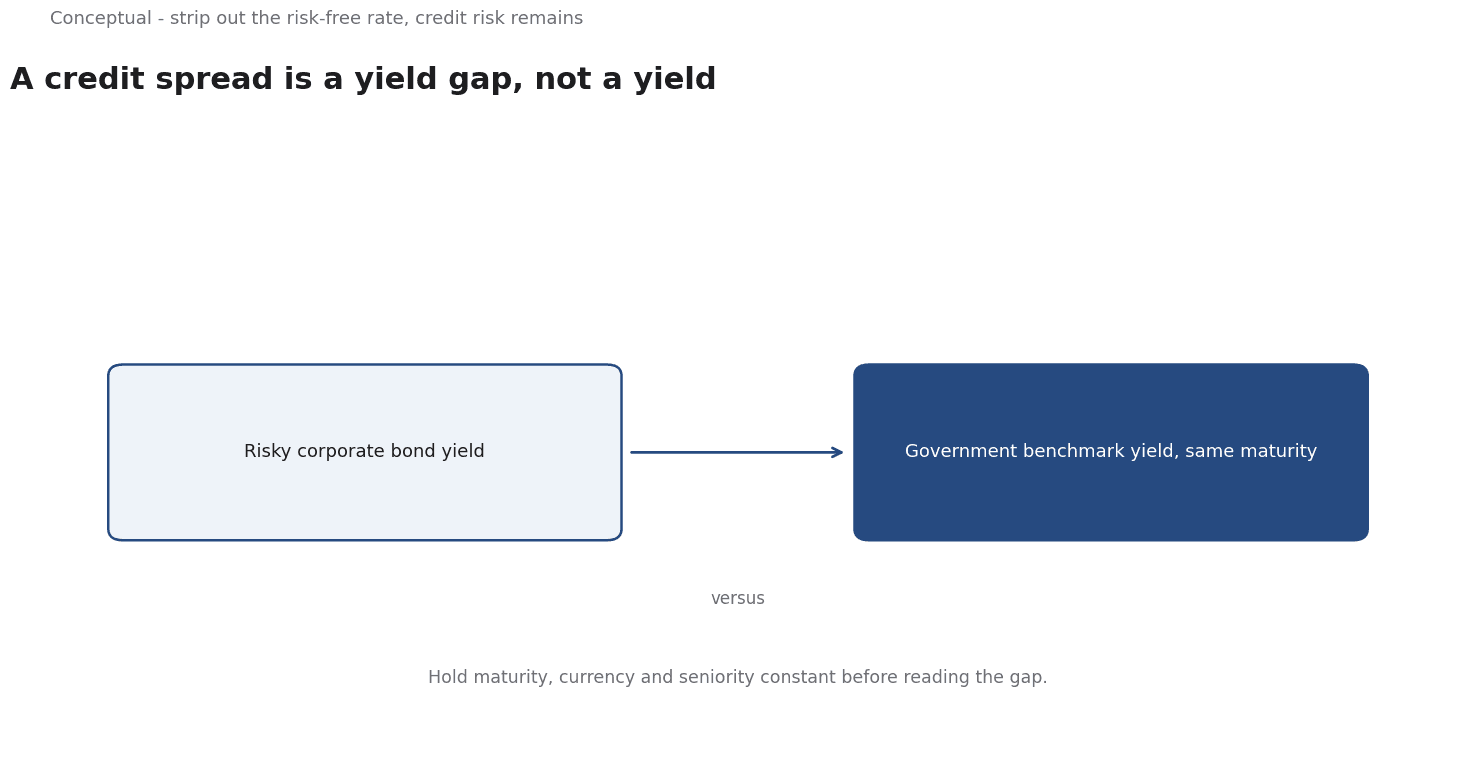
Direct answer: A credit spread is the difference in yield between a risky bond and a comparable risk-free benchmark of the same maturity. It compensates investors for default risk, widening when perceived credit quality falls and narrowing when it improves. Ratings are one input, but the spread is the market's live priced judgment.
Delta: This article adds a compact reading checklist beyond the sources: it maps the mechanics of a spread to a concrete decision about whether a yield gap is compensation or a warning, with claim status explicit.
The mechanism
The encyclopedia entry on credit spreads defines the spread as the yield difference between a security and a benchmark, typically a government bond of equivalent maturity.
The practical consequence is that a spread isolates the compensation for credit risk from the general level of interest rates.
Strip out the risk-free rate and what remains is the market's price for the chance that the borrower fails to pay. That is why two bonds can move together on rate news yet diverge on company-specific news.
The entry on bond credit ratings explains that agencies assign letter grades, from high investment grade down to speculative and default categories, reflecting creditworthiness. A better rating usually means a tighter spread, all else equal. But ratings are lagging opinions rather than prices. The spread can therefore move before a rating change appears, because traders reprice risk daily while committees revise grades on a slower cycle.
Spreads widen when investors fear defaults or when liquidity dries up, and they narrow in calm markets. Because the spread is a yield gap, its movement can come from the risky bond's price falling or from the benchmark's yield shifting. Reading it correctly requires holding maturity, currency, and seniority roughly constant; otherwise the number mixes credit risk with duration and currency effects.
For a beginner the discipline is to compare like with like. A spread that looks generous may simply reflect a shorter time to maturity or a subordinated claim rather than a bargain. The decision test at the end turns this principle into repeatable steps, so the spread becomes a structured signal instead of a headline.
A worked example
The following is hypothetical and illustrative. A hypothetical investor compares two five-year corporate bonds, both yielding 6 percent, and assumes they are equivalent. Three checks change that view. First, Bond A is senior and rated A, while Bond B is subordinated and rated BB, so the matching yields hide very different risk. Second, the government benchmark for that maturity yields 3 percent, meaning a modest spread on A but a much wider risk premium once B's lower rating and junior claim are priced in. Third, B's spread has widened over the past quarter while A's stayed flat, suggesting the market sees deteriorating credit. The outcome: the investor rejects the same-yield assumption, treats B's premium as a warning rather than free income, keeps A as the core holding, and sizes B as a small speculative position.
Evidence status
| Claim | Status | Source | Verified | Recheck when |
|---|---|---|---|---|
| A credit spread is the yield gap versus a benchmark of comparable maturity | source-reported | Credit spread (Wikipedia) | 2026-11-18 | Benchmark conventions change |
| Agency letter grades distinguish investment grade from speculative grade | source-reported | Bond credit rating (Wikipedia) | 2026-11-18 | Rating scales are revised |
| Spreads can widen before a formal rating change appears | inferred | Derived from the sources | 2026-11-18 | New pricing evidence emerges |
The two structural claims come directly from the encyclopedia entries and are stable definitions, so they carry low recheck risk. The third is an inference about timing: because ratings are opinions and spreads are prices, a spread can move first. Treat it as a useful heuristic rather than a guarantee, and revisit it if pricing or benchmark conventions shift.
What it cannot do
A spread is a single number and cannot explain why it moved. A widening spread might mean rising default fear, a liquidity squeeze, or a broad risk-off move with nothing to do with the issuer. The number alone cannot separate these causes. Anyone who reads a spread as a verdict on one company is over-interpreting a measure that is, at heart, a relative price.
Comparing spreads across bonds also hides frictions. Bid-ask spreads, call features, and tax treatment can make an apparently attractive spread less valuable in practice. A callable bond may show a wide spread precisely because the issuer can redeem it when rates fall, truncating the investor's upside. The quoted gap is not the realized return, and ignoring that distinction is a common source of disappointment.
Spreads are often wide for good reasons. A beginner who buys the widest spread in a sector may be collecting a premium right before a default, which is the classic value trap in fixed income. The spread compensates for risk; it does not promise that the risk will not materialize.
Spread analysis also has a boundary around maturity and currency. A spread quoted against the wrong benchmark, or compared across currencies without hedging, mixes credit risk with duration and foreign-exchange effects. At that point the comparison stops being about credit at all. The simpler the instrument and the cleaner the benchmark, the more trustworthy the reading.
Finally, both ratings and spreads need regular review. A position taken on a tight spread can deteriorate as fundamentals change, and an agency can downgrade with little warning. The checklist is a starting screen, not a set-and-forget rule; it must be reapplied as new prices and new ratings arrive.
Counterargument: the claim that spread analysis is too blunt for professionals is fair for precise relative-value trades and incomplete for beginners, who mainly need a consistent way to avoid comparing unlike bonds.
A decision test
- Fix the comparison to one maturity, currency, and seniority before reading any spread.
- Identify the correct risk-free benchmark for that maturity.
- Compute the spread as the yield gap, expressed in basis points.
- Check the issuer's rating and note whether it is investment grade.
- Compare the spread with peers in the same sector and rating band.
- Look at the spread's recent direction, not only its current level.
- Decide whether the premium is compensation or a warning, then size the position accordingly.
Used in order, these steps turn a single yield number into a structured judgment about credit risk. They work best as a repeatable screen applied consistently across candidates rather than a one-off check. Revisit the benchmark and the peer set whenever market conditions or the issuer's fundamentals change.
For further reading, see Cash-flow forecasting: a 13-week operating model.
References & Further Reading
- Wikipedia contributors, 2026. Credit spread - Wikipedia — The difference between a risky bond yield and a comparable risk-free yield, and what a widening spread signals; a secondary reference used with FRED and investor-education material.
- Wikipedia contributors, 2026. Bond credit rating - Wikipedia — How ratings express creditworthiness and how rating changes relate to yield spreads.