Critical Thinking Costs Explained
Critical thinking is effortful by design. See what the sources say about analysis and bias, a worked example, and why the cost is deliberate attention.
Critical thinking is routinely praised and rarely budgeted for. The Wikipedia material describes the skills and dispositions involved, and Kahneman's lecture describes how intuitive judgment goes wrong. The real problem is that sound reasoning consumes attention that fast judgment does not, so teams systematically underinvest in it.
Direct answer: Critical thinking is the objective analysis and evaluation of an issue in order to form a judgment, relying on skills such as inference, evaluation, and self-regulation. Kahneman's work shows that intuitive judgments are subject to systematic biases which deliberate reasoning can catch. The cost is the time and attention required to engage that slower, more effortful mode.
Delta: This article adds a claim-status table and a worked example beyond the sources: it maps the two accounts of judgment to a decision about when to slow down, with claim status explicit.
The mechanism
The Wikipedia account treats critical thinking as more than a checklist of questions. It is an objective analysis and evaluation of an issue that aims at a judgment, and it involves both skills - analysis, inference, evaluation, explanation - and dispositions such as openness and a willingness to reconsider. The practical consequence is that critical thinking is a practice, not a one-time decision to be careful. A person can perform the steps mechanically while keeping the conclusions that arrived intuitively, which is why the dispositions matter as much as the technique.
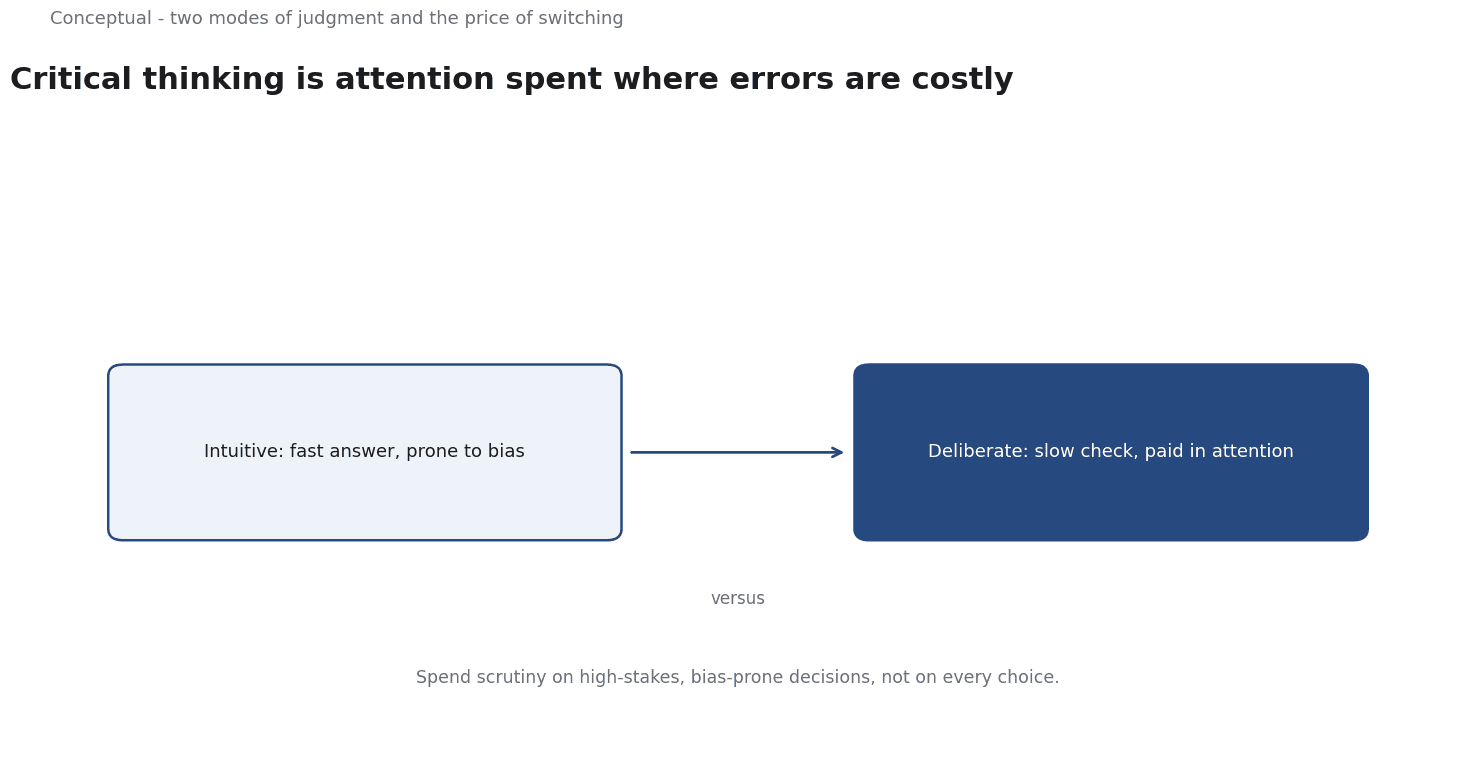
Kahneman's lecture approaches the same gap from the other side. It describes intuitive judgment as fast and efficient but subject to systematic biases, including tendencies to substitute an easier question for a harder one and to be influenced by how information is framed. Deliberate, effortful reasoning is the corrective, but it is also slow and something people avoid when a plausible answer is already available.
The implication for cost is direct: the errors of fast judgment are cheap to make and expensive to discover, while the discipline that catches them has to be paid for in attention up front.
Put together, the sources describe a trade-off. The intuitive mode provides an answer quickly and feels certain; the deliberate mode tests that answer and often finds it wanting. Neither is sufficient alone. Discarding intuition wastes a fast source of hypotheses, while trusting it without check exposes a decision to biases that are predictable enough to be named. The useful question is therefore not whether to think critically but where the extra effort buys the most - which decisions are consequential, reversible, and likely to trigger a bias.
That allocation is a local decision. The sources describe the skills and the biases; they do not rank the decisions in your week by how much scrutiny each deserves. Deciding where to slow down depends on the stakes and on the kinds of error a domain tends to produce, which is why the rows below mark the synthesis as inferred rather than documented.
A worked example
The following is hypothetical and illustrative. A team is reviewing a proposal to extend a pilot, and the initial reaction is that results look strong. Three checks decide how much scrutiny to apply. First, a stakes check: the decision commits budget for two quarters, so it merits more than a quick agreement. Second, a bias check: the team asks whether early numbers are being given more weight than later ones and whether the proposal's framing makes a neutral reading difficult. Third, a disconfirmation check: it seeks one piece of evidence that would argue against extension. The outcome is a decision to extend on narrower terms with a defined review point, and the reasons are recorded. The scenario is hypothetical; the mapping from cost to scrutiny is the contribution.
Evidence status
| Claim | Status | Source | Verified | Recheck when |
|---|---|---|---|---|
| Critical thinking involves objective analysis and evaluation to form a judgment | source-reported | Wikipedia: Critical thinking | 2026-11-18 | Definition or skill model changes |
| Intuitive judgment is prone to systematic biases that deliberate reasoning can catch | source-reported | Kahneman Nobel lecture | 2026-11-18 | Bias research is revised |
| Scrutiny should be allocated to consequential, bias-prone decisions | inferred | Derived from the sources | 2026-11-18 | Decision context or error rates change |
The source-reported rows carry the two accounts: one of the skills and dispositions, the other of biased intuition and its deliberate corrective. The inferred row is the synthesis of those accounts into an allocation rule, not a claim either source makes. Recheck it if the model of judgment changes or if a domain's error profile shifts enough to change where scrutiny pays.
What it cannot do
This framing has a definite limit. The sources describe what critical thinking involves and why intuition fails in predictable ways; they do not tell you which of your decisions matter most, how much time to spend on each, or whether a given conclusion is correct. Those are judgments about a specific context. A claim that a decision is now free of bias is not something the framework can support, because the discipline reduces some errors while leaving others untouched. Read it as a way to decide where attention is worth spending, not as a guarantee of sound conclusions.
A hidden cost is that deliberation can be spent in the wrong place. It is possible to analyse a question exhaustively while ignoring the framing that made it the wrong question, and the effort then reinforces the original mistake. Kahneman's account suggests why: effortful reasoning is often recruited to defend an intuitive answer rather than to test it. The practical cost is that time spent thinking is not evidence of thinking well. A review process that rewards visible analysis without requiring disconfirming evidence can increase the hours while leaving the quality unchanged.
The main failure mode is applying scrutiny uniformly. Treating every decision as equally deserving of slow analysis exhausts attention on trivial choices and leaves consequential ones to a tired intuition at the end of the day.
A third is the opposite error - becoming so suspicious of the intuitive answer that no decision is ever made, which converts a tool for judgment into a reason for paralysis. The discipline has a stopping point, and recognizing it is part of the skill.
The boundary is when deliberation is worth its cost. For low-stakes, reversible choices with quick feedback, the intuitive answer is usually good enough and the extra effort is better spent elsewhere. For high-stakes, hard-to-reverse choices, or decisions where feedback arrives too late to correct them, the cost of a check is small relative to the error it may catch. The sources support the general distinction but do not draw the line for your work; that depends on the domain's error rates and on what a wrong decision actually costs.
The practice also needs review. Biases are not removed by a single act of care, and the conditions that make a decision bias-prone can change as a project evolves. Keep a record of the consequential decisions, the checks applied, and the outcome, then revisit them when a decision is reversed or a prediction fails. Without that feedback loop, critical thinking becomes a memory of having once been careful rather than a practice that improves. The record is what turns effort into learning rather than repeated effort.
The counterargument that critical thinking is simply being careful is fair as a description of the intent and incomplete as a method, because care without a way to test an intuitive answer often defends it.
A decision test
- Name the decision. State what is being decided and what it commits.
- Grade the stakes. Mark it high or low, reversible or hard to reverse.
- Check the framing. Ask whether the question is posed in a way that favours one answer.
- Look for a bias. Identify whether speed, framing, or an anchor is doing work.
- Seek disconfirmation. Find one credible piece of evidence against the preferred answer.
- Decide and record. Choose a course and write down the checks and the reasons.
- Review the outcome. Revisit when the result is known and adjust the rule.
The cost of critical thinking is the attention it asks for, and that cost is the reason it is worth allocating deliberately. The sources describe the skills and the biases; the decision of where to spend the effort is local. Grade the stakes, test the intuitive answer, and record the result, and the effort becomes a practice that improves rather than a habit that fades.
For further reading, see Decision Memos That Survive Review.
References & Further Reading
- Wikipedia contributors, 2026. Critical thinking - Wikipedia — Disciplined analysis and evaluation of reasoning.
- Daniel Kahneman, 2002. Daniel Kahneman Prize Lecture - NobelPrize.org — The primary source for the bias taxonomy used in behavioural finance.