Crisis Communication Templates: Before You Need Them
A crisis leaves no time to design a process. Read the three templates worth preparing, a worked activation, and why they must be owned.
A crisis is the wrong moment to decide who speaks, what gets said, and how often an update goes out. The first hours are consumed by facts that are not yet complete and by pressure to say something reassuring. Templates prepared in advance do not supply the facts, but they remove the procedural decisions that slow a response and lead to contradictions.
Direct answer: Prepare three templates — an acknowledgement, an update, and a closure — with named owners, approval paths, and a defined cadence. Crisis-management principles treat the first hours as a sequence of decisions, and marketing-communications research covers consistency across channels. The boundary: a template cannot make an organisation honest or competent; it only removes avoidable delay, which the pre-deployment risk-assessment article argues for known failure modes.
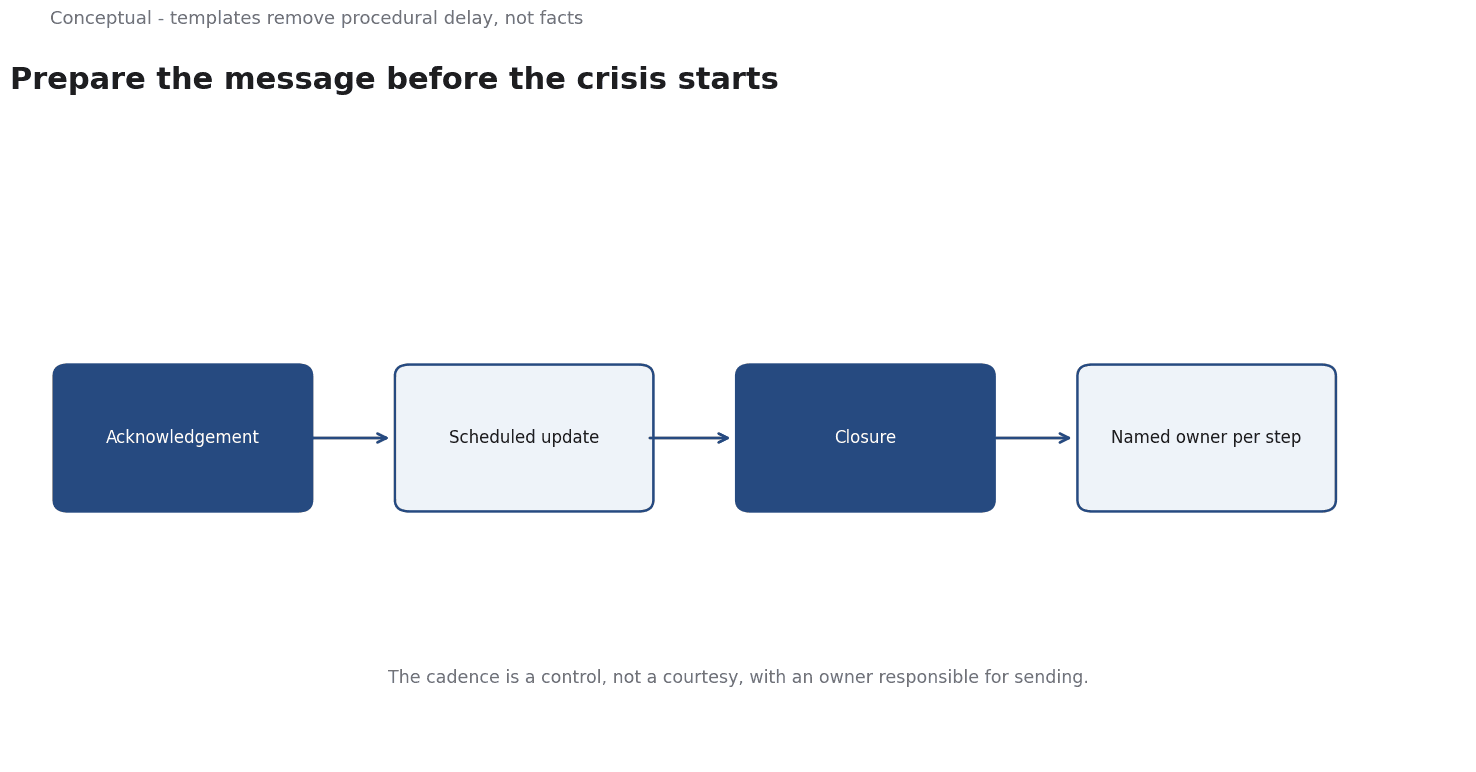
The three templates
Acknowledgement. The first message says what is known, what is being investigated, and when the next update will come. It should contain no speculation, no blame, and no promised cause. The crisis-management article describes this as the first stage of a response, where the goal is to establish that the organisation is aware and working.
Update. A recurring message with the same structure each time: confirmed facts, what has changed, what remains unknown, and the next update time. Repeating a structure matters because an anxious audience compares versions, as the brand-consistency article explains for meaning that must travel intact.
Closure. The final message states what happened, what was fixed, and what changes afterwards. It should be dated and attributable, which the data-governance article requires for any record people will rely on later.
Each template needs a named approver and a backup. A document that says "legal approves" without a name is a delay waiting to happen, which the governance checklist treats as an accountability gap.
A worked activation
The following is hypothetical and illustrative. A data incident is discovered at 09:00. The prepared template sets a one-hour acknowledgement window and a four-hour cadence for updates.
At 10:00 the acknowledgement goes out: a confirmed description of the affected system, a statement that investigation is underway, and a promise of an update by 14:00. No cause is named. By 13:00 the team learns that a configuration change exposed a limited set of records; the update states the confirmed scope and says the cause is still being verified. At 17:00 a second update names the change and the remediation. The closure, two days later, records the fix and the prevention measure.
Three checks decide whether the templates worked. First, time to first message: a short interval is a sign that procedural decisions had been made in advance, which the incident-response article treats as a reliability property. Second, contradiction rate: if later updates silently reverse earlier ones, the template is not preventing guesswork, as the evaluation-rubric article argues for explicit evidence. Third, channel consistency: the same facts should appear on the status page, in direct messages, and in support replies, which the marketing-communications article treats as coordinated messaging.
Why cadence matters more than words
An audience in uncertainty watches the clock as closely as the words. A message that arrives when promised establishes that the organisation has a handle on the response, even when the facts are incomplete. A message that arrives late, or not at all, invites speculation that fills the gap, which the reputation article treats as the central failure of a slow response.
The cadence is therefore a control, not a courtesy, and it belongs in the template with a named owner who is responsible for sending even when there is little new to say.
The content of an update should be structured so a reader can compare it with the previous one. Facts that changed, facts that remain unknown, and the next update time give the reader a stable frame. A changing structure forces the reader to reread everything to find the difference, which the brand-consistency article treats as a failure of continuity. Repetition of the frame is not redundancy in a crisis; it is the feature that makes an evolving situation legible.
Templates also need a review trigger. A response plan written for a product incident does not fit a regulatory investigation, and one written for a small company does not fit a large one. The risk-assessment article recommends tying a review to material change, which applies to the channels, obligations, and owners a plan depends on.
What templates cannot do
They cannot replace leadership. A response with perfect cadence but no accountable owner will drift, which the AI-governance article argues for named authority. They cannot substitute for facts; an update built on a guess becomes a liability when corrected, as Crisis Management: PR Crises, Product Recalls, and Reputation Recovery warns about claims experience contradicts. And they go stale when the product, regulators, or channels change, which the monitoring article treats as a review trigger.
The counterargument that preparing for a crisis invites pessimism misses the operational point.
Fire drills do not expect a fire; they remove uncertainty about what to do if one occurs, as Site Reliability Engineering: SLOs, Error Budgets, and Incident Response explains.
A decision test
- Write the acknowledgement, update, and closure templates now.
- Name an approver and a backup for each.
- Set a first-message window and a recurring cadence.
- Require confirmed facts only, with unknowns stated.
- Test the templates in a tabletop exercise.
- Measure time to first message and contradictions.
- Review after any change to product, channels, or obligations.
For the response sequence, see Crisis Management; for the operational view, see Site Reliability Engineering.
References & Further Reading
- Wikipedia contributors, 2026. Marketing communications - Wikipedia — The coordination of messages across channels and the distinction between consistent and identical communication.
- American Association for Public Opinion Research, 2026. AAPOR — The professional association for public opinion and survey research; its standards and resources underpin the survey-design discussion.