Crisis Management: PR Crises, Product Recalls, and Reputation Recovery
Crisis decisions are made before the facts are complete. Read how recall law, incident response, and breach notification set the clock — and what to do in the first hours.
The hardest moment in a crisis is usually the first one: a product may be defective, a system may be breached, and the facts needed for a confident statement do not exist yet. What an organisation does in that gap — whether it acknowledges, investigates, and communicates with a defined owner — determines more of the outcome than the eventual root cause. Crisis management is the discipline of making those decisions deliberately rather than improvising them under pressure.
Direct answer: Crisis management covers preparation, response, and recovery from events that threaten operations, stakeholders, or reputation. The useful frameworks are operational rather than rhetorical: the incident-response lifecycle in NIST SP 800-61, recall classifications in 21 CFR Part 7, and breach-notification deadlines in the GDPR. The boundary is that these instruments set clocks and define severity; they do not tell you what to say. That judgement belongs to named people deciding with incomplete information.
Why crises escalate
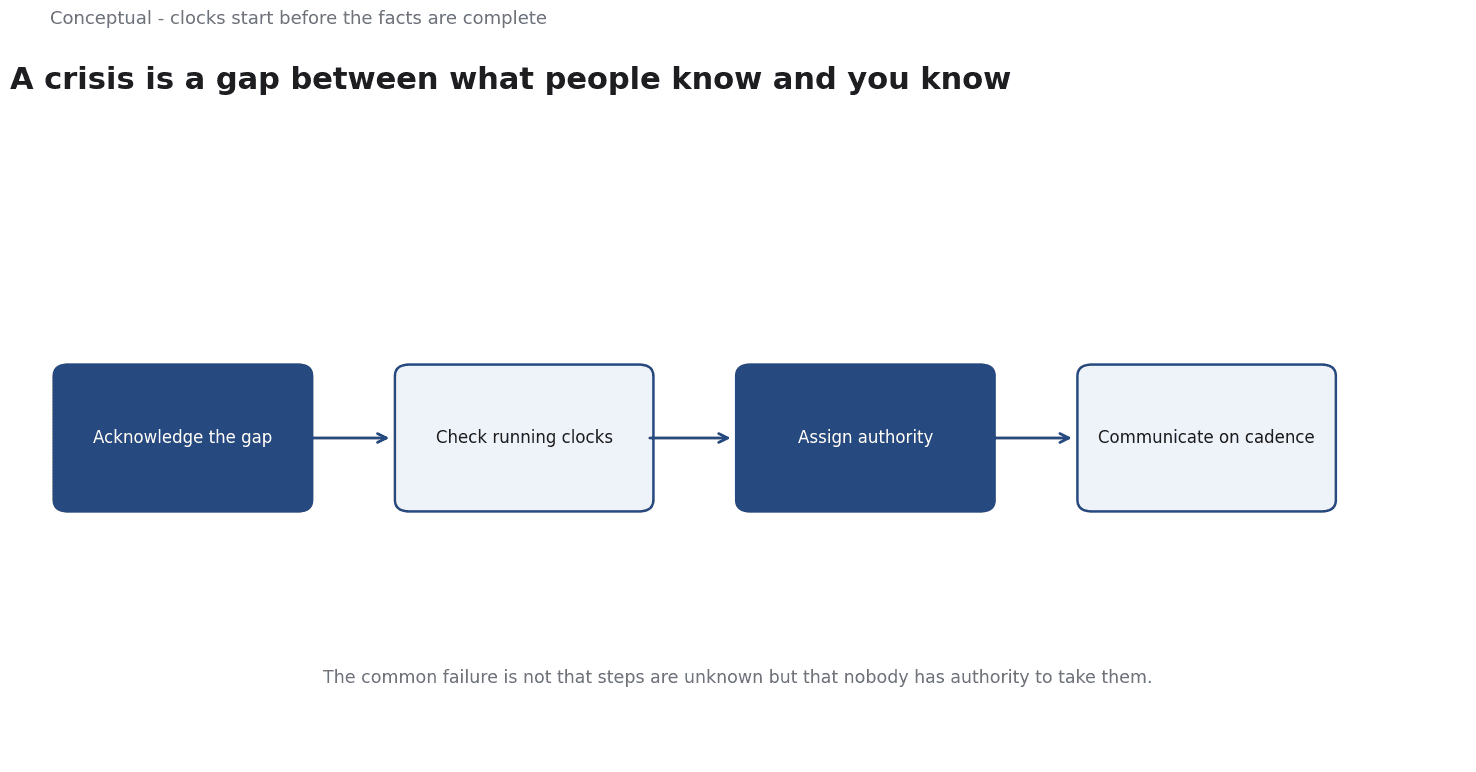
A crisis is not defined by the triggering event but by the gap between what stakeholders know and what the organisation knows.
Three mechanisms turn a manageable problem into a reputation event.
An information vacuum. When an organisation is silent, others fill the space. A holding statement that says what is known, what is not, and when the next update will come is more useful than a perfect statement delivered too late.
Coordination failure. A crisis crosses functions — operations, legal, communications, security, finance. Without a defined decision authority, each function acts in its own interest, and the customer sees contradictory messages.
Trust debt. An organisation that has been transparent before a crisis has credibility to spend during one. One that has not must earn it while under scrutiny.
These mechanisms explain why preparation matters more than eloquence. The goal is not a memorable apology; it is a response that stakeholders can verify.
The clocks that are already running
Some crisis decisions are not discretionary. Regulation sets deadlines that begin before the investigation is complete.
Breach notification. GDPR Article 33 requires the controller to notify the competent supervisory authority "without undue delay and, where feasible, not later than 72 hours after having become aware of it", unless the breach is "unlikely to result in a risk to the rights and freedoms of natural persons". Seventy-two hours is not a comfortable investigation window; it is a reason to have detection and escalation procedures in place before an incident.
Product recalls. In the United States, 21 CFR Part 7 defines recall classifications by the hazard presented. Class I is "a situation in which there is a reasonable probability that the use of, or exposure to, a violative product will cause serious adverse health consequences or death". Class II covers consequences that "may cause temporary or medically reversible adverse health consequences" or where the probability of serious consequences is remote. Class III covers products that are "not likely to cause adverse health consequences". The classification determines the urgency and the public framing of the response.
Incident response. NIST SP 800-61 Rev. 2, the Computer Security Incident Handling Guide, organises the work into preparation; detection and analysis; containment, eradication, and recovery; and post-incident activity. Its premise is blunt: "establishing a successful incident response capability requires substantial planning and resources". A team discovering its escalation path during an incident is already behind.
The FDA's public recalls, market withdrawals, and safety alerts are the visible record of these decisions — and a reminder that not every recall has a press release, which is itself a lesson about the limits of public signal.
A worked example of recall classification
The following scenario is hypothetical, constructed to show how the legal definitions change the response.
A company ships 40,000 units of a consumer device. Reports arrive that a small fraction of batteries overheat; one unit has scorched a surface, with no injury. The quality team cannot yet quantify the failure rate.
Apply the 21 CFR Part 7 definitions:
- Class I would apply if there were a reasonable probability that use would cause serious adverse health consequences or death. A scorch with no injury does not, on the reported facts, meet that threshold — but the assessment must change if evidence of burns or fire emerges.
- Class II fits the reported facts better: a temporary or medically reversible consequence, or a remote probability of serious consequences. A recall here still requires public notification and a remediation path, but the language differs from a Class I warning.
- Class III would apply only if adverse health consequences were unlikely. If the overheating damages property but presents little health risk, this may be the correct classification — and the company must be able to defend it with documentation.
Three decisions follow from the classification, not from intuition:
- The scope of notification. A Class I event demands immediate, prominent public communication; a Class III event may be handled through direct customer contact.
- The remediation. Replacement, repair, or a usage restriction follows from the hazard, not from what is cheapest.
- The record. eCFR requires that health-hazard conclusions be supported "as completely as possible by scientific documentation". A classification made without evidence is a liability later.
The important lesson is that the company must make this call before the failure rate is known. That is what a crisis plan is for: a pre-agreed method for classifying under uncertainty, with the authority to escalate when new facts arrive.
The response sequence
A useful first-24-hours sequence, adapted from the incident-response lifecycle:
- Acknowledge. Confirm that the organisation is aware, that it is investigating, and when the next update will come. Avoid speculation and blame.
- Assess. Establish the confirmed facts, the affected population, and the regulatory obligations. Separate what is known from what is suspected.
- Activate. Convene the decision group with a named lead, and move from a holding statement to a detailed one as facts allow.
- Notify. Reach customers, employees, regulators, and partners through defined channels. A single source of truth prevents contradictions.
- Review. Once the immediate event is contained, reconstruct the timeline and update the plan.
Each step has an owner.
What the playbook cannot guarantee
Three qualifications matter when a crisis is live.
Speed and accuracy conflict. A holding statement issued early may be incomplete; one issued late may be overtaken by events. The honest rule is to communicate what is known early and label what is not, rather than waiting for a complete picture or guessing.
Transparency and legal privilege pull in different directions. Recording facts carefully and involving counsel are prudent, but an over-broad claim of privilege can look like concealment. The boundary should be decided in advance, not during the first press call.
Blameless review is not the same as no accountability. A post-incident review that avoids blame improves reporting, which improves detection. But stakeholders may reasonably expect someone to own the failure. The organisation needs both a learning posture and an accountable owner, applied to different questions.
A further limit: there is no reliable playbook for reputation recovery. Sentiment tracking and third-party audits are useful signals, not a mechanism that restores trust on a schedule. Trust returns when the promised fixes are verified, which takes time.
A decision test
- What is the hazard classification, and what evidence supports it? Revisit it when facts change.
- Which clocks are running — notification deadlines, customer commitments, media cycles?
- Who has authority to make the next decision, and who is the backup?
- What can be said now without speculation, and when is the next update?
- Which stakeholders are affected, and have they been contacted through a defined channel?
- What would change the classification or the remediation?
- Who owns the post-incident review, and when will the plan be updated?
For the operating frameworks behind this, see Cybersecurity Fundamentals; for the governance context, see AI Governance.
A counterargument
A reasonable critic would argue that the article overstates what preparation delivers. GDPR Article 33's 72-hour deadline and the hazard classes in 21 CFR Part 7 set floors, not outcomes: meeting them does not repair the trust the piece calls the real stake. NIST SP 800-61 and SP 800-30 both insist that capability requires substantial planning and resources, an assumption that quietly excludes organisations without a standing response function. The article itself concedes there is no reliable playbook for reputation recovery, which weakens its claim that preparation is decisive.
Where a crisis turns on perception rather than a classifiable hazard, these instruments have little to say and recovery may depend on factors outside the organisation's control.
References & Further Reading
- U.S. Food and Drug Administration, 2026. Recalls, Market Withdrawals, & Safety Alerts — The public record of product recalls, market withdrawals and safety alerts, and the entry point to FDA recall guidance.
- U.S. Code of Federal Regulations (eCFR), 2026. 21 CFR Part 7 - Enforcement Policy — Section 7.41 defines Class I, II and III recalls by the degree of health hazard — the basis for the worked recall example.
- Paul Cichonski, Thomas Millar, Tim Grance, Karen Scarfone (NIST), 2012. SP 800-61 Rev. 2, Computer Security Incident Handling Guide — The incident-response capability lifecycle: preparation, detection and analysis, containment/eradication/recovery, and post-incident activity.
- European Union (GDPR text via gdpr-info.eu), 2016. Art. 33 GDPR – Notification of a personal data breach to the supervisory authority — Article 33: notification of a personal-data breach to the supervisory authority within 72 hours where feasible, and the risk-based exception. Stable HTML rendering of the EU regulation text.
- NIST, 2026. SP 800-30 Rev. 1, Guide for Conducting Risk Assessments | CSRC — The standard threat-modelling method.