Customer Advocacy and User-Generated Content
Customer voices are more credible than brand claims — when they are genuine. Read how to earn advocacy, a worked programme, and the fraud risk.
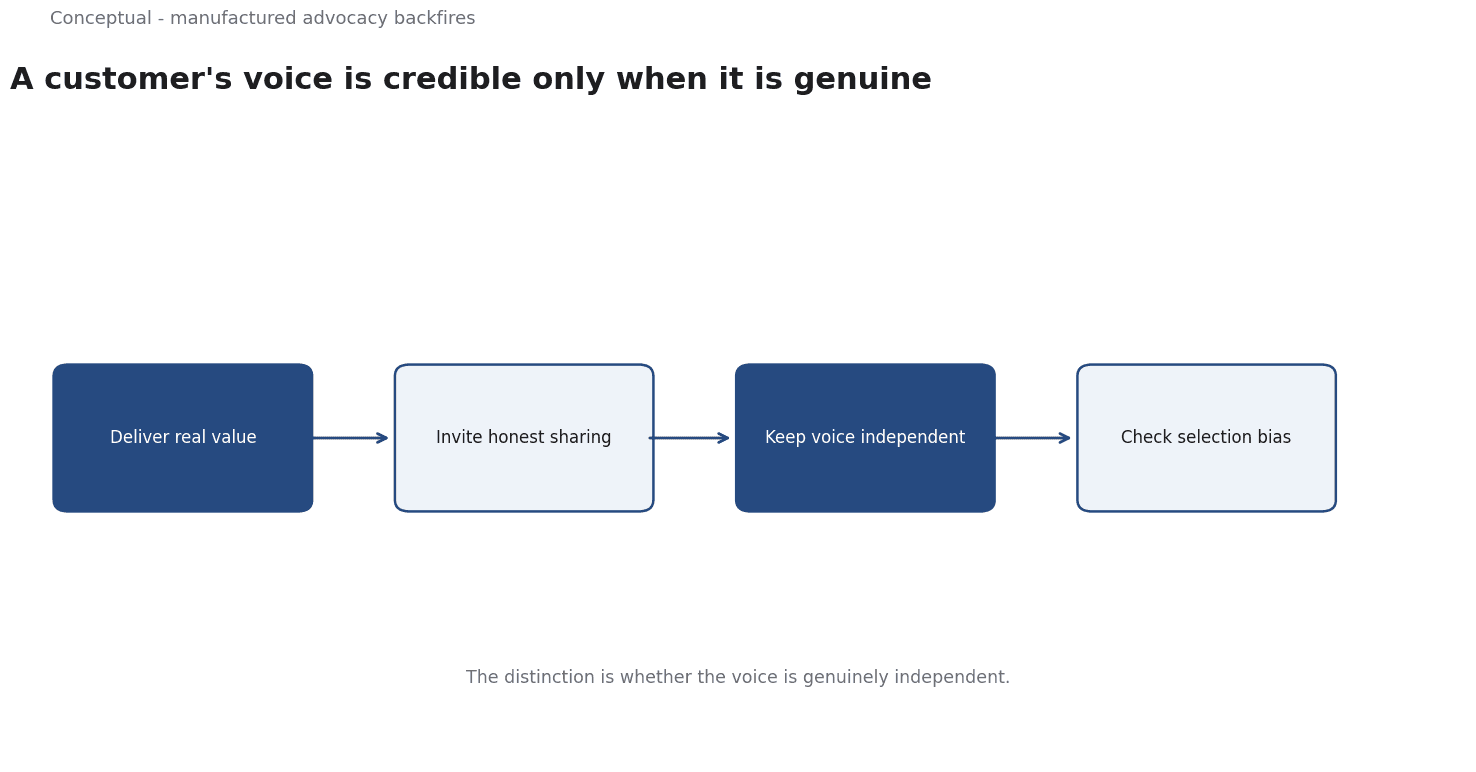
A customer describing their experience in their own words carries a credibility a brand cannot claim for itself. That is why advocacy and user-generated content are valuable — and why manufactured versions of them backfire.
The distinction is whether the voice is genuinely independent.
Direct answer: Earn advocacy by delivering value worth talking about and make it easy for customers to share honest experience; do not script or buy the voice. Demand-generation principles explain the preference stage advocacy serves, and AAPOR's standards apply if you survey customers about their experience. The boundary: a testimonial that is selected only for praise is evidence of a selection process, not of the product, as Online Reviews and Reputation Management explains for reputation.
What works
Real stories with specifics. A customer describing what they tried, what failed, and what changed is more persuasive than a polished quote, as the customer-journey article recommends for evidence.
Easy sharing. Give customers something worth passing on — a template, a result, a useful example — which the content-repurposing article treats as a value asset.
Response. When a customer posts about the product, a thoughtful company response is itself visible evidence, which the reputation-management article covers.
A worked programme
The following is hypothetical and illustrative.
A B2B product wants more customer stories. The programme:
- Identify customers who already talk about the product publicly, as the advocates article recommends looking for existing behaviour.
- Ask with AAPOR-style wording — an open, non-leading request about their experience, with a defined population, as the survey standards require.
- Publish with context — the customer's situation, what they did, and the outcome, with any numbers defined, as the data-governance article requires for relied-upon figures.
Three checks decide whether it works:
- Independence — was the story solicited without conditions on what it says? A required positive quote is a brand claim in disguise, which the reputation article warns about.
- Specificity — does the story contain verifiable detail, or only adjectives, as the evaluation-rubric article argues for concrete evidence?
- Downstream effect — do prospects who see the story convert better, which the funnel article treats as a stage metric rather than a vanity measure?
Three conclusions follow:
- The best advocates are found, not created, as the advocacy principle suggests.
- Honesty is the asset, which the value-proposition article treats as the claim the business can support.
- Measurement is per stage, which the marketing-attribution article requires.
Making stories useful rather than promotional
Three edits keep it credible:
Include the problem before the product. A story that starts with the customer's situation gives the reader something to recognise, which the customer-journey article recommends for evidence tied to a stage.
Keep the numbers defined. If the story says time was saved, state how it was measured, as the data-governance article requires for any relied-upon figure.
Let the customer's voice remain. Heavy editing turns a credible account into brand copy, which the brand-voice article treats as a loss of authenticity.
These edits make the story useful to a buyer, which the content-marketing article argues is the purpose of content before any ask.
What advocacy cannot do
It cannot fix a product that disappoints. A story that oversells creates a gap between expectation and experience, which the retention article treats as a churn cause.
It cannot be bought without cost. Paid endorsements without disclosure damage trust and may breach rules, which the influencer-measurement article treats as a measurement and ethics question.
It is not a guarantee. No specific story structure guarantees conversion, which the publication standard makes explicit for content claims.
The counterargument — that customers will not talk without incentives — is often true at the start and misses the point: the first step is delivering something worth talking about, which the value-proposition article argues is the underlying condition.
A decision test
- Find existing advocates from public behaviour, as the advocacy article recommends.
- Ask with AAPOR-style wording, without leading, as the survey standards require.
- Publish with context and defined numbers, as the data-governance article requires.
- Never require a positive quote, which the reputation article treats as a credibility failure.
- Respond to stories publicly, as Online Reviews and Reputation Management advises.
- Measure downstream conversion, not just views, as the funnel article recommends.
- Check disclosure rules for any incentive, as the influencer-measurement article covers.
For the reputation frame, see Online Reviews and Reputation Management; for the evidence standard, see AAPOR.
References & Further Reading
- American Association for Public Opinion Research, 2026. AAPOR — The professional association for public opinion and survey research; its standards and resources underpin the survey-design discussion.
- Wikipedia contributors, 2026. Demand generation - Wikipedia — An overview of demand generation as a marketing discipline distinct from lead generation; secondary reference used with the lead-generation entry.