Cybersecurity Fundamentals: Threat Modeling, Zero Trust, Incident Response
Security is a set of decisions about trust and failure. Read the three frameworks that make those decisions explicit — and the boundary each one has.
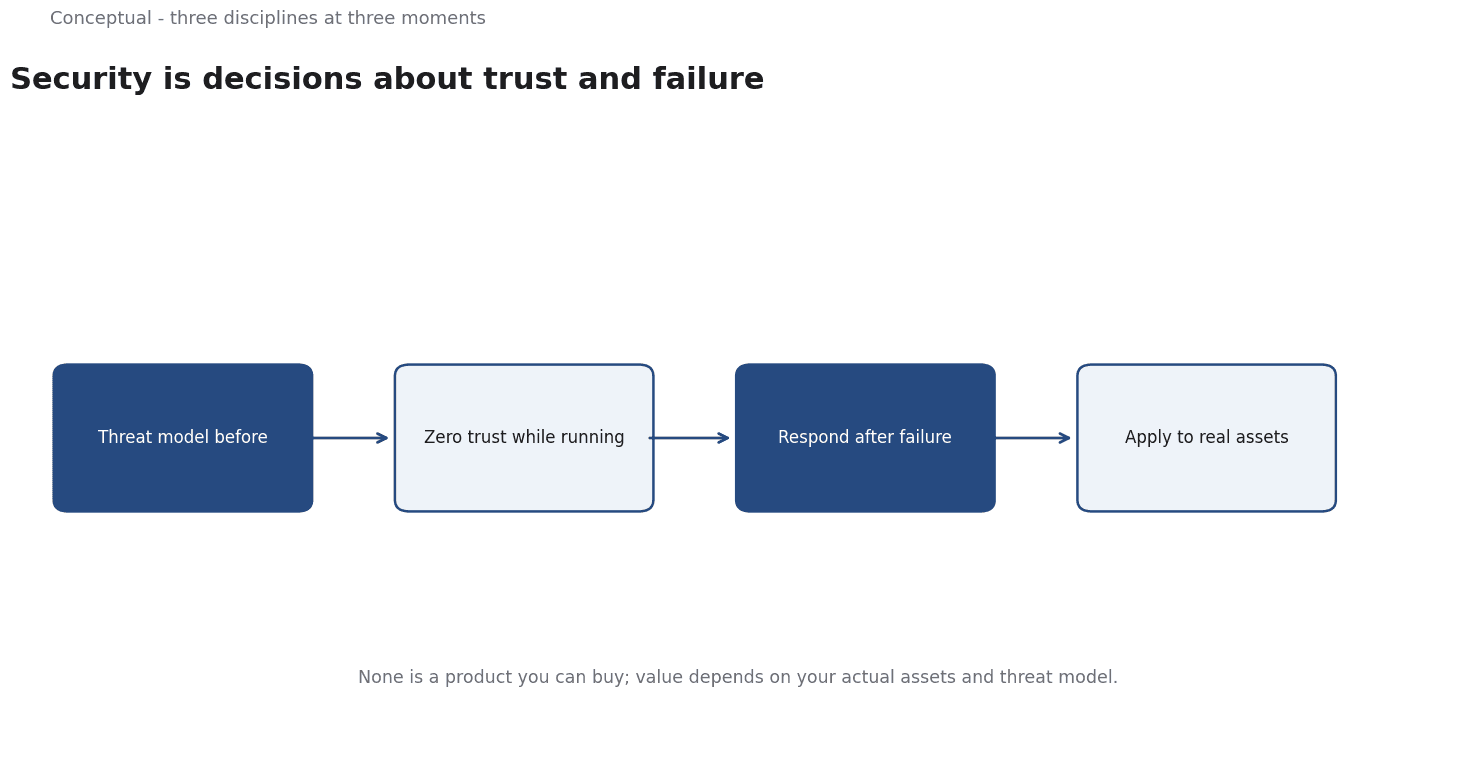
Security advice often collapses into a list of tools. A more useful starting point is a question: what are you protecting, from whom, and what happens when a control fails? Threat modeling, zero trust, and incident response are three ways of making that question explicit at different moments — before a system is built, while it runs, and after something goes wrong.
Direct answer: Threat modeling identifies assets, adversaries, and likely attack paths before implementation; zero trust is an architecture that removes implicit trust based on network location; incident response is the organised process of detecting, containing, and learning from a breach. NIST SP 800-30 provides the risk-assessment method, SP 800-207 defines zero trust, MITRE ATT&CK catalogues adversary behaviour, and SP 800-53 supplies the control catalogue.
The boundary is that none of these is a product you can buy: they are disciplines whose value depends on being applied to your actual assets and threat model.
Threat modeling: decide before you build
A threat model is a structured answer to four questions: what are we protecting, who might attack it, how could they, and what is the impact if they succeed? Doing this before implementation is cheaper than discovering the answer during an incident.
NIST Special Publication 800-30 Rev. 1, published in September 2012, provides guidance for "conducting risk assessments of federal information systems and organizations", with risk assessments carried out "at all three tiers in the risk management hierarchy". Its vocabulary — threat, vulnerability, likelihood, impact, residual risk — is the common language of the field.
MITRE ATT&CK adds the adversary side. It is a "globally-accessible knowledge base of adversary tactics and techniques based on real-world observations", used as a foundation for threat models in industry, government, and security products. ATT&CK's value is that it describes behaviour rather than tools: an adversary may phish, escalate privileges, or move laterally regardless of which product is installed.
Three practical steps turn this into an exercise:
- List the assets — data, credentials, availability — and rank them by the damage their compromise would cause.
- Choose relevant adversaries and consult ATT&CK for techniques plausible against your environment, rather than inventing a generic attacker.
- Map controls to the paths and record the residual risk — what remains after the controls are applied.
The last step is where threat modeling earns its keep. A control that does not reduce a plausible path is a cost, not a protection.
Zero trust: remove implicit trust
Traditional network security treated the inside of a corporate network as trusted and the outside as hostile. That assumption breaks when users work remotely, devices are personally owned, and services live in clouds outside a company-owned boundary.
NIST SP 800-207 describes zero trust as "an evolving set of cybersecurity paradigms that move defenses from static, network-based perimeters to focus on users, assets, and resources". Its central statement is that "zero trust assumes there is no implicit trust granted to assets or user accounts based solely on their physical or network location". The architecture is a response to "remote users, bring your own device (BYOD), and cloud-based assets that are not located within an enterprise-owned network boundary".
Three principles follow, and they are more concrete than the slogan:
- Verify explicitly. Authenticate and authorise each request using all available context — identity, device state, location, behaviour — not a one-time login.
- Use least privilege. Grant the minimum access needed, for the minimum time, with just-in-time elevation where possible.
- Assume breach. Design as if an attacker is already inside: segment access, encrypt traffic, and monitor continuously so that one compromised account does not expose everything.
The honest limitation is that zero trust is a direction, not a switch. SP 800-207 describes a set of principles and possible deployment models; migrating an existing estate takes years, and a partial implementation can create gaps where the old perimeter assumption still lingers.
Incident response: assume the controls will fail
No set of controls is complete. Incident response is the discipline of making failure survivable: detecting it quickly, containing it, and learning enough to prevent recurrence.
NIST SP 800-53, "Security and Privacy Controls for Information Systems and Organizations", provides the control catalogue that underpins much of this work, including the incident-response and monitoring families. The point of a catalogue is consistency: it gives an organisation a shared list of what "protected" is supposed to mean.
The OWASP Top 10 complements this at the application layer. OWASP calls it "the reference standard for the most critical web application security risks" and "a standard awareness document for developers and web application security", representing "a broad consensus about the most critical security risks". The current release is the OWASP Top 10 2025. A team that maps its incident history to these categories is looking at the problems that recur across the industry, not just its own last outage.
Incident response has a measurable rhythm: detect, triage, contain, eradicate, recover, and review. The review is the step most often skipped, and it is the one that converts an incident into a control improvement.
A worked example of a risk decision
Suppose a service holds customer records and runs on a legacy network where any internal host can reach the database. A threat-model review identifies the path: compromise any low-value internal machine, then connect to the database directly.
Using the risk vocabulary from SP 800-30, assess two options:
Option A — network segmentation. Restrict database access to a small set of application hosts. Likelihood of lateral movement drops substantially; impact of a compromised application host is unchanged. Cost: a few days of engineering and some operational friction. Residual risk: an attacker who compromises an allowed host still reaches the data.
Option B — assume the database is already reachable. Add per-query authorisation, audit logging, and anomaly alerts on access patterns. This does not remove the path but makes abuse visible and limits what any single credential can do. Cost: more engineering, and alert tuning over time.
A zero-trust reading favours doing both, because neither eliminates the other's failure mode: segmentation reduces opportunity, while explicit authorisation and monitoring reduce the damage if the boundary is crossed. The decision is not "which control is best" but "what residual risk are we willing to accept, at what cost".
This is where a penetration test or an ATT&CK mapping becomes useful — not as a score, but as evidence about whether the chosen controls actually interrupt the path you care about.
What the frameworks do not give you
Three limits are worth stating plainly.
A catalogue is not a guarantee. SP 800-53 lists controls; it does not implement them, and a control marked "selected" can be configured ineffectively. Compliance and security overlap but are not identical.
ATT&CK describes behaviour, not your exposure. The knowledge base is built from real-world observations, but a technique being in the catalogue does not mean it is plausible in your environment. Relevance has to be judged locally.
Zero trust can be performed badly.
A decision test
- Name the assets and adversaries before choosing controls.
- Map at least one real attack path end to end and check which controls interrupt it.
- Treat network location as untrusted in new designs, per SP 800-207.
- Assume breach and verify that monitoring would reveal it.
- Rehearse the incident response and review what the last incident taught you.
- Measure residual risk, not just the number of controls deployed.
For the organisational case for this work, see Why Cybersecurity Is Becoming a Business Priority; for the operational side, see Observability.
A counterargument
A reasonable critic would push back that the discipline-not-a-product framing understates how much security depends on budget and incentives. NIST SP 800-30 and SP 800-53 supply a vocabulary and a control catalogue, but the worked example ends at "what residual risk are we willing to accept, at what cost" - a budget judgement, not a technical output. MITRE ATT&CK is built from observed behaviour and therefore lags novel techniques; mapping controls to a catalogue can reassure about known paths while missing the one that matters. SP 800-207 presents zero trust as a multi-year direction, and the article concedes partial migrations create gaps.
The frameworks are necessary, but incomplete where the piece implies correct application is mostly a matter of method rather than of power and attention.
References & Further Reading
- NIST, 2026. SP 800-30 Rev. 1, Guide for Conducting Risk Assessments | CSRC — The standard threat-modelling method.
- NIST, 2020. NIST SP 800-53: Security and Privacy Controls for Information Systems and Organizations — The control catalogue behind most compliance programmes.
- MITRE, 2026. MITRE ATT&CK — The adversary tactic and technique knowledge base used for detection engineering.
- NIST, 2020. Zero Trust Architecture — The official zero-trust architecture and its tenets.
- OWASP Foundation, 2021. OWASP Foundation — The consensus web-application risk list.