Currency Risk: a Decision Framework
A bounded framework that maps foreign exchange risk types to hedging decisions, with exposure checks, instrument trade-offs, and a review rule.
Finance teams often treat currency risk as a single number to be hedged or ignored, but the exposure behind that number can be transactional, translational, or economic. Each type calls for a different instrument and a different decision. The distinction matters because a hedge that fits one type can be useless or costly for another.
Direct answer: Foreign exchange risk is the risk that a currency movement changes the value of a transaction, a reported balance, or a competitive position. Wikipedia's foreign exchange risk entry separates transaction, translation, and economic exposure, while the hedge entry describes a position taken to offset such exposure. The decision is which exposures are material enough to offset, and with which instrument.
Delta: This article adds a decision framework beyond the sources: it maps each exposure type to a hedging decision, with claim status explicit.
The mechanism
The foreign exchange risk entry defines the risk as the possibility that a change in exchange rates affects the value of an investment, a transaction, or a business. It groups exposures into three kinds. Transaction risk attaches to a known future cash flow in a foreign currency. Translation risk arises when financial statements are converted from one currency into another. Economic risk is the longer-run effect of currency moves on a firm's competitive position. The practical consequence is that the word exposure is too vague to act on until it is sorted into one of these buckets, because each bucket answers a different question.
The hedge entry describes a hedge as a position or action that offsets the risk of an adverse move in another asset or liability. Common instruments include forwards, futures, options, and swaps. A forward locks an exchange rate for a future date, while an option sets a floor or ceiling while preserving some upside. The practical consequence is that hedging resembles buying insurance more than making a profit: it trades a known cost for the removal of an unknown loss, and it also gives up some favourable movement.
Matching the instrument to the exposure is the core of the framework.
A transaction exposure with a known amount and date is the cleanest case, because a forward can be sized to the invoice. Translation exposure usually cannot be hedged with a simple derivative, since it concerns reported values rather than cash flows; it is managed through the currency mix of assets and liabilities. Economic exposure is strategic and slow-moving, addressed through where a firm sources, produces, and sells rather than through a short-dated contract. The practical consequence is that a single hedging policy applied to all three types will misfit at least two of them.
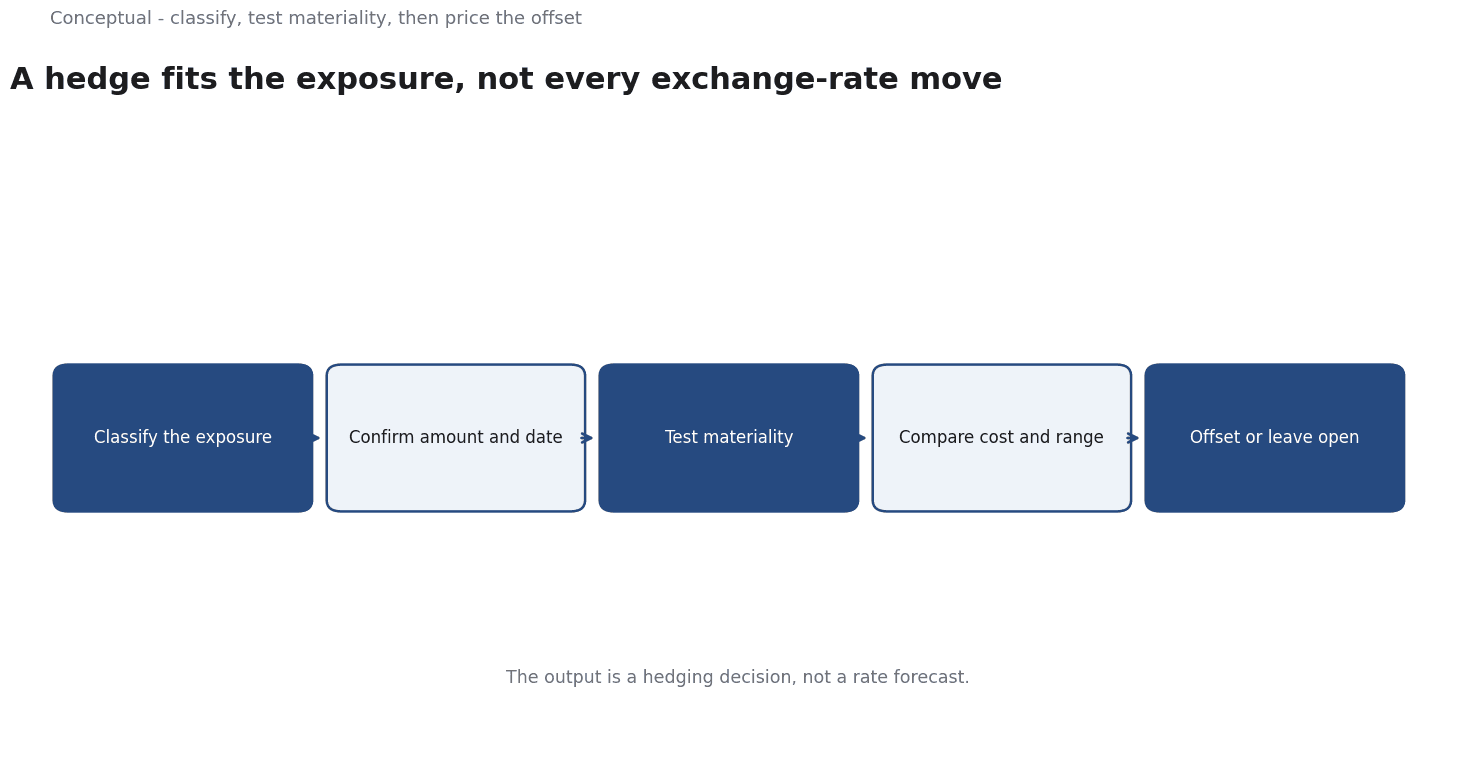
The mechanism ends with materiality and cost. Hedging has a price, whether in a premium, a bid-ask spread, or the opportunity cost of a locked rate, so a small or infrequent exposure may not justify it. The decision therefore resolves into a sequence: identify the exposure type, confirm the amount and timing, estimate the cost of the hedge against the plausible range of outcomes, and choose an instrument only if that cost is justified. The output is a hedging decision, not a forecast of exchange rates.
A worked example
The following is hypothetical and illustrative. A mid-size manufacturer has a euro-denominated receivable due in one quarter and is deciding whether to hedge it. Three checks structure the decision. First, the exposure is classified: the invoice is a known amount at a known date, so it is transaction risk rather than translation or economic risk. Second, materiality is tested against the margin on that sale, since a currency move large enough to erase the margin changes the answer while a small move does not. Third, instrument cost is compared with the outcome range: a forward removes uncertainty completely, while an option preserves upside at a premium. The outcome is a rule, not a prediction. If the margin is thin and the forward cost is small relative to it, the hedge is justified; if the exposure is trivial, the honest conclusion is to leave it unhedged and revisit only if volumes grow.
Evidence status
| Claim | Status | Source | Verified | Recheck when |
|---|---|---|---|---|
| Foreign exchange risk covers transaction, translation, and economic exposure | source-reported | Foreign exchange risk - Wikipedia | 2026-11-18 | The risk entry is substantially revised |
| A hedge offsets the risk of an adverse move through instruments such as forwards and options | source-reported | Hedge (finance) - Wikipedia | 2026-11-18 | The hedge entry or instrument definitions change |
| Matching instrument to exposure type improves the hedging decision | inferred | Derived from the sources | 2026-11-18 | Accounting treatment or the firm's exposure profile changes |
The two definitional claims come directly from the encyclopedia entries and are stable. The third row is an inference about matching instruments to exposures, which is a planning rule rather than a measured result. It should be revisited if hedging instruments, accounting treatment, or the firm's own exposure profile changes materially.
What it cannot do
A hedge removes downside by construction, and that same construction removes the favourable outcome. A locked forward rate cannot benefit from a currency move in the firm's favour, so a hedged position can underperform an unhedged one in absolute terms even when the decision was sound. The relevant comparison is against the outcome the firm was trying to avoid, not against the best possible outcome after the fact. A hedging programme judged by whether it beat the spot rate will look wrong in some periods, which invites the worse error of abandoning a sensible policy after a single adverse comparison.
The hidden costs are financial and operational. Premiums, spreads, and margin requirements consume cash even when the hedge is never needed. Beyond the direct cost sit accounting and administration: hedge accounting rules, documentation, counterparty limits, and the staff time to monitor positions. These costs are invisible in a headline about hedging an exposure but decisive for a small team. A policy that is rational for a multinational with a treasury desk can be irrational for a firm whose finance function is one person, because the overhead exceeds the risk being removed.
A forecast purchase that never happens leaves a contract that becomes a speculative bet, and the line between hedging and speculation blurs as soon as the underlying exposure disappears. Basis risk is a quieter version: a hedge indexed to one rate may not offset an exposure tied to a different currency or tenor, so the position protects only partially. The practical consequence is that every hedge needs a named underlying exposure and a rule for unwinding it when that exposure changes.
There are settings where currency hedging should not be used at all. Rare, small, or highly uncertain exposures carry more cost than risk. Long-horizon economic exposure cannot be hedged with short-dated contracts, and trying to do so creates a rolling cost with little strategic benefit. Where the counterparty itself is a credit risk, a derivative can introduce a new failure mode in the attempt to remove an old one. The honest boundary is that hedging fits known, material, near-term cash flows, not every movement in an exchange rate.
Finally, a hedging policy needs scheduled review because exposures and instruments drift. Suppliers change, invoices move into new currencies, and a once-material exposure can shrink. The practical requirement is to keep a register of exposures, to record which hedge offsets which item, and to revisit the policy on a fixed cadence. Without that discipline, hedging becomes a habit inherited from a past risk profile, and the firm carries costs for protection it no longer needs.
The counterargument that hedging is unnecessary speculation is fair for small, irregular exposures and incomplete for firms with known, material foreign-currency cash flows, where the point is to remove variance rather than to predict a rate.
A decision test
- Name the decision the hedge is meant to support and the exposure behind it.
- Classify the exposure as transaction, translation, or economic.
- Confirm the amount, currency, and date of the underlying cash flow.
- Test materiality against the margin or budget at stake.
- Compare instrument cost with the plausible range of outcomes.
- Choose the instrument that fits the exposure and record the offset.
- Set a review date and a rule for unwinding if the exposure changes.
These steps keep the hedge tied to a real cash flow and a real decision. The test is passed when a reader can trace each contract to the exposure it offsets and the cost it was judged against, and failed when the position exists only because that is what the company always does. Revisit the framework when the currency mix of revenue or suppliers changes.
For further reading, see Cash Flow Forecasting.
References & Further Reading
- Wikipedia contributors, 2026. Foreign exchange risk - Wikipedia — Exposure to currency exchange rate movements.
- Wikipedia contributors, 2026. Hedge (finance) - Wikipedia — Reducing an existing exposure with an offsetting position.