Customer Acquisition Cost Costs Explained
CAC is a ratio whose numerator is often incomplete. Read what it includes, a worked calculation, and why a low figure can be misleading.
Customer acquisition cost is often quoted as spend divided by new customers, which hides the choices inside both numbers. The Wikipedia entry defines the metric, and Damodaran's framework insists on explicit assumptions. A figure that omits salaries or counts the wrong customers is not a smaller cost; it is a different metric.
Direct answer: State what enters the numerator and the denominator, align them to the same period, and read CAC beside retention and contribution. The sources define the measure; the disclosure rule is a synthesis.
Delta: This article adds a claim-status table and a worked calculation, separating the documented definition from the local choices that decide what the number means.
The mechanism
Three choices matter:
- The numerator. Paid media is obvious; salaries, tools, and agency fees are often excluded. The Wikipedia entry defines the metric without deciding which costs a particular business must include.
- The denominator. A new customer can mean a signup, a first purchase, or a retained customer. The choice changes the number substantially.
- The period. Spend in one period and customers acquired in another produce a misleading ratio. Aligning them is a bookkeeping decision.
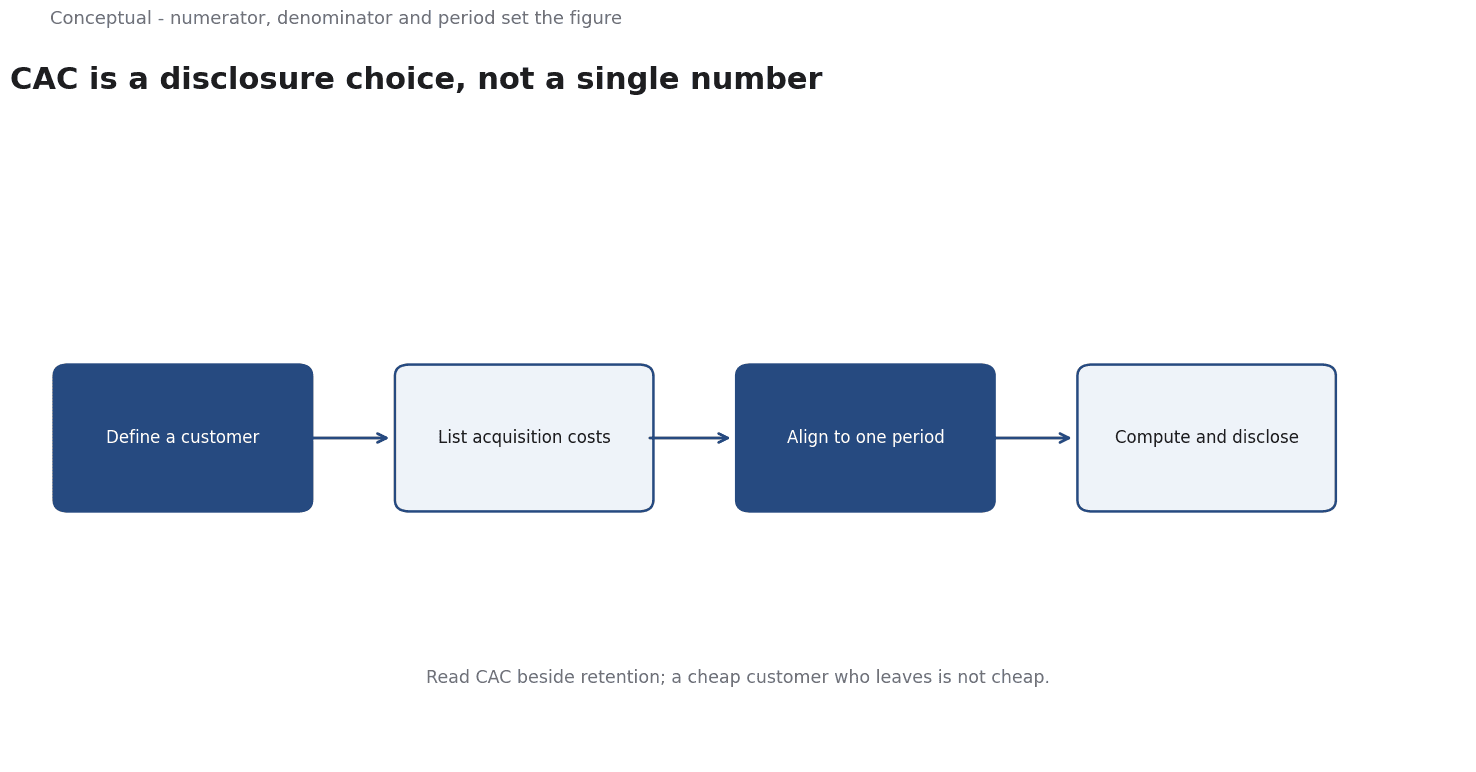
The sequence is: define a customer, list the costs that led to that customer, align the period, then compute. The definitions are local judgement, so they are inferred; the existence of the metric is source-reported.
A worked calculation
Illustrative. A company reports 1,000 new signups and 50,000 in ad spend.
Three checks decide. First, do the 1,000 signups become customers, and over what window? Second, does the 50,000 include the people whose time was spent acquiring them, or only external media? Third, what is the retention of those customers, since a cheap customer who leaves immediately is not cheap?
The outcome is a qualified CAC with a period and a definition. The numbers are hypothetical; the disclosure method is the contribution.
Why the numerator is where the argument lives
Two teams can compute CAC from the same spend and produce different numbers because they disagree about what belongs in the numerator. Paid media is rarely disputed. Salaries, tooling, content, and management time are, because they are shared across activities and harder to allocate.
The decision is not a matter of correctness; it is a matter of what the number will be used for.
A ratio used to decide next month's budget should include the costs that change with that budget. A ratio used to understand long-run business health should include more of the fixed cost. Stating which question is being answered makes the choice defensible and lets a reader recalculate with different assumptions.
The denominator deserves the same clarity. A signup and a retained customer are different outcomes, and mixing them produces a figure that is easy to improve by lowering the bar. Defining the customer before the calculation removes that temptation.
What a good report shows
A useful CAC report states the definition, the period, the components of the numerator, and the retention of the acquired cohort. It shows the ratio beside contribution, because a cheap customer with low contribution is not a good acquisition. With those elements present, the number can be challenged and improved rather than merely quoted.
Evidence status
| Claim | Status | Source | Verified | Recheck when |
|---|---|---|---|---|
| CAC measures the cost of acquiring a customer | source-reported | Wikipedia, CAC | 2026-11-18 | Definition revised |
| Valuation depends on explicit assumptions | source-reported | Damodaran Online | 2026-11-18 | Framework updated |
| State numerator, denominator and period | inferred | Derived from measurement practice | 2026-11-18 | Cost structure changes |
Why a low CAC can be worse
A low figure can come from excluding costs or from counting weak customers. Signing up many people who never return lowers the ratio while raising the real cost of a retained customer. Reading CAC beside retention is the simplest correction.
The denominator also hides timing. A customer acquired this month may have been influenced by spend from previous months.
A stated window makes the figure reproducible and open to challenge.
The same caution applies to comparisons between channels. A channel with a lower reported CAC may be reaching customers who need more support or who buy less, and neither difference appears in the acquisition ratio. Reading the metric beside downstream behaviour is the only way to tell.
What it cannot do
It cannot prove that acquisition was efficient, because it says nothing about the value of the customer. It does not replace contribution analysis. And it cannot guarantee that the same cost will hold in the next period.
The counterargument that a lower CAC is always better is fair for a stable definition and incomplete when the definition changes.
A decision test
- Define a customer.
- List all acquisition costs.
- Align the period.
- Compute the ratio.
- Read beside retention and contribution.
- Record the definition and the recheck date.
For the wider economics, see Unit Economics.
References & Further Reading
- Wikipedia contributors, 2026. Customer acquisition cost - Wikipedia — The cost of acquiring a new customer.
- Aswath Damodaran, 2026. Damodaran Online: Home Page for Aswath Damodaran — Publicly maintained datasets for industry averages, WACC, and valuation.