Customer Experience Examples
Experience is formed across interactions, not at one touchpoint. Read worked examples, a worked diagnosis, and why a survey score is a lagging signal.
Customer experience is often treated as a single interaction, which misses how perceptions accumulate. The Wikipedia entry describes experience as a perception formed across interactions, and the customer-review entry covers public feedback. The examples show where a bad experience actually begins.
Direct answer: Diagnose experience by mapping the journey, locating where expectations and reality diverge, and measuring behaviour alongside stated satisfaction. The sources describe the concept; the diagnostic method is a synthesis.
Delta: This article adds a claim-status table and worked examples, separating documented concepts from local choices about what to measure.
The mechanism
Three points matter:
- The journey is the unit. The Wikipedia entry describes experience across interactions. A single touchpoint is only one part of it.
- Feedback is public. The customer-review entry treats reviews as a record. A poor experience often becomes visible there before it appears in internal metrics.
- Behaviour and statement differ. The NPS literature warns about intentions. Observed behaviour is the complementary signal.
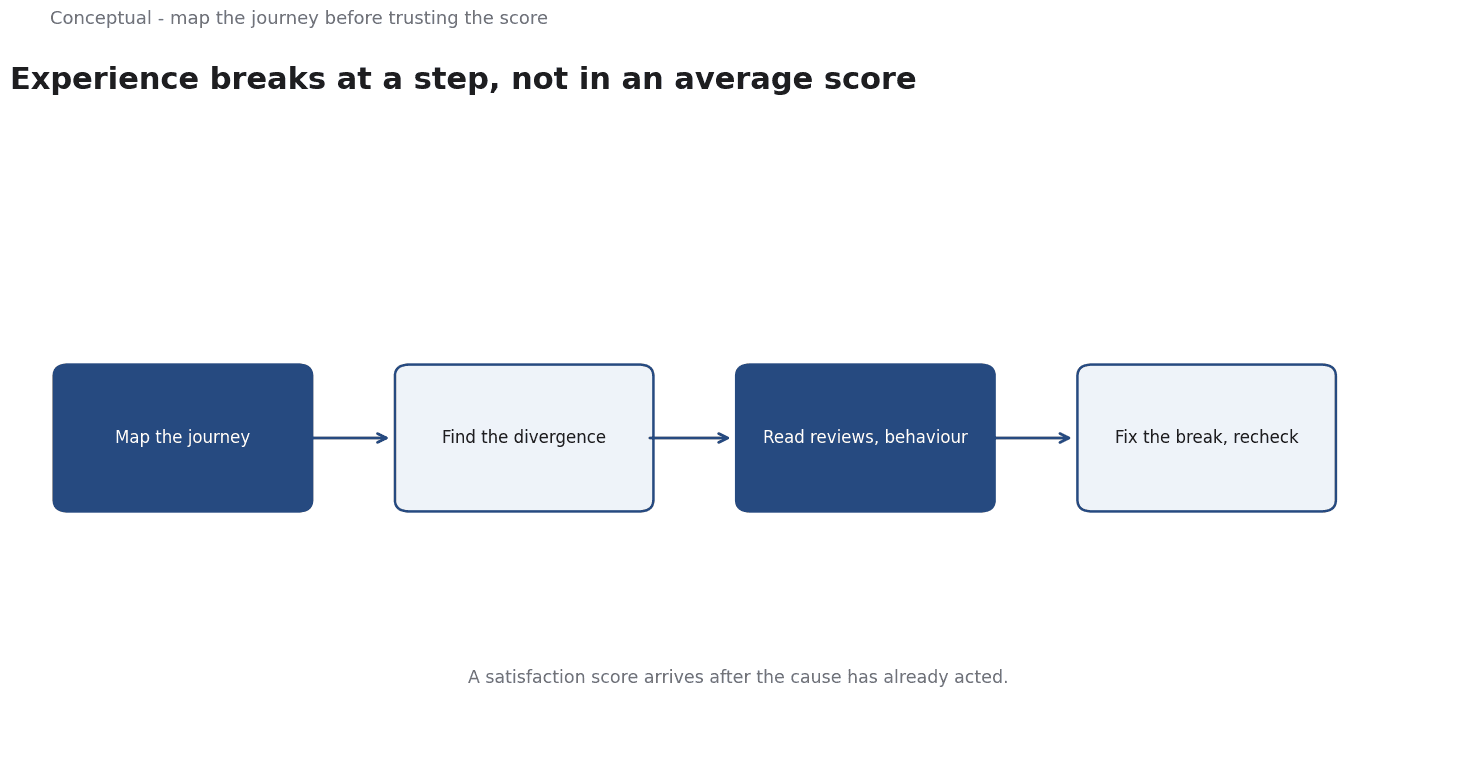
The sequence is: map the journey, find the divergence, then measure both behaviour and statements. Mapping is local work, so it is inferred; the concepts are source-reported.
Worked examples
Illustrative. A customer praises a product but cancels after a confusing billing step. A survey would record satisfaction; the journey shows the break at billing.
A second example: reviews mention slow support, while internal metrics show fast replies. The divergence suggests the issue is resolution quality, not response time.
The outcome is a located cause rather than a general score. The scenarios are hypothetical; the diagnostic method is the contribution.
Why the break matters more than the average
An experience is often described by an average score, but the average hides the specific moment where a customer's perception changed. A single confusing step can undo a good journey, and a score collected at the end will not show where it happened.
Locating the break is the diagnostic work that turns feedback into a fix.
Why reviews arrive early
Public reviews are written by customers who felt strongly enough to post. They are not representative of everyone, which is a limit, but they often name the problem before internal metrics do. Reading them as signals rather than as statistics is the useful approach: the first mentions point to where to look.
Evidence status
| Claim | Status | Source | Verified | Recheck when |
|---|---|---|---|---|
| Experience forms across interactions | source-reported | Wikipedia, Customer experience | 2026-11-18 | Definition revised |
| Reviews are a public record | source-reported | Wikipedia, Customer review | 2026-11-18 | Platform changes |
| Map the journey to locate divergence | inferred | Derived from the concept | 2026-11-18 | Journey changes |
Why a score is lagging
A satisfaction score is collected after the experience. By the time it moves, the cause has already affected customers. Journey mapping and behavioural signals are earlier, which is why they are more useful for diagnosis.
A further point is that experience is partly shaped by factors outside the organisation's control, such as a delivery partner or a network failure. A diagnosis that assigns every problem to the product will miss these, and the fix will not address the cause. Naming the boundary of responsibility is part of an honest diagnosis.
The examples also show why a single owner matters.
Assigning an owner to the journey, not just to the touchpoints, is what makes a fix more than a temporary patch.
A further consideration is that the person who feels the experience is the customer, not the team that designed it. Internal language about a journey can become abstract, and the actual friction — a form that fails on a phone, a wait that feels long — disappears from the discussion. Keeping examples concrete is what keeps the diagnosis grounded.
The measurement should also cover the moments after the main interaction. A customer who completes a purchase easily but struggles to resolve a problem later will describe the experience as poor, and the earlier success will not compensate. The journey therefore extends beyond the conversion event.
A diagnosis should also state what evidence would change it, so the team can tell a real improvement from a temporary one.
The examples are illustrations, not findings, and the method is the part that transfers to a real journey.
A recorded diagnosis gives the next reviewer a place to start.
What it cannot do
It cannot guarantee satisfaction. It does not replace listening to customers. And it cannot fix a product that does not deliver value.
The counterargument that a single score is enough is fair for tracking and incomplete for diagnosis.
A decision test
- Map the journey.
- Locate the divergence.
- Read reviews and behaviour together.
- Choose one fix.
- Measure after the change.
- Record the decision and recheck date.
For the feedback process, see Voice of Customer.
References & Further Reading
- Wikipedia contributors, 2026. Customer experience - Wikipedia — The overall perception customers form across interactions.
- Wikipedia contributors, 2026. Customer review - Wikipedia — How online reviews form a public reputation record.