Dark Social in Practice
Not all referrals carry a source label. Read what dark social means, a worked example, and why direct traffic is not the same as no influence.
Dark social describes visits whose source is not recorded, often because a link was shared in a private message. The word-of-mouth entry describes how recommendations spread, and web analytics covers what can be observed. The practice concerns what to do with the part that cannot be seen.
Direct answer: Treat unattributed visits as a measurement gap, not a channel, and use indirect signals and experiments rather than guessing. The sources describe the mechanisms; the method is a synthesis.
Delta: This article adds a claim-status table and a worked example, separating documented behaviour from local judgements about attribution.
The mechanism
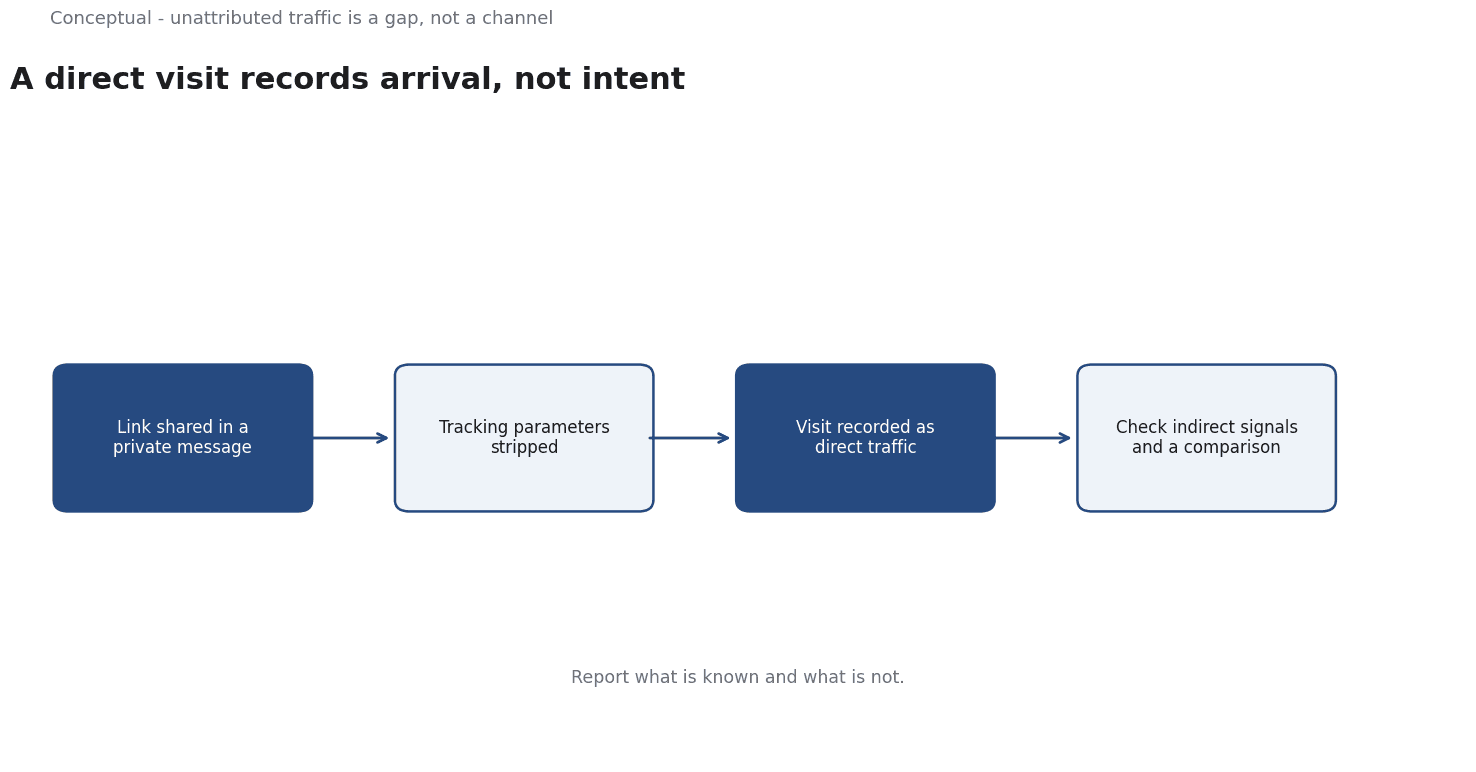
The first point is why the source is missing. The word-of-mouth entry describes recommendations between people, which often happen in places analytics cannot see. A link pasted into a message loses its tracking parameters, and the visit appears as direct traffic even though it was referred.
The second point is the limit of analytics. The web-analytics entry describes collection and interpretation as distinct, which applies here.
A direct visit is an observation about how the request arrived, not a statement that nobody recommended the page, and the interpretation should stay within that boundary.
The third point is the response. Tagging every internal link would reduce the gap but would not reach private conversations, and a heavy tagging scheme can change behaviour. Using indirect signals, such as branded searches or mentions, alongside experiments is the practical approach.
The sequence is: accept the gap, measure indirect signals, use a comparison where possible, then state what remains unknown. The judgements are local, so the conclusions are inferred; the mechanisms are source-reported.
A worked example
Illustrative. A site sees a rise in direct traffic after an article is published.
Three checks decide. First, did the article appear in channels where the source would not be recorded? Second, did branded searches or mentions rise in the same period? Third, would a holdout or a different publication date distinguish the effect from background trends?
The outcome is a qualified interpretation rather than an assigned channel. The scenario is hypothetical; the method is the contribution.
Evidence status
| Claim | Status | Source | Verified | Recheck when |
|---|---|---|---|---|
| Recommendations spread between people | source-reported | Wikipedia, Word of mouth | 2026-11-18 | Definition changes |
| Analytics has collection and interpretation layers | source-reported | Wikipedia, Web analytics | 2026-11-18 | Definition changes |
| Read unattributed visits as a gap | inferred | Derived from both | 2026-11-18 | Channel changes |
Why direct traffic is not no influence
A source label is a property of the request, not of the decision that led to it. Treating an unlabelled visit as organic removes the possibility that a recommendation happened, which is a measurement choice with consequences for what gets funded.
A further point is that trying to label every share can change the behaviour being measured.
Accepting some opacity is often the honest choice.
The indirect signals are also imperfect. A branded search can be caused by an advertisement rather than a recommendation, and a rise in mentions can reflect a news event. Treating any one signal as proof is the error that a comparison is meant to prevent.
Finally, the gap is not a defect to be eliminated entirely. Some sharing will always happen outside measurement, and a plan that depends on seeing everything will be disappointed. Reporting what is known and what is not is more useful than a confident guess.
A direct visit records how a request arrived, not whether a recommendation caused it.
Not every recommendation leaves a trace, and a measurement plan should admit that boundary.
Indirect signals should be read together, since each has causes the other ones do not.
A measured gap should be reported as such, not assigned to a channel by guesswork.
A private recommendation will often leave no label, which is a limit of measurement.
What it cannot do
It cannot recover the missing source. It does not prove that a campaign caused a visit. And it cannot replace a comparison design.
The counterargument that direct traffic is simply direct is fair for the record and incomplete for the cause.
A decision test
- Accept the attribution gap.
- Measure indirect signals.
- Use a comparison where possible.
- Keep source labels where they are honest.
- State what remains unknown.
- Record the interpretation and recheck date.
For the related measurement, see Zero-click Content.
References & Further Reading
- Wikipedia contributors, 2026. Word of mouth - Wikipedia — How recommendations spread between customers.
- Wikipedia contributors, 2026. Web analytics - Wikipedia — Collection and interpretation of website behaviour data.