Dark Funnel Metrics that Matter
Make sense of the invisible parts of the buyer journey: how purchase funnels and web analytics frame dark funnel signals, and which metrics survive scrutiny.
A large share of buying happens in channels that analytics cannot see: private conversations, word of mouth, and offline research leave no clean clickstream. Teams then misread the visible slice as the whole journey and over-credit the last tracked touch. The dark funnel is the name for that invisible portion, and the underlying problem is measurement rather than effort.
Direct answer: The dark funnel is the part of a buyer's research and evaluation that leaves no trackable digital trace, so ordinary web analytics cannot attribute it.
The practical decision is not to measure the unmeasurable directly, but to treat funnel and analytics data as partial signals and triangulate them with qualitative evidence before reallocating spend.
Delta: This article adds a signal-quality frame beyond the sources: it maps each funnel stage to what analytics can and cannot observe, so a metric becomes a decision about what to trust, with claim status explicit.
The mechanism
A purchase funnel is a staged model of how a person moves from first awareness to an eventual action. Classic formulations describe awareness, interest, desire, and action, and later variants expand or rename the middle stages. The model is useful because it separates outcomes: generating awareness and converting an already-interested buyer are different tasks. The practical consequence is that a single conversion number conflates two distinct problems, and a team cannot tell whether it needs more reach or a better close.
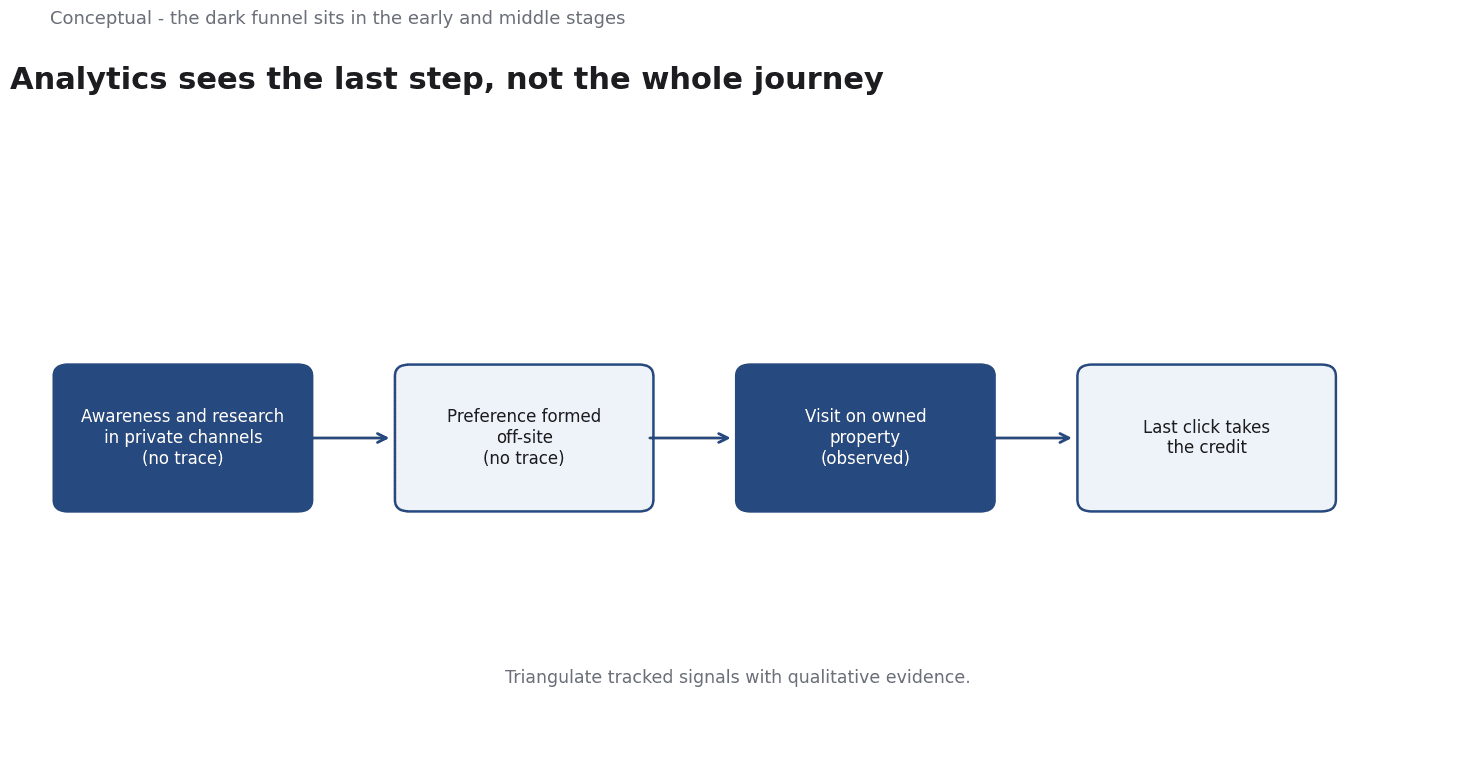
Web analytics is the collection and analysis of web data to understand and optimize usage. It captures what happens on property: visits, page views, paths through pages, and events that the measurement setup records. The practical consequence is that analytics sees behavior on owned surfaces with reasonable clarity, but it sees nothing once the buyer leaves those surfaces. A funnel stage that plays out in a messaging app, a private community, or a conversation with a colleague produces no row in the data.
The dark funnel maps mostly to the early and middle stages, where buyers form preferences before they show up in a tracked session. By the time a visit is recorded, much of the evaluation may already be done, so the visible click understates the influence of unseen sources. This is why last-touch attribution is fragile: it assigns credit to the final observed step while ignoring the unobserved work that made that step possible. The practical consequence is that a channel can look weak in analytics while doing decisive early work.
The response is to treat different signals at different weights. Funnel data is a model, not a measurement of reality; analytics data is a measurement of a subset of behavior. Neither alone closes the gap. The practical consequence is that a decision to change budget or positioning should be supported by multiple partial signals that agree, such as a tracked increase in branded search alongside consistent notes from sales conversations. Agreement across independent signals is stronger evidence than any single metric.
A worked example
The following is hypothetical and illustrative. A software team sees steady visits but few demo requests, and analytics credits most conversions to a paid search campaign. Three checks frame the response. First, separate the stages: the visit volume shows awareness is not the constraint, so the question is what happens between arrival and action. Second, inspect the observable path: visitors who read a comparison page convert more often, suggesting that late-stage evaluation matters more than the first click. Third, add a qualitative signal: sales notes repeatedly mention a peer recommendation that no tool records. The outcome is a decision to treat peer influence as a real early-stage driver and to support it with comparison content, while keeping paid search but no longer treating its last click as the whole story. The example is illustrative and is not a claim about any actual company.
Evidence status
| Claim | Status | Source | Verified | Recheck when |
|---|---|---|---|---|
| A purchase funnel models staged progression from awareness to action | source-reported | Wikipedia funnel | 2026-11-18 | Funnel models are redefined |
| Web analytics measures behavior on owned web properties | source-reported | Wikipedia analytics | 2026-11-18 | Measurement scope changes |
| Last-touch credit understates unseen early-stage influence | inferred | Derived from the sources | 2026-11-18 | Attribution model changes |
The source-reported rows define the funnel as a staged model and analytics as measurement of web behavior. The inferred row follows from combining those definitions with the premise that some buying happens off-property, and it is a reasoning step rather than a sourced finding. Recheck the table when the attribution model or the channels buyers use shift, because either change alters how much of the journey remains visible.
What it cannot do
The idea of a dark funnel does not make the invisible measurable. It is a label for a gap, and treating it as a channel with a reportable number invites false precision. Any figure attached to dark funnel influence is an estimate built from proxies, and the proxies can be wrong in both directions. A team that puts such a number in a forecast and then acts on it as if it were observed data is building decisions on an assumption it cannot verify. The honest use of the concept is to mark uncertainty, not to erase it.
The hidden cost is the effort of triangulation. Combining analytics, funnel staging, and qualitative input takes time and requires people who can read each source without overclaiming. Qualitative notes are rich but hard to aggregate; quantitative signals are easy to aggregate but blind to off-property behavior. Reconciling them is judgment work, and it is slower than reading a single dashboard. Teams that want a quick answer often skip this work and fall back to the most visible metric, which is usually the least complete one.
If a campaign cannot be evaluated, it is tempting to say the influence was invisible and leave the spend untouched. That move makes the concept unfalsifiable: success is credited to unseen forces and failure is blamed on poor tracking. The result is a budget that can never be questioned. A disciplined approach states in advance what observable signals would count as supporting or contradicting the hypothesis, so the claim remains open to revision.
There is a boundary around what the funnel model explains. It describes progression, not causation, and it assumes a roughly linear path that real buyers rarely follow. People loop back between stages, involve others, and decide for reasons the model cannot represent. Web analytics adds granularity to the observable part but inherits the same limitation: it records what happened on a page, not why it mattered. Neither source tells a team which message changed a mind, so the model is a scaffold for questions rather than an answer key.
For all these reasons the framing needs regular review. Buyers move between channels, measurement setups change, and a signal that was once informative can become noise. A team should revisit its assumptions when the buying process shifts or when a new channel appears, and it should keep the status of each claim explicit so that inferred links are not quietly promoted to observed facts. The value lies in maintaining a careful map of what is known and what is assumed, not in claiming the map is complete.
Counterargument: the claim that dark funnel thinking is speculative is fair when it is used to avoid accountability for spend, and incomplete when a real, documented portion of evaluation genuinely happens off-property.
A decision test
- State the decision at stake, such as changing spend or changing messaging.
- List the funnel stages relevant to that decision and which are observable.
- For each stage, name the web analytics signal that could speak to it.
- Mark the stages that analytics cannot see and name one qualitative proxy for each.
- Check whether the quantitative and qualitative signals agree before drawing a conclusion.
- Record which claims are observed and which are inferred, and keep that record.
- Define in advance what evidence would change your mind, then revisit on that trigger.
These steps keep the dark funnel a prompt for better questions rather than a catch-all explanation. If step four produces no proxy, the team is not measuring that stage in any sense and should say so plainly. The test is meant to make partial knowledge visible, so a decision can be made with eyes open about which parts of the journey remain unobserved.
For further reading, see Voice of customer: turning feedback into decisions.
References & Further Reading
- Wikipedia contributors, 2026. Purchase funnel - Wikipedia — Model of the customer path to purchase.
- Wikipedia contributors, 2026. Web analytics - Wikipedia — Collection and interpretation of website behaviour data.