Datasheets at Scale
Datasheets and model cards work only when they change a release decision. Read the documentation map, a worked example, and where templates decay.
Datasheets and model cards are often treated as paperwork finished after a model ships. The sources propose them as transparency instruments, but they do not say how to keep them useful when an organization holds many datasets and models. The real problem is making documentation a decision input rather than an archive that nobody reads.
Direct answer: A datasheet documents a dataset's motivation, composition, collection, preprocessing, uses, and maintenance, while a model card reports a model's intended use, evaluation data, metrics, and limitations. Gebru et al. propose the datasheet and Mitchell et al. propose the model card. The practical step is to tie each documentation field to a release decision so the document changes what actually ships.
Delta: This article adds a documentation-to-decision map beyond the sources: it maps each documentation field to a release decision, with claim status explicit.
The mechanism
The datasheet proposal from Gebru et al. argues that every dataset should be accompanied by a document describing its motivation, composition, collection process, preprocessing, uses, distribution, and maintenance. The aim is transparency: a consumer should be able to understand the context in which a dataset was created and the purposes it was meant to serve. The practical consequence is that a datasheet surfaces what a dataset is and is not fit for, so a team can judge fit before building on it rather than discovering problems later.
The model card proposal from Mitchell et al. makes a parallel case for trained models. A card reports intended use, training and evaluation data, metrics often broken out across conditions, ethical considerations, and known limitations. The aim is to make model behavior and its caveats inspectable by people who did not build it. The consequence is that a reviewer can see both how a model performed and where its authors warn that it should not be relied on. The two proposals are complementary: one describes the input data, the other the trained system.
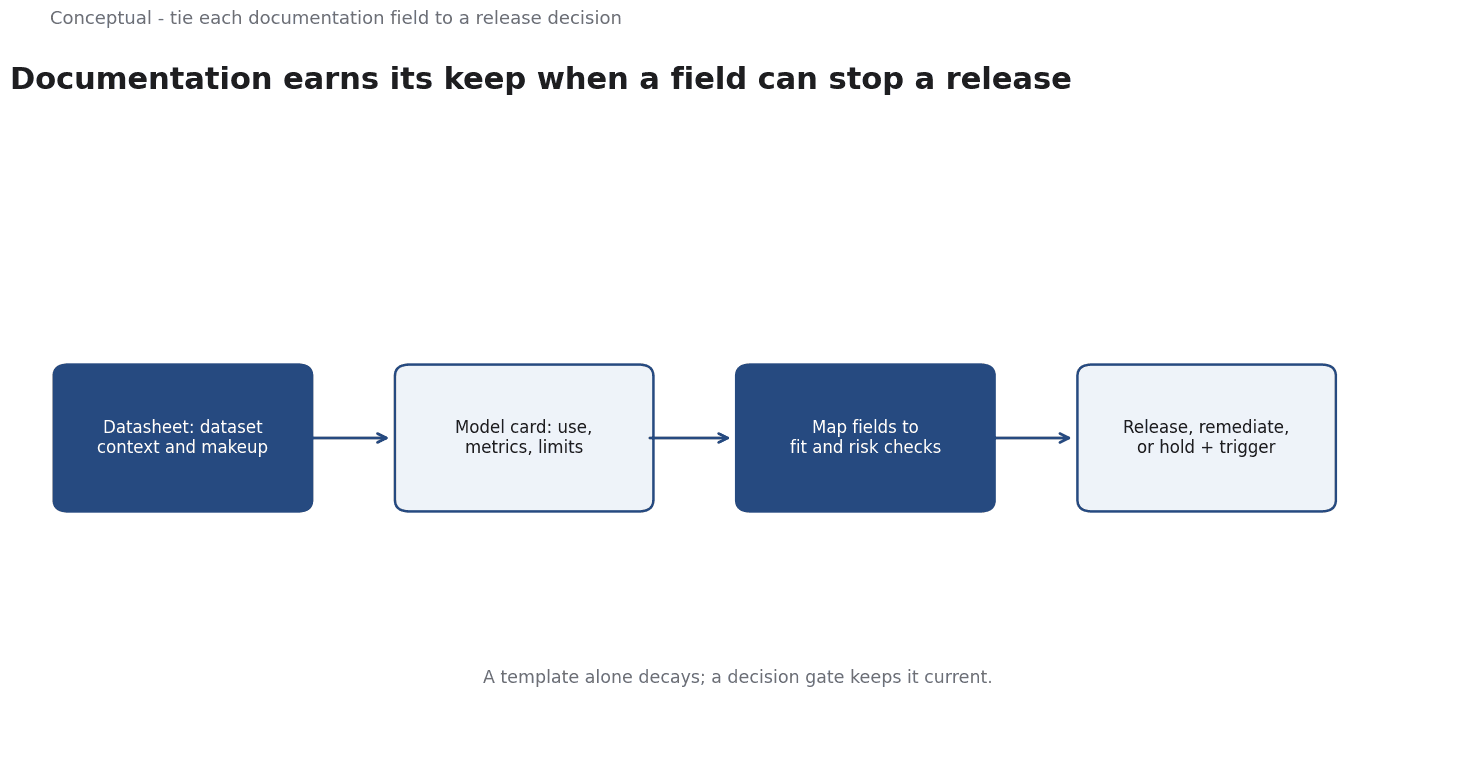
A documentation-to-decision map is built by connecting fields to the choices they should inform. Composition and collection fields answer whether data is fit for an intended use. Evaluation metrics and their breakdowns answer whether performance holds in the context that matters. Ethical considerations and limitations answer whether residual risks are understood and accepted. Each field can be read as an input to a release, remediate, or hold decision. This map is a synthesis of the two proposals, not a claim either paper makes, and it is treated as inferred.
At scale, the hard part is consistency and freshness rather than the first document. A template alone decays: fields get copied, intended use is stated generically, and limitations go unread. Tying each field to a decision keeps it alive, because a change trigger such as new data or a retrained model forces the relevant document back into review.
Documentation earns its keep only when a missing or stale field can stop a release, which is a local governance choice rather than something the sources prescribe.
A worked example
The following is hypothetical and illustrative. A team prepares to ship a model trained on a newly acquired dataset and runs three checks before release. First, composition: does the datasheet state the collection process and makeup of the data well enough to judge fit for the intended use? Second, evaluation: does the model card report metrics with breakdowns relevant to the affected context, rather than a single headline number? Third, limitations: are known limitations documented and accepted by a named owner? The review finds composition complete and limitations noted, but the evaluation lacks a breakdown that the affected context requires. The outcome is a hold decision until that breakdown is added, with an owner and a recheck date assigned. The numbers are absent by design; the verification method is the point.
Evidence status
| Claim | Status | Source | Verified | Recheck when |
|---|---|---|---|---|
| Datasheets document a dataset's motivation, composition, collection, uses and maintenance | source-reported | Gebru et al., Datasheets | 2026-11-18 | The proposal or community guidance changes |
| Model cards report intended use, evaluation data, metrics and limitations | source-reported | Mitchell et al., Model Cards | 2026-11-18 | The proposal or community guidance changes |
| Tying a documentation field to a release decision keeps the field current | inferred | Derived from the sources | 2026-11-18 | Documents decay despite the gate |
The first two rows summarize the field lists proposed in the papers and remain stable unless those proposals or the conventions around them change. The third is an inference about how documentation behaves inside an organization, not a claim the papers make. It is the row most likely to need revision, because decay depends on local habits rather than on a published format. Readers should treat the table as a snapshot tied to the verification date.
What it cannot do
The sources propose formats and fields; they do not provide enforcement. A filled template is not evidence that the answers are honest, complete, or current. Both papers describe what a document should contain and why transparency matters, but neither can make an author disclose an uncomfortable limitation or know every downstream use of a dataset. The documents describe what the authors knew at writing time.
Treating a completed datasheet as proof of safety confuses a record of disclosure with a guarantee about the system.
There is a real hidden cost. Writing these documents takes time and expertise, and the cost multiplies with the number of datasets and models an organization maintains. Some fields, such as distribution or maintenance, may depend on facts the original authors no longer hold. At scale, the work can become a bottleneck that teams resent, which creates pressure to fill fields quickly and move on. That pressure is exactly what produces the boilerplate the proposals were meant to replace. Any scaling plan has to budget authorship and review effort, not just distribute a template.
An intended use written as a broad generic phrase, or a limitations section that lists only trivial caveats, looks complete while telling a reviewer nothing. A gate that accepts such a document is worse than no gate, because it records a check that did not happen. The defense is to make specific fields answerable, for example by asking which condition a metric was broken out for and which use a warning actually rules out, so a vague answer is visibly inadequate.
There is also a clear boundary around what documentation can establish. A datasheet or model card reports what is known; it does not itself detect bias, prove fairness, or validate a system in a new context. It cannot cover uses that nobody anticipated, and it cannot substitute for testing in the deployment setting. The proposals are transparency instruments, not verification instruments. A reader who expects a card to settle whether a model is acceptable has misunderstood the kind of claim it makes.
Finally, documentation needs review because both data and models change. A retrain, a new source, or a shift in how a system is used can make a once-accurate document misleading. Each document should carry a change trigger and a named owner, and the release gate should check the trigger before accepting the document as current. The field of practice also evolves, so the field lists themselves deserve periodic reconsideration rather than being frozen at the verification date.
Counterargument: the claim that documentation gates improve transparency is fair for systems with clear intended uses and incomplete for systems reused in unforeseen ways, where the most relevant limitations are the ones nobody wrote down.
A decision test
- Identify the dataset and model a release depends on before the gate begins.
- Check the datasheet fields for motivation, composition, collection, preprocessing, uses, and maintenance.
- Check the model card fields for intended use, evaluation data, metrics, and limitations.
- Test fitness by asking whether the documented composition supports the intended use.
- Test evaluation by asking whether metrics are broken out for the affected context.
- Confirm ownership of residual limitations and name who accepts them.
- Set a change trigger that reopens the documents when data or models change.
A document set is useful only when a missing field can change an outcome. The test gives each field a question and each question a decision, so a reviewer can point to the exact gap that holds a release. That is the difference between documentation that governs a launch and documentation that merely accompanies it.
For further reading, see Responsible AI.
References & Further Reading
- Timnit Gebru et al., 2021. Datasheets for Datasets — The document format that makes a dataset's provenance and limits reviewable.
- Margaret Mitchell et al., 2019. Model Cards for Model Reporting — The reporting template used to document intended use, evaluation, and limitations.