Direct-to-consumer for Small Teams
Direct-to-consumer removes the middle layer but adds new obligations. See what the channel requires, how e-commerce data frames the choice, and which claims to check.
Small teams often adopt direct-to-consumer thinking it simply means higher margins and a closer customer relationship. The real problem is that removing a wholesale partner transfers a set of functions - traffic, checkout, fulfillment, returns, and support - onto the team itself. Those functions carry fixed costs that quietly consume the margin the channel was meant to create.
Direct answer: Direct-to-consumer is a distribution model in which a brand sells to end customers without intermediaries. Wikipedia's direct-to-consumer entry describes this channel structure. The Census Bureau's Quarterly Retail E-Commerce Sales supplies the broader context of online retail within total retail. The boundary: DTC removes a layer; it does not remove the cost of reaching and serving customers.
Delta: This article adds a mapping from the channel definition and e-commerce context to the concrete decision of whether a small team can absorb the displaced functions, with claim status explicit.
The mechanism
Direct-to-consumer is defined by disintermediation: the brand sells to the end customer rather than through a wholesaler or retailer. Wikipedia's entry frames the model around this removal of the middle layer. The practical consequence is two-sided. The brand keeps the customer relationship and the first-party data that comes with it, but it also inherits every task the intermediary used to perform. For a small team, that is not a detail; it is the whole operating model.
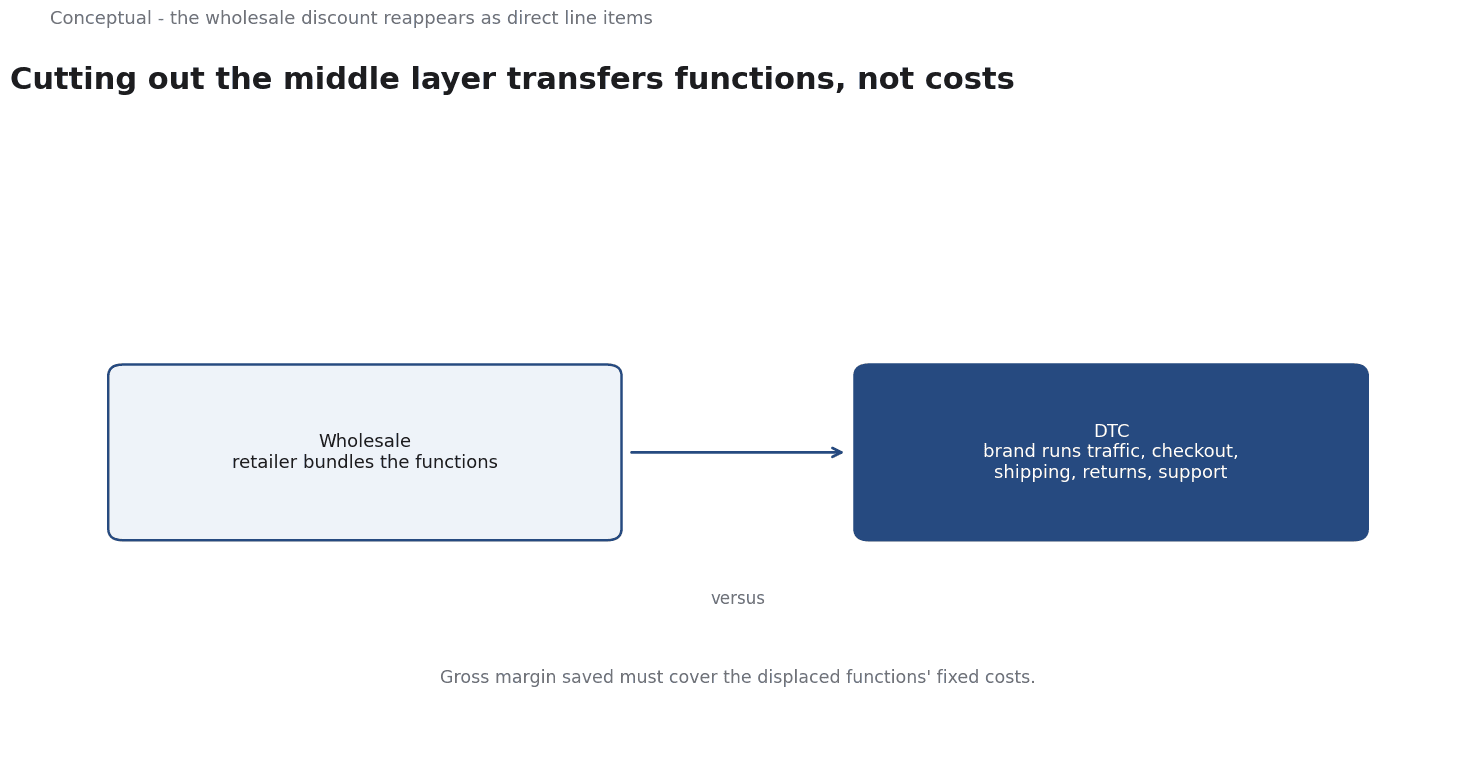
Those displaced functions are concrete. Without a retailer, the brand must drive traffic, run the storefront, process payments, manage inventory, ship orders, handle returns, and answer support requests. Each has a cost, and several are fixed rather than variable. A wholesale partner previously bundled these into a single discount. In DTC they reappear as separate line items, and they do not shrink just because the team is small. The margin gained by cutting out the retailer can be overwhelmed by the cost of performing all of these activities directly.
The Census Bureau's Quarterly Retail E-Commerce Sales gives macro context for the channel choice. It reports the level and share of e-commerce sales within total retail, showing how much commerce moves online. That is useful as a sanity check on whether the channel is substantial, but it is not a verdict on any single brand. A growing national share says nothing about whether a particular team can acquire customers profitably. The practical consequence is to treat the data as background, not as justification: it tells you the channel is real, not that it is right for you.
Unit economics is where the decision resolves. The gross margin saved by removing the retailer must be compared with customer acquisition cost, returns, and ongoing support. The direct relationship is an asset only if repeat purchase and retention eventually cover acquisition. That is why a small team should evaluate DTC on contribution margin after all direct costs, not on gross margin. A channel that looks profitable before these costs can be deeply unprofitable after them, and the difference is invisible if the team only watches revenue.
A worked example
The following is hypothetical and illustrative. A small apparel team considers dropping a wholesale account to sell only through its own store. Three checks are run. First, contribution margin is calculated after acquisition cost, shipping, and returns rather than from the wholesale price comparison alone. Second, operational capacity is tested against a normal order week, including who handles returns and support. Third, repeat purchase is estimated from first-party data already collected. The outcome is conditional: the direct channel works only if repeat purchase covers acquisition. When it does not, the team keeps wholesale for volume and uses DTC selectively for high-margin items.
Evidence status
| Claim | Status | Source | Verified | Recheck when |
|---|---|---|---|---|
| Direct-to-consumer sells to end customers without intermediaries | source-reported | Wikipedia DTC | 2026-11-18 | The DTC entry is substantially revised |
| Quarterly Retail E-Commerce Sales reports e-commerce's share of total retail | source-reported | Census Bureau | 2026-11-18 | A new quarterly release changes the series |
| Disintermediation transfers acquisition and fulfillment costs to the brand | inferred | Derived from the sources | 2026-11-18 | Channel economics or platform costs change |
The first two rows report the cited sources directly. The third is an inference from the channel definition: if the intermediary is removed, its functions must be performed somewhere. Neither source quantifies that transfer for a specific firm, which is why the claim is labelled inferred rather than source-reported.
What it cannot do
A DTC channel cannot eliminate the cost of distribution; it relocates it.
The wholesale discount was a visible, negotiated number, while the costs of running a direct channel are spread across software, labor, shipping, and advertising. This makes the economics harder to see, not cheaper. A team that celebrates the removal of a middle layer without mapping the new costs is likely to underestimate what the channel really consumes. The first honest contribution-margin calculation is often a sobering moment.
It also cannot guarantee a closer customer relationship. Owning the transaction does not own attention. Customers may buy once from the brand and return to a marketplace or a competitor the next time. First-party data is valuable only if it is analyzed and acted on; collecting email addresses without a retention strategy produces a list, not loyalty. The closeness DTC promises is a potential that must be earned through product and service, not a property that comes with the channel.
A hidden cost is the working capital absorbed by inventory and returns. Selling direct means the brand holds stock until the customer pays and absorbs the reverse logistics of returns. For a small team, cash tied up in inventory can constrain the ability to invest in product or marketing. This is an operational reality that a revenue-focused view of DTC misses entirely, and it is why the channel should be evaluated alongside a short-term cash model rather than in isolation.
The Census series describes an aggregate, not a demand curve for a particular product. Teams that extrapolate the aggregate into their own plans end up overestimating demand and overbuilding capacity. The correct use of macro data is to inform the boundaries of the decision, not to supply the central estimate. Brand-level evidence has to come from brand-level tests.
The boundary is that DTC is a channel choice, not a strategy on its own. It works when the economics and the operational capacity line up, and it fails when either is missing. Because acquisition costs and platform rules change, the decision is not permanent. A channel that is viable this year may need revisiting next year, so the team should review contribution margin and capacity on a fixed schedule rather than assuming the model keeps working.
The counterargument that DTC always yields better margins is fair for brands with strong repeat demand and incomplete for brands whose customers rarely return.
A decision test
- Is contribution margin calculated after acquisition, shipping, returns, and support?
- Which functions previously handled by the partner are now the team's responsibility?
- Can current operations absorb a normal order week without breaking?
- Is repeat purchase measured from first-party data rather than assumed?
- How much working capital will inventory and returns tie up?
- Is macro e-commerce data used as context rather than as a brand forecast?
- Is there a scheduled review of margin and capacity?
A small team should enter DTC with its eyes on the displaced functions, not just the removed discount. These questions turn a vague channel preference into a checkable decision. If several answers are unknown, the right move is a limited test with clear stopping conditions rather than a full commitment.
For further reading, see Cash Flow Forecasting.
References & Further Reading
- Wikipedia contributors, 2026. Direct-to-consumer - Wikipedia — Selling directly to end customers without intermediaries.
- U.S. Census Bureau, 2026. Quarterly Retail E-Commerce Sales — The official definition and estimates for retail e-commerce sales.